ADHD Paralysis: What It Is and How to Get Out of It
What ADHD paralysis is, the three types, how it differs from procrastination, laziness and depression, what research says, and how to get out of it.

ADHD paralysis is the state of knowing exactly what you need to do and not being able to start it. You sit with the tax return open in another tab for three hours, or with forty unread emails, or in front of ten small chores you can’t choose between, and nothing moves. It isn’t a medical term, and it isn’t laziness. It’s a starting problem.
The way out is the same for most people: make the next step so small that starting stops being a decision, and take the choosing out of the moment. Below: what ADHD paralysis is, the three types, why it happens, how it differs from procrastination, laziness and depression, and how to get out of it, step by step.
What is ADHD paralysis?
ADHD paralysis isn’t a diagnosis, and it doesn’t appear in the DSM-5-TR, the manual clinicians use to diagnose ADHD. It overlaps with three of the inattention symptoms listed there: trouble organizing tasks and activities, avoiding or being reluctant to start tasks that take sustained mental effort (for adults, things like preparing reports or filling in forms), and not following through or finishing work. The phrase comes from how people with ADHD describe the experience of being stuck at the start.
ADHD isn’t rare in adults. A 2021 global meta-analysis estimated that about 2.6% of adults have ADHD that began in childhood, and about 6.8% have significant ADHD symptoms whenever they began. Russell Barkley, one of the best-known ADHD researchers, describes ADHD less as a problem of knowing what to do than of doing it at the moment it’s needed. ADHD paralysis is that gap, felt from the inside.
What does ADHD paralysis feel like?
From the outside it looks like nothing is happening. From the inside it’s usually loud:
- You know the task, you even know the first step, and your hands won’t start it.
- You spend the afternoon on small, easy things to avoid the one that matters, then feel worse for it.
- Every option looks equally urgent, so you pick none and scroll instead.
- A message you’ve been dreading sits unanswered for days, and each day makes it heavier.
- You’re waiting for the right mood, a free afternoon or a deadline close enough to force you.
Types of ADHD paralysis
People usually describe three kinds. They’re not clinical categories, but they need different fixes.
| Type | What it looks like | What usually helps |
|---|---|---|
| Task paralysis | You know what to do and can’t start | A first step small enough to take in two minutes |
| Decision paralysis | Too many options, so you pick none | A rule that picks for you: first on the list, nearest deadline |
| Mental paralysis | Too much in your head at once, and you freeze | Write everything down, then choose one thing |
Why ADHD paralysis happens
Nobody has studied ADHD paralysis as such, but the research around it points to a few causes, and they usually work together.
- Executive function. A large 2005 review of 83 studies found that people with ADHD scored lower on tests of planning, working memory and self-control, on average, though these weaknesses didn’t show up in everyone with ADHD. Starting a task leans on exactly these skills: holding the goal in mind, working out the steps, and not drifting to something easier.
- Procrastination. In studies of adults, people who report more inattention symptoms also report procrastinating more, and the link is much weaker for hyperactivity. In a 2026 study of 640 adults, the link was partly explained by how hard it is to wait for a payoff and by seeing the task as not worth much.
- Time. In lab studies, people with ADHD judge short intervals less accurately and less consistently than their peers, on average: a 2022 meta-analysis of 27 studies in children and teens found moderate differences, and a 2024 meta-analysis across all ages reached the same conclusion. When “later” doesn’t feel real, “now” never arrives.
- Emotions. A 2014 review estimated that roughly a third to two thirds of adults with ADHD seen in clinics also have marked trouble regulating emotions. A dreaded task comes with dread, and dread is easier to avoid than to sit through.
- Too many choices. A small 2025 conference report surveyed 50 adults with ADHD, and most said they often struggled to make decisions. It had no comparison group and hasn’t been published as a full study, but it matches what many people describe.
ADHD paralysis vs procrastination, laziness and depression
| How to tell it apart | |
|---|---|
| ADHD paralysis | You want to start and can’t, as part of a lifelong pattern. It eases when the task shrinks, a deadline arrives or someone sits with you. |
| Procrastination | Putting off a task you don’t want to do. Everyone does it; people with more inattention symptoms report doing it more. |
| Laziness | Not wanting to do it, and not minding. ADHD paralysis usually comes with frustration and guilt instead. |
| Executive dysfunction | The wider trouble with planning, starting, organizing and keeping track of time. ADHD paralysis is one way it shows up. |
| Depression | Low mood or loss of interest in nearly everything, most days, for weeks. If nothing feels worth doing, not just this task, talk to a doctor. |
| Burnout | Exhaustion after a long stretch of overload. Rest helps burnout; it doesn’t fix paralysis on its own. |
ADHD and depression often come together, so it can be both. If the stuck feeling is new, lasts for weeks or comes with hopelessness, see a doctor rather than a planner.
How to get out of ADHD paralysis
These steps work best in order. You don’t need all of them every time; often the first two are enough.
1. If your head is full, empty it first
When everything feels urgent, nothing gets picked. Write every task, worry and loose end down in one place, without sorting. It takes five minutes, and it turns a fog into a list. Our brain dump guide has the details.
2. Pick one thing, and let a rule choose if you can’t
Choose the one task that matters most today. If you can’t choose, don’t deliberate: take the one with the nearest deadline, or simply the first on the list. A rule you set before you got stuck makes the choice for you.
3. Shrink it until the first step takes two minutes
“Do the tax return” can’t be started. “Open last year’s return” can. Keep breaking the task down until the first step is a physical action you could do in the next two minutes. Listing the steps also makes the task more honest: in a 2004 set of experiments, people who listed the steps of a task before estimating it gave longer and more realistic time estimates, especially for tasks with many steps. The adult ADHD program in Mary Solanto’s 2010 trial put the same idea in one cue phrase: “if I can’t get started, the first step is too big.”
4. Write the first step where you’ll see it
A first step you only thought of is gone by the time you stand up. Write it under the task, on paper or in your planner, so the next time you look, the step is there instead of the whole task. Barkley’s advice for ADHD is to put the help at the point of performance, the time and place where the task happens.
5. Start for five minutes, with permission to stop
Set a timer for five or ten minutes and do only the first step. When the timer goes off, you’re allowed to stop. There’s no good trial of this trick. Old lab studies do show that people tend to go back to tasks they’ve already begun, and once the first step is done, the second one is a smaller decision than the whole task was.
6. Get someone in the room
Some people start more easily with another person nearby, in the same room or on a video call, each working on their own thing. It’s called body doubling. It’s popular among people with ADHD, but so far research has only described it: a 2024 survey of 220 mostly neurodivergent people looked at how, when and why they use it. No controlled study has shown that it works yet, so treat it as something to try, not a proven fix.
7. Move first, if you’re frozen
Stand up, walk to another room, get a glass of water, then come back to the first step. Early research in adults with ADHD suggests a single bout of exercise can briefly sharpen self-control on lab tasks, while the evidence for regular exercise is still mixed. Moving won’t do the task for you, but it can break the freeze.
8. Go easy on yourself
ADHD paralysis isn’t a character flaw, and the guilt that comes with it is part of what keeps you stuck. Being hard on yourself makes the next start heavier. When a step is done, tick it off, even if it was tiny. It’s evidence that you’ve started.
How to prevent ADHD paralysis
Getting unstuck is easier when the day is set up so you don’t get stuck as often.
- Decide tomorrow’s first step tonight. Choose the one thing for tomorrow and write its first step before you close the laptop, so the morning starts with an action, not a decision.
- Keep today’s list short. Three things you finish beat ten you avoid.
- Plan in if-then form. “If it’s 10:00, I open the tax site.” In a 2006 meta-analysis of 94 tests, Peter Gollwitzer and Paschal Sheeran found that people who made if-then plans were more likely to reach their goals than people who only set the goal. In lab experiments, children with ADHD who added an if-then plan were better at stopping a response and at waiting for a bigger reward; that’s promising, but not yet tested in adults’ everyday lives.
- Put time on paper. Give the task a slot and a length, and use a timer, so time is something you can see rather than guess.
- Look at the plan at the same time every day. A fixed moment, like the first coffee, beats remembering to check.
Our ADHD planner guide sets this up in six steps.
ADHD paralysis treatment
There’s no test for ADHD paralysis, because it isn’t a diagnosis. ADHD itself is diagnosed by a clinician, and if you think you have it, that’s the first step.
What helps with the paralysis is mostly what helps with ADHD itself:
- Medication. A 2018 review of 133 trials found that several ADHD medications reduced adult symptoms more than placebo over about 12 weeks. The evidence is short term, and side effects made some people stop, so it’s a conversation to have with a clinician.
- Skills-based therapy. In a trial with 86 adults who still had symptoms despite medication, 12 sessions of cognitive behavioral therapy, which included breaking overwhelming tasks into steps, beat relaxation training with education (Safren and colleagues, 2010). In another trial with 88 adults, a 12-week group program on planning, time and breaking tasks into parts clearly helped 42% of participants, against 12% with supportive therapy (Solanto and colleagues, 2010). A 2018 Cochrane review rated the evidence for CBT in adults as low quality and mostly short term, and a 2017 meta-analysis found a small-to-medium effect.
The steps above are the self-help part of what those programs teach. They’re not a replacement for treatment.
Getting unstuck with Plannedo
Plannedo is a planner, not a treatment, but it’s built around the method above. Everything goes into the Inbox first, unsorted. Today holds the few things you chose for the day. And any task can be broken into subtasks right on Today, so the first step sits under the task where you’ll see it, and ticking it off counts.
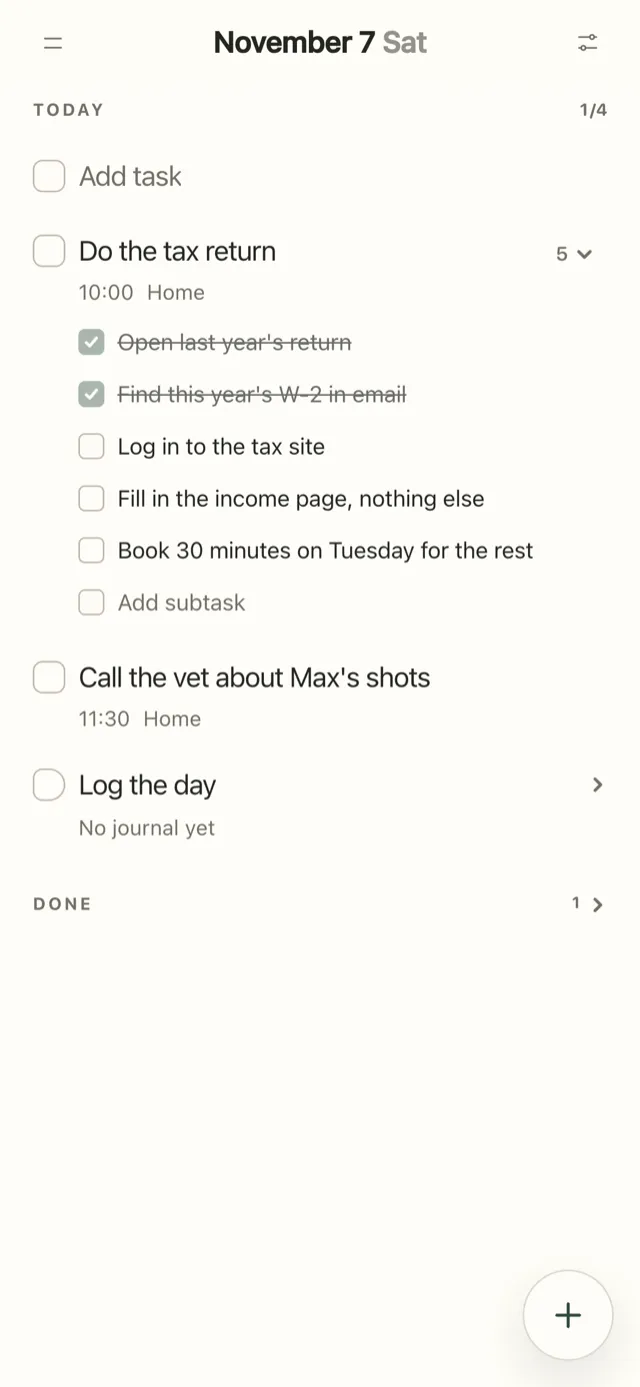

The last subtask is a step too: “Book 30 minutes on Tuesday for the rest” turns an unfinished task into a plan instead of a guilty leftover. More in the help centre: adding tasks and subtasks and the Inbox.
FAQ
Is ADHD paralysis real?
It isn’t a diagnosis or an official symptom, but the experience is common in people with ADHD: knowing what to do and being unable to start. The closest official criteria are about trouble organizing tasks, avoiding tasks that need sustained mental effort, and failing to finish work.
How do I get out of ADHD paralysis fast?
Pick one task, shrink it to a first step you can do in two minutes, write that step down and start a five-minute timer. If your head is too full to pick, write everything down first. If you can’t choose, take the first item on the list.
Is ADHD paralysis the same as executive dysfunction?
Not quite. Executive dysfunction is the wider difficulty with planning, starting, organizing and keeping track of time. ADHD paralysis is one way it shows up: being stuck at the start.
Is ADHD paralysis just laziness?
No. Laziness means not wanting to do something and not minding. ADHD paralysis usually comes with wanting to start, frustration at not starting, and guilt afterwards.
Can ADHD paralysis be depression?
They can look alike, and they often occur together. Depression usually means low mood or loss of interest in nearly everything for weeks, not just one task. If that sounds like you, talk to a doctor.
Does ADHD medication help with paralysis?
It can. A 2018 review of 133 trials found that several ADHD medications reduced adult symptoms more than placebo over about 12 weeks. The trials didn’t measure paralysis on its own, so talk to a clinician about whether medication is right for you.
What is ADHD decision paralysis?
Getting stuck because there are too many options and each one looks equally important, so you choose none. A rule decided in advance, such as “nearest deadline first”, takes the choice out of the moment.
Is there an app for ADHD paralysis?
No app treats it, but a planner can make starting easier. Plannedo keeps everything in one Inbox, a short list on Today, and lets you break any task into small subtasks right where you’ll see them. It runs on iPhone, Mac and the web, and the free plan includes unlimited tasks.
Studies mentioned
- American Psychiatric Association. (2022). Diagnostic and statistical manual of mental disorders (5th ed., text rev.). American Psychiatric Publishing.
- Barkley, R. A. (n.d.). The important role of executive functioning and self-regulation in ADHD. Fact sheet, russellbarkley.org.
- Cortese, S., Adamo, N., Del Giovane, C., Mohr-Jensen, C., Hayes, A. J., Carucci, S., Atkinson, L. Z., Tessari, L., Banaschewski, T., Coghill, D., Hollis, C., Simonoff, E., Zuddas, A., Barbui, C., Purgato, M., Steinhausen, H.-C., Shokraneh, F., Xia, J., & Cipriani, A. (2018). Comparative efficacy and tolerability of medications for attention-deficit hyperactivity disorder in children, adolescents, and adults: A systematic review and network meta-analysis. The Lancet Psychiatry, 5(9), 727-738.
- Eagle, T., Baltaxe-Admony, L. B., & Ringland, K. E. (2024). “It was something I naturally found worked and heard about later”: An investigation of body doubling with neurodivergent participants. ACM Transactions on Accessible Computing, 17(3), 1-30.
- Gawrilow, C., & Gollwitzer, P. M. (2008). Implementation intentions facilitate response inhibition in children with ADHD. Cognitive Therapy and Research, 32(2), 261-280.
- Ghibellini, R., & Meier, B. (2025). Interruption, recall and resumption: A meta-analysis of the Zeigarnik and Ovsiankina effects. Humanities and Social Sciences Communications, 12, 962.
- Gollwitzer, P. M., & Sheeran, P. (2006). Implementation intentions and goal achievement: A meta-analysis of effects and processes. Advances in Experimental Social Psychology, 38, 69-119.
- Knouse, L. E., Teller, J., & Brooks, M. A. (2017). Meta-analysis of cognitive-behavioral treatments for adult ADHD. Journal of Consulting and Clinical Psychology, 85(7), 737-750.
- Kruger, J., & Evans, M. (2004). If you don’t want to be late, enumerate: Unpacking reduces the planning fallacy. Journal of Experimental Social Psychology, 40(5), 586-598.
- Lopez, P. L., Torrente, F. M., Ciapponi, A., Lischinsky, A. G., Cetkovich-Bakmas, M., Rojas, J. I., Romano, M., & Manes, F. F. (2018). Cognitive-behavioural interventions for attention deficit hyperactivity disorder (ADHD) in adults. Cochrane Database of Systematic Reviews, 3, CD010840.
- Metcalfe, K. B., McFeaters, C. D., & Voyer, D. (2024). Time-perception deficits in attention-deficit/hyperactivity disorder: A systematic review and meta-analysis. Developmental Neuropsychology, 49(1), 1-24.
- Netzer Turgeman, R., & Pollak, Y. (2026). What are you waiting for?! Roles of motivation, goal orientation, and emotion regulation in explaining the link between ADHD and procrastination. Journal of Attention Disorders, 30(5), 694-704.
- Niermann, H. C. M., & Scheres, A. (2014). The relation between procrastination and symptoms of attention-deficit hyperactivity disorder (ADHD) in undergraduate students. International Journal of Methods in Psychiatric Research, 23(4), 411-421.
- Oroian, B. A., Nechita, P., & Szalontay, A. (2025). ADHD and decision paralysis: Overwhelm in a world of choices. European Psychiatry, 68(S1), S161. Conference abstract.
- Safren, S. A., Sprich, S., Mimiaga, M. J., Surman, C., Knouse, L., Groves, M., & Otto, M. W. (2010). Cognitive behavioral therapy vs relaxation with educational support for medication-treated adults with ADHD and persistent symptoms: A randomized controlled trial. JAMA, 304(8), 875-880.
- Shaw, P., Stringaris, A., Nigg, J., & Leibenluft, E. (2014). Emotion dysregulation in attention deficit hyperactivity disorder. American Journal of Psychiatry, 171(3), 276-293.
- Solanto, M. V., Marks, D. J., Wasserstein, J., Mitchell, K., Abikoff, H., Alvir, J. M. J., & Kofman, M. D. (2010). Efficacy of meta-cognitive therapy for adult ADHD. American Journal of Psychiatry, 167(8), 958-968.
- Song, P., Zha, M., Yang, Q., Zhang, Y., Li, X., & Rudan, I. (2021). The prevalence of adult attention-deficit hyperactivity disorder: A global systematic review and meta-analysis. Journal of Global Health, 11, 04009.
- Willcutt, E. G., Doyle, A. E., Nigg, J. T., Faraone, S. V., & Pennington, B. F. (2005). Validity of the executive function theory of attention-deficit/hyperactivity disorder: A meta-analytic review. Biological Psychiatry, 57(11), 1336-1346.
- Xu, S., Zhao, C., & Hu, L. (2026). The effects of acute and chronic exercise on executive functions and core symptoms in adults with ADHD: A systematic review and meta-analysis. Psychology of Sport and Exercise, 84, 103088.
- Zheng, Q., Wang, X., Chiu, K. Y., & Shum, K. K. (2022). Time perception deficits in children and adolescents with ADHD: A meta-analysis. Journal of Attention Disorders, 26(2), 267-281.