Brain Dump: How to Do One (+ Free Template and Trigger List)
A brain dump gets everything on your mind onto one page. How to do one in 25 minutes, how to sort what comes out, a trigger list and a free printable.
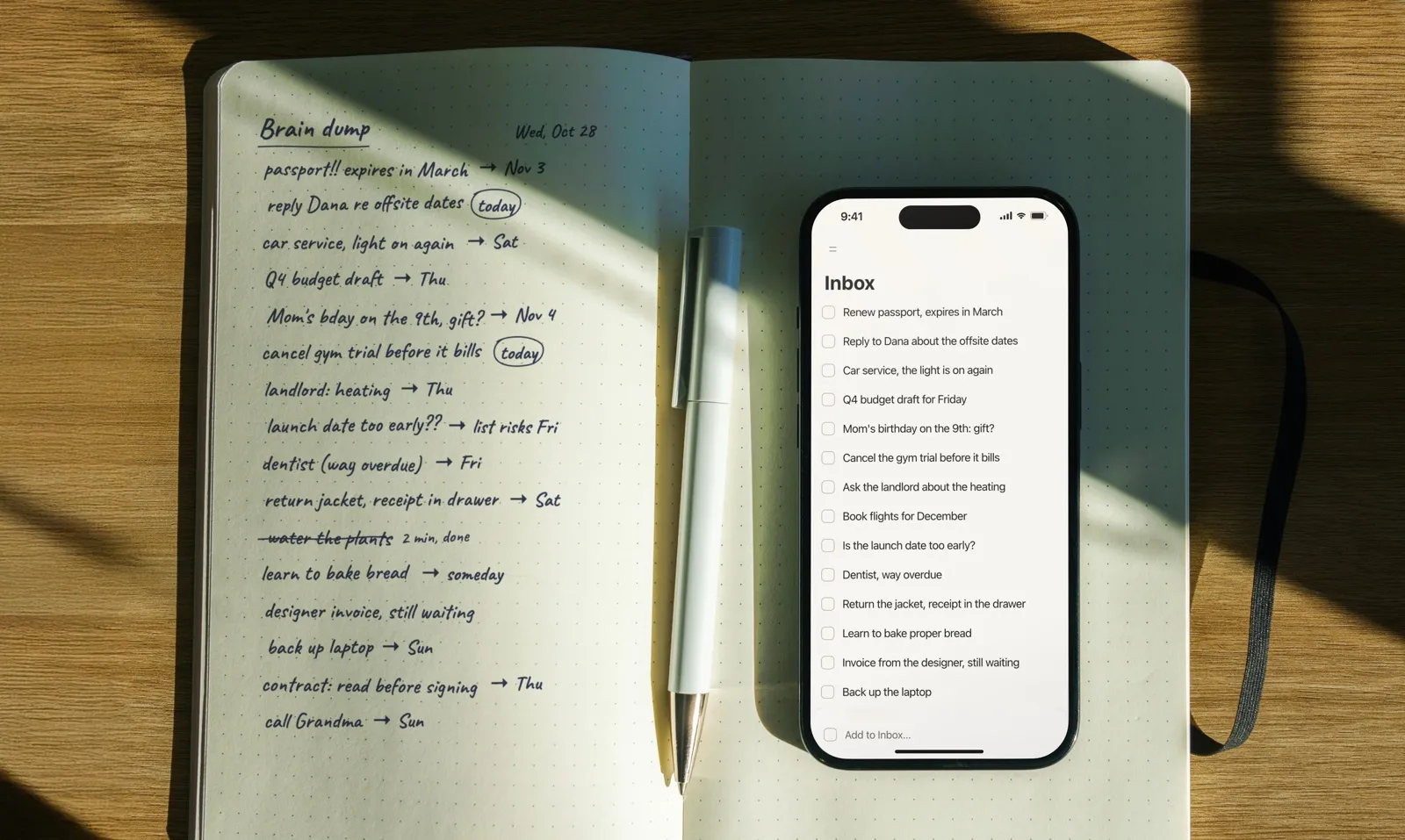
A brain dump is writing down everything on your mind, in one sitting and in no particular order: tasks, errands, worries, ideas, half-made decisions. To do one, set a timer for 15 minutes, write one thing per line until nothing else comes, then spend 10 minutes sorting the list: what happens today, what gets a day this week, what waits, and what you let go.
Most advice about brain dumps is about getting everything out. That part feels good, but the research points to the second half. Unfinished tasks keep pulling at your attention until each one has a plan, even a one-line plan. This guide covers both halves, a trigger list for when you get stuck, the before-bed and anxiety versions, and a free two-page template.
What is a brain dump?
A brain dump moves everything you’re carrying in your head onto paper or a screen, so you can see it, sort it and stop rehearsing it. The point isn’t a neat list. It’s an empty head, followed by a short list of decisions.
David Allen, who built Getting Things Done around this idea, calls the same exercise a mind sweep, and the GTD line for it is “Your mind is for having ideas, not holding them.” A brain dump is the capture step on its own: everything out first, organized second.
| Brain dump | To-do list | Journal | |
|---|---|---|---|
| What goes in | Everything on your mind | Tasks you’ve decided to do | Thoughts and feelings about your day |
| Order | None while you write | By priority or day | By time |
| How often | Weekly, or when you feel overloaded | Daily | Daily or when you need it |
| What comes out | A sorted plan and a shorter worry list | Done tasks | Understanding |
A brain dump feeds the other two. The tasks go to your to-do list or calendar, and anything that needs thinking through can go to a journal.
Why a brain dump works
Unfinished tasks pull at your attention until they have a plan
In a 2011 series of experiments, E. J. Masicampo and Roy Baumeister left people with a goal they hadn’t finished and watched what it did to the rest of their thinking. It kept getting in: more stray thoughts about the goal while they read an unrelated text, and worse scores on an unrelated word puzzle. When participants wrote a specific plan for the goal, those effects went away, although the goal itself was still unfinished.
That’s the case for both halves of a brain dump. Writing a task down gets it out of your head, but the relief comes from deciding what happens to it: a day, a first step, or a clear “not now”. A list of 40 open loops with no decisions is still 40 open loops, only on paper.
Writing worries down frees up attention
In 2011, Gerardo Ramirez and Sian Beilock gave 20 college students two short math tests, the second under pressure: money for good scores, a teammate depending on them, a camera and teachers reviewing the work. Before the second test, half of them spent 10 minutes writing about their feelings about it; the other half sat quietly. The quiet group’s accuracy dropped by 12%. The writing group improved by 5%. Another experiment showed it wasn’t writing as such that helped: it had to be writing about the worries.
The same team then tried it with ninth graders before their first high school biology final. Among the most test-anxious students, those who wrote about their worries first averaged a B+; those who didn’t averaged a B−.
A related line of research points the same way over a longer period. In two semester-long experiments in 2001, Kitty Klein and Adriel Boals had students write about stressful experiences and measured their working memory, the mental space you use to hold and juggle information. Expressive writing led to larger working memory gains and, in the second study, fewer intrusive thoughts. Their explanation: less of your mind is busy circling the thing that worries you.
Before bed, the list should look forward
In a 2018 sleep-lab study, Michael Scullin and colleagues had 57 young adults write for five minutes before lights out. Those who wrote a to-do list for the coming days fell asleep about nine minutes faster than those who wrote about tasks they had already completed, and more specific lists went with falling asleep faster. A brain dump in the evening fits that pattern as long as it ends with what happens next, not a replay of the day.
How to do a brain dump, step by step
A full brain dump takes about 25 minutes: 15 to write and 10 to sort.
- Pick one place. A sheet of paper, one note, or one inbox in your planner. One place, so nothing ends up in two lists.
- Set a timer for 15 minutes. The timer keeps you writing past the first easy items, which is where the useful ones start.
- Write one thing per line, as it comes. Big and small, work and home, tasks and worries. “Passport expires in March” and “Is the launch date too early?” both belong. Don’t sort, judge or fix anything yet.
- When you stall, use the trigger list. Read the prompts below slowly; each one tends to shake two or three more lines loose.
- Stop and read the list once. You’ll see repeats and items that are really the same worry in different words. Merge them.
- Do the two-minute jobs now. David Allen’s rule: if something takes less than two minutes, doing it is faster than tracking it. Do those and cross them out.
- Give every other line a home. Today, a day this week, a later date, Someday, not mine (ask or hand it over), or let go. For a project, write only the next physical step: not “Kitchen”, but “Get three quotes for the kitchen”.
- Split the worries in two. What you can do something about becomes a task with a day. What you can’t control, write down once and leave on the page.
- Choose tomorrow’s first three. Of everything that got a day, pick the three that matter most and put them in order.
How often? Once a week works for most people, as part of a weekly review. Add an extra one whenever your head feels full: before a holiday, after one, at the start of a big project or a new job.
Brain dump trigger list
When the pen stops, read these slowly. You don’t need to answer each one; it’s there to jog your memory.
- Work: projects in progress, projects not started, emails to send, calls to make, things you promised someone, deadlines, meetings to prepare, decisions you’re putting off, files to find, people to thank.
- Home: repairs, cleaning, things to buy, things to return, paperwork, the car, the garden, things to sell or give away.
- Money: bills, subscriptions and renewals, refunds, taxes, insurance, savings, anything you lent or borrowed.
- People: replies you owe, birthdays and gifts, plans to make, favors, someone you’ve been meaning to call, conversations you’re avoiding.
- Health: appointments, prescriptions, check-ups you’re late for, sleep, exercise, food.
- Waiting on: answers, deliveries, decisions, invoices, other people’s tasks you depend on.
- Ideas: trips, things to learn, books and films, someday projects.
- Worries: anything that keeps coming back, at 3 a.m. or in the shower.
Free brain dump template
Our brain dump template is one sheet with two sides. The front, “Everything, out of your head”, is two columns of lines with the trigger list down the margin. The back, “Now, sort it”, has a box for each home (Today, This week, Later, Someday, Not mine, Let go), a worries section split into what you can do and what you can’t control, and three lines for tomorrow. Print it or type into the PDF.
Brain dump before bed
If your mind starts listing tomorrow the moment you lie down, do a short version an hour or so before bed: five minutes of dump, then pick tomorrow’s first three and stop. Keep it forward-looking. In Scullin’s study, writing a specific to-do list helped people fall asleep; writing about what they had already done didn’t. The full evening routine is in how to plan your day the night before.
Brain dump for anxiety
A worry dump is the same exercise aimed at worries only. Write every worry down, then sort each one: “Can I do something about this?” If yes, write the next step and give it a day. If no, write it down once and leave it on the page. Ramirez and Beilock found that 10 minutes of writing about worries helped anxious students most. It’s a useful habit, not a treatment: if anxiety runs your days, talk to a doctor or a therapist.
Brain dump for ADHD
There’s no research on brain dumps and ADHD specifically, but the method suits the problems people with ADHD describe most often: too many open loops and a working memory that drops things. A few adjustments help. Keep the capture place within reach all day, so a thought goes down before it disappears. Make the dump shorter and more frequent: five minutes, twice a day. And sort right away, because an unsorted dump is one more thing to remember.
Brain dump in Plannedo
In Plannedo, the brain dump goes into the Inbox. Type a line, press Enter on a computer or the Send key on a phone, and the field stays ready for the next one, so you can empty your head without stopping. A task you add elsewhere without a date or a list lands there too.
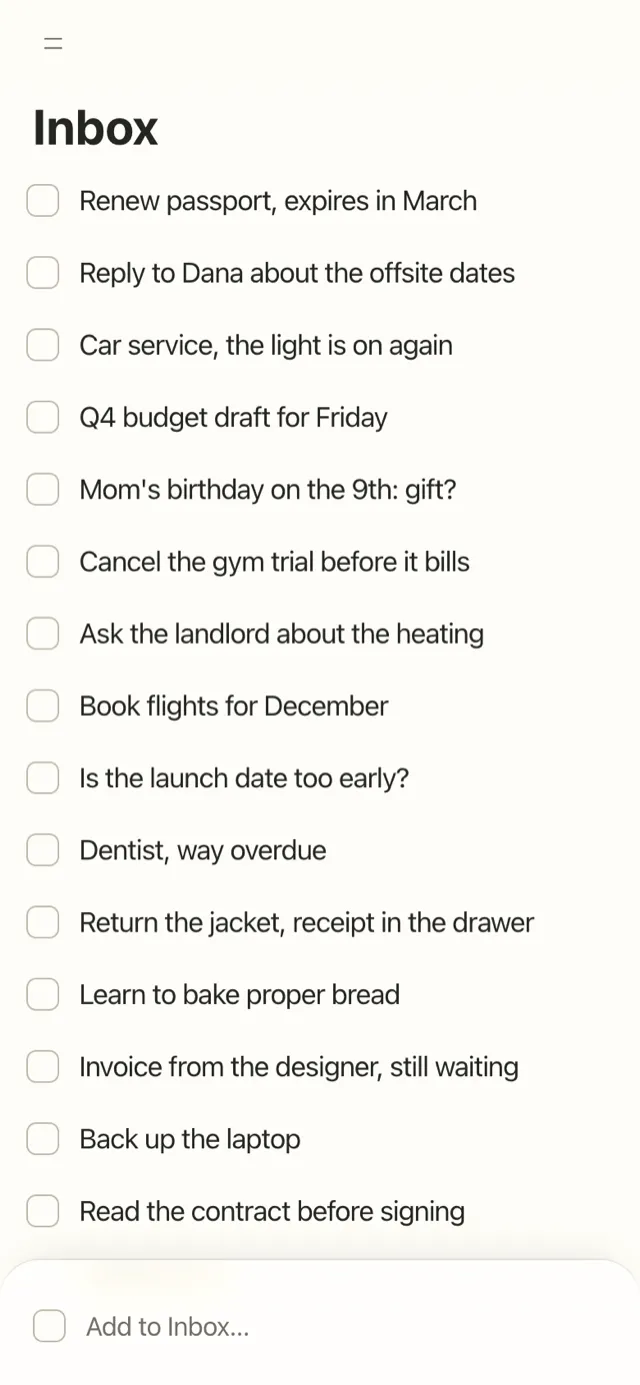

Then sort. Every Inbox item has the same buttons: Today, Schedule for a day (with Tomorrow and Next Monday one tap away), Someday for things without a date, and … to give it a list or link it to a goal, or delete it. Scheduled items leave the Inbox and appear on their day, so after ten minutes of sorting, the dump has turned into a week. What’s still waiting on someone else can stay in the Inbox until it moves. See Inbox in the help centre for details.
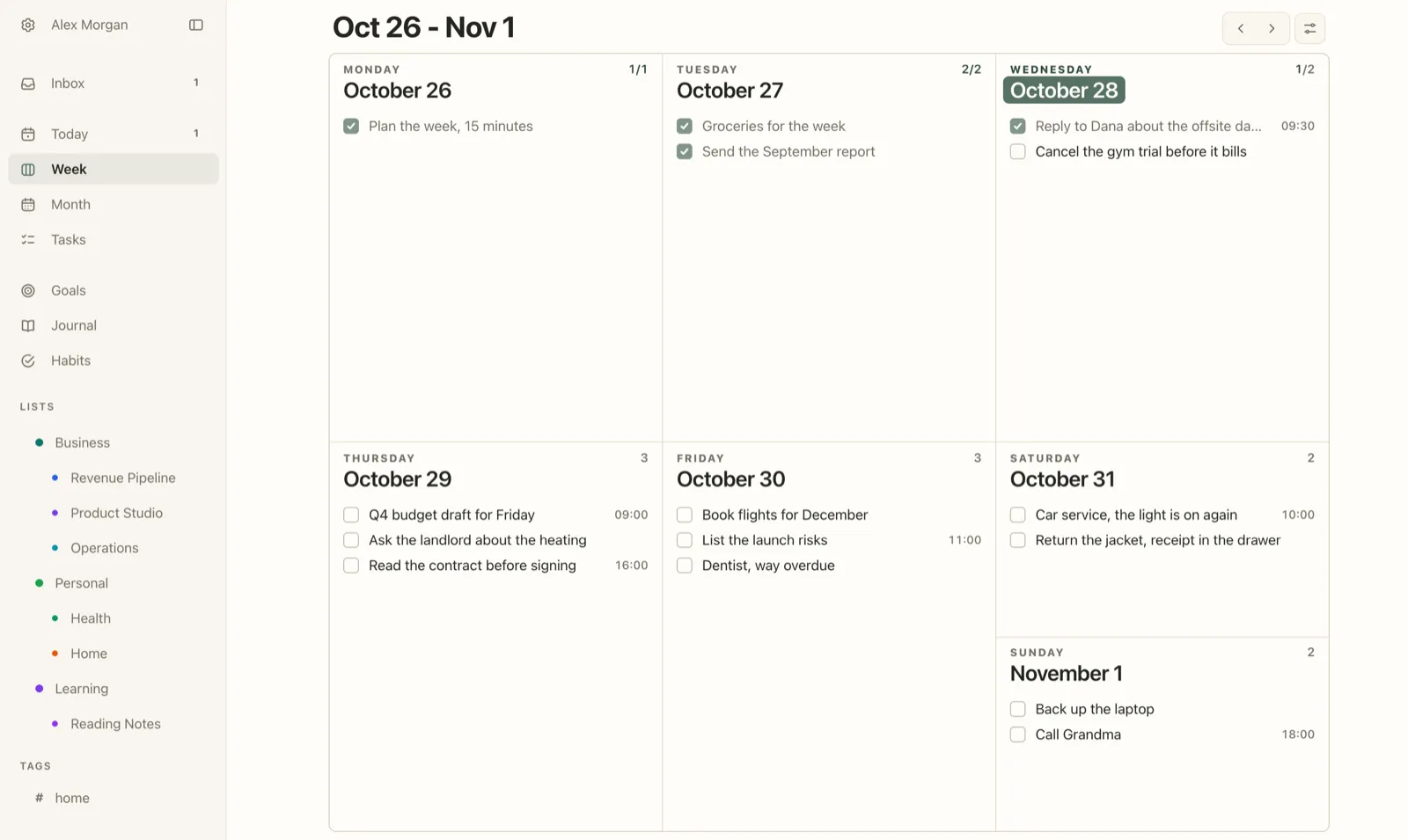
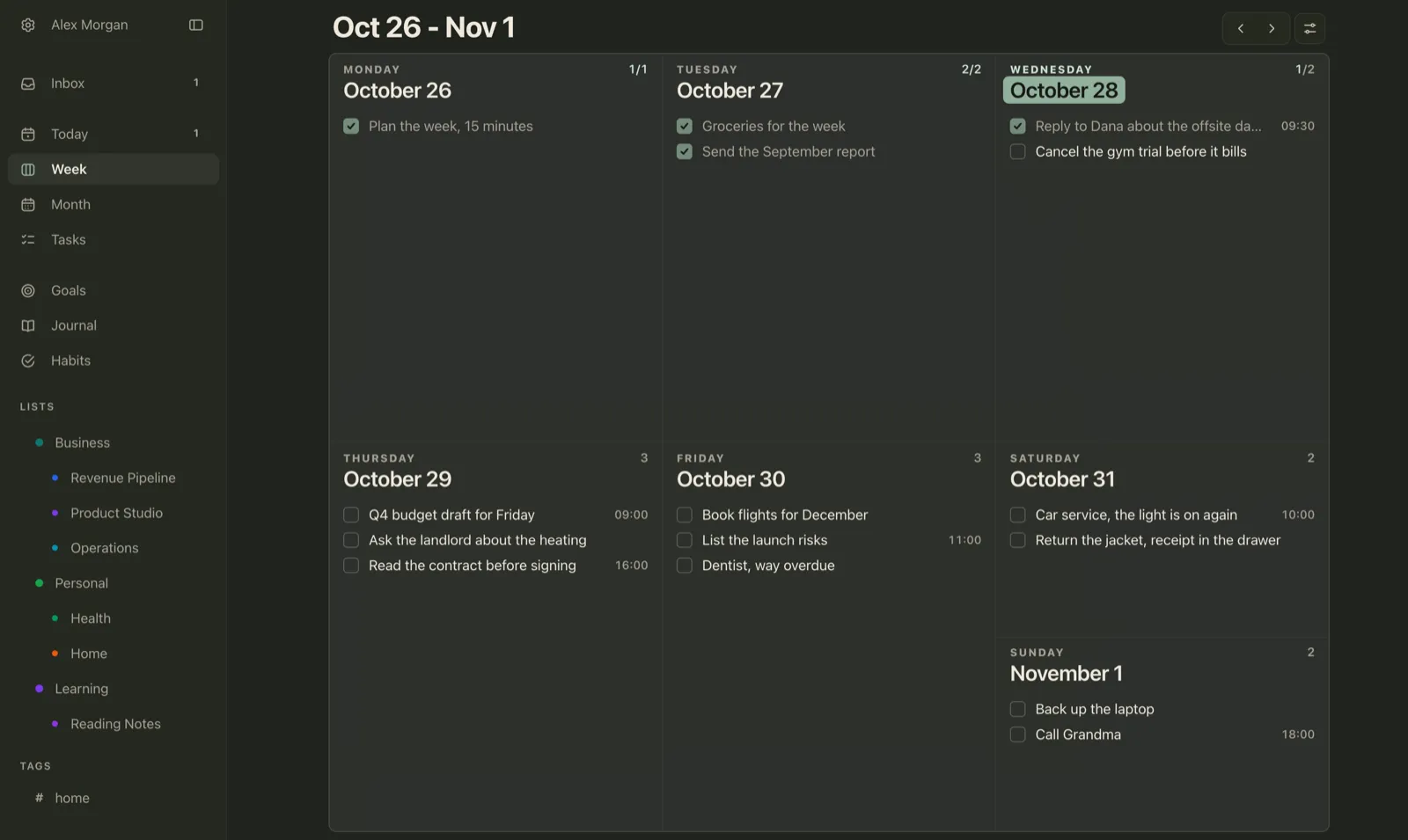
If you plan by the week, the next step is in how to plan your week. Once the week is under way, a ta-da list keeps track of what got done, including the things no dump predicted.
FAQ
What is a brain dump?
A brain dump is writing down everything on your mind in one sitting: tasks, errands, worries, ideas and decisions, one per line and in no particular order. You then sort the list so each line gets a next step, a day, or a decision to drop it.
How do I do a brain dump?
Set a timer for 15 minutes and write one thing per line until nothing else comes; use a trigger list when you stall. Then spend 10 minutes sorting: do anything under two minutes right away, give every other line a home (today, a day this week, later, someday, someone else, or let go), and pick tomorrow’s first three.
How long should a brain dump take?
About 25 minutes for a full one: 15 minutes of writing and 10 of sorting. A quick daily version can take five minutes, especially in the evening.
How often should I do a brain dump?
Once a week works for most people, often as part of a weekly review. Add one whenever your head feels crowded, for example before or after a holiday or at the start of a big project.
What’s the difference between a brain dump and a to-do list?
A brain dump is unsorted and includes everything, worries and ideas too. A to-do list holds only tasks you’ve decided to do, usually with a day. The dump comes first; your to-do list is what’s left after you sort it.
Should I do a brain dump before bed?
A short one, yes, as long as it looks forward. In a sleep-lab study, people who wrote a specific to-do list before bed fell asleep about nine minutes faster than people who wrote about what they had already done. Dump for five minutes, choose tomorrow’s first three, and stop.
Does a brain dump help with anxiety?
Writing worries down can help. In one study, students who wrote about their worries for 10 minutes before a high-pressure test did better than those who didn’t, and the most anxious gained most. Sort each worry into what you can act on and what you can’t control. It isn’t a substitute for professional help.
What is a brain dump trigger list?
A trigger list is a set of prompts that jog your memory during a brain dump: categories like work projects, calls, money, home repairs, people, health and things you’re waiting on. David Allen’s mind sweep uses the same idea.
What’s the best app for a brain dump?
Any app with one place to capture fast works: a notes app or a planner with an inbox. In Plannedo, the Inbox keeps the input field open between lines, and each item can then be scheduled for a day, sent to Someday, given a list or linked to a goal.
Sources
- Masicampo, E. J., & Baumeister, R. F. (2011). Consider it done! Plan making can eliminate the cognitive effects of unfulfilled goals. Journal of Personality and Social Psychology, 101(4), 667-683.
- Ramirez, G., & Beilock, S. L. (2011). Writing about testing worries boosts exam performance in the classroom. Science, 331(6014), 211-213. The figures are from the University of Chicago’s summary of the study.
- Klein, K., & Boals, A. (2001). Expressive writing can increase working memory capacity. Journal of Experimental Psychology: General, 130(3), 520-533.
- Scullin, M. K., Krueger, M. L., Ballard, H. K., Pruett, N., & Bliwise, D. L. (2018). The effects of bedtime writing on difficulty falling asleep: A polysomnographic study comparing to-do lists and completed activity lists. Journal of Experimental Psychology: General, 147(1), 139-146.
- Getting Things Done: Episode #3, David Allen guides you through a Mind Sweep and Episode #79, the two-minute rule.
Photo credits
The cover photo is by Jakub Żerdzicki on Unsplash.