Atomic Habits Summary: Key Points, 4 Laws and the Research
A summary of Atomic Habits by James Clear: the key points, the 4 laws and how to break bad habits, habit stacking and the 2-minute rule with examples, every chapter in one line, and what research says about each idea.
Atomic Habits, James Clear’s 2018 book, argues that lasting change comes from small habits repeated every day, and that you build them by designing your system and your surroundings rather than by relying on motivation. Its core is four laws: make a habit obvious, attractive, easy and satisfying. To break a bad habit, invert them.
The book has sold more than 30 million copies, by Clear’s own count, and it earned them: it’s clear, practical and short on fluff. We build a habit tracker, so we read it with a pencil. Below are the key points, the four laws with examples, all 20 chapters in a line each, and what research says about each idea, including the few that hold up less well than the book suggests.
Atomic Habits key points
- Small habits compound. Tiny changes, repeated for months and years, make a large difference, even when you can’t see it at first.
- Systems beat goals. Goals set the direction; the system, meaning your habits and routines, is what gets you there.
- Change who you are, not just what you do. The most durable habits are tied to an identity, and every repetition is a small vote for it.
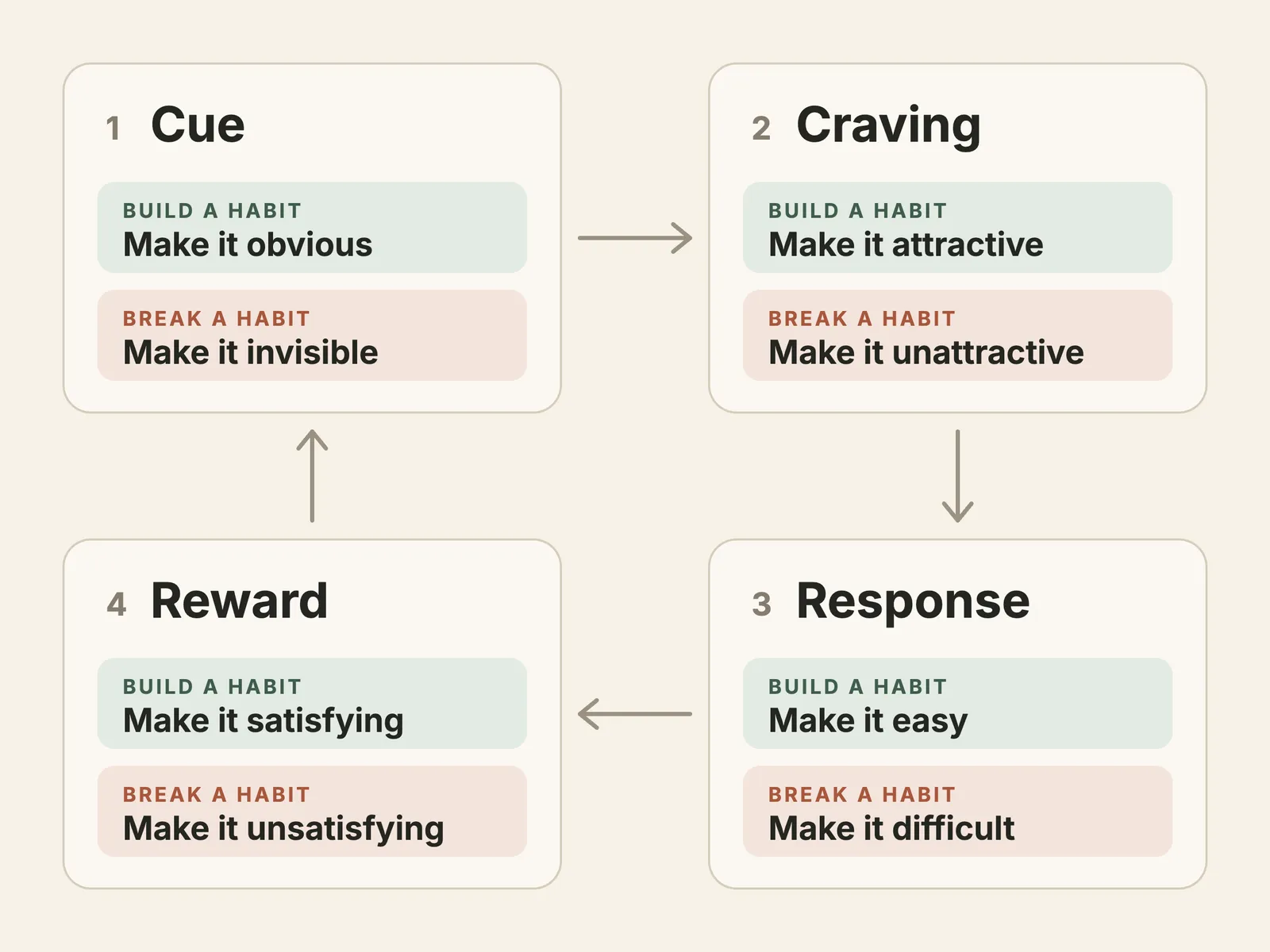
- Every habit runs on a loop: a cue, a craving, a response and a reward.
- Four laws build a habit: make it obvious, attractive, easy and satisfying. Their inversions break one: invisible, unattractive, difficult and unsatisfying.
- Environment beats willpower. Change what you see and how easy things are, instead of trying harder.
- Start smaller than feels useful. The Two-Minute Rule shrinks a habit until starting takes no effort.
- Never miss twice. Missing once is an accident; missing twice is the start of a new habit.
The 1% rule and the plateau of latent potential
The book opens with arithmetic: get 1% better every day for a year and you end up about 37 times better (1.01 to the power of 365 is about 37.8), while getting 1% worse every day takes you close to zero. Clear’s point is that habits compound, and that their results arrive late. For a long time effort seems to produce nothing, which he calls the plateau of latent potential, and then the results show up all at once.
What the research says. The 37 times is arithmetic, not a finding, and skills don’t compound like interest. When Andrew Heathcote and colleagues fitted 7,910 learning series from practice experiments, improvement was fastest at the start and slowed after that. Habits behave the same way: in Phillippa Lally’s study at UCL, how automatic a new habit felt rose quickly in the first weeks and then leveled off. So read the 1% as a mood rather than a forecast. Small steps matter because they’re the steps you can actually take every day.
Chapter 1 also tells the story of British Cycling and its “aggregation of marginal gains”. Clear has since written on his site that the team’s story turned out more complicated than he believed when he wrote the book, and he gives the details there.
Systems vs goals
Clear’s argument: winners and losers usually have the same goals, so the goal can’t be what separates them. A goal is a result you want; a system is the process that produces results. Reaching a goal changes your life only for a moment, and tying your happiness to it postpones it. Goals are good for choosing a direction, he writes, and systems are what make progress.
What the research says. There’s support for this in sport. A 2024 meta-analysis by Ollie Williamson and colleagues found that process goals, which focus on how you perform, improved performance far more than outcome goals, which focus on the result (d = 1.36 against 0.09). Outside sport, decades of research reviewed by Edwin Locke and Gary Latham still find that specific, challenging goals beat “do your best”. You don’t need to drop goals. Give each one a system. More on that in how to set goals.
Identity-based habits
Clear describes three layers of change: outcomes (what you get), processes (what you do) and identity (what you believe about yourself). Most people start with outcomes. He suggests starting with identity: decide the type of person you want to be, then prove it to yourself with small wins. Each time you write a sentence, you cast a vote for being a writer.
What the research says. How people see themselves does go together with what they intend to do: across 40 tests, a meta-analysis by Jostein Rise, Paschal Sheeran and Silje Hukkelberg found a strong correlation between self-identity and intentions (r = .47). Whether relabeling yourself changes behavior is less clear. Clear cites a 2011 study in which asking people about “being a voter” rather than “voting” raised turnout. A large field replication in 2016 found no effect, although the original authors argued that the replication wasn’t comparable. Treat identity as a helpful way to think about habits, not a lever with proven force.
The habit loop: cue, craving, response, reward
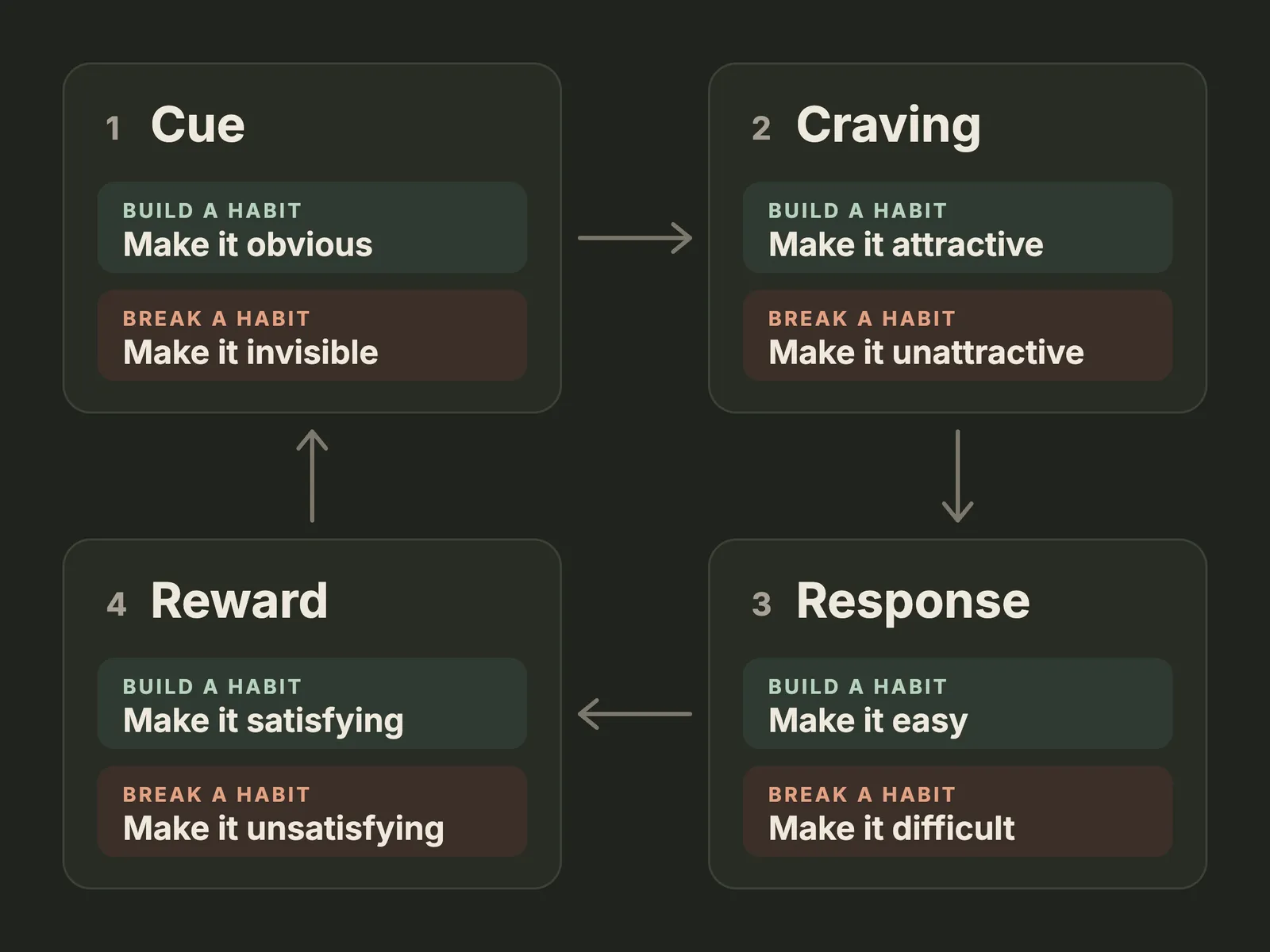
Every habit, in Clear’s model, runs through four steps. The cue triggers it: a time, a place, a feeling, the action before it. The craving is the motive: you don’t want the cigarette, you want the relief. The response is the habit itself. The reward is what you get, and it teaches your brain to repeat the loop next time. The four laws map onto the four steps, and each has an inversion for breaking a bad habit.
The 4 laws of behavior change (and how to break bad habits)
| Law | To break a bad habit | Main tactics in the book |
|---|---|---|
| 1. Make it obvious | Make it invisible | Habits Scorecard, implementation intentions, habit stacking, environment design |
| 2. Make it attractive | Make it unattractive | Temptation bundling, joining a group where your habit is normal, reframing |
| 3. Make it easy | Make it difficult | Less friction, priming the environment, the Two-Minute Rule, commitment devices |
| 4. Make it satisfying | Make it unsatisfying | Immediate rewards, habit tracking, never missing twice, a habit contract |
1st law: Make it obvious
Many habits run without notice, so the first step is to see them. Clear’s Habits Scorecard is a list of everything you do in a day, each marked as good, bad or neutral. Then give every new habit a clear cue. An implementation intention names the behavior, the time and the place: “I will write for 15 minutes at 7:00 at the kitchen table.” Habit stacking ties the new habit to one you already have (more below). And design your environment so the cue is in sight: the guitar on its stand in the middle of the room, the vitamins next to the coffee. To break a habit, take its cues out of sight.
What the research says. This is the best-supported part of the book. Plans that name when and where are among the most studied ideas in psychology: a 2025 meta-analysis of 642 tests by Paschal Sheeran, Olivia Listrom and Peter Gollwitzer found a reliable effect (d = .36, smaller after correcting for publication bias), and plans with both a time and a place beat plans with only a time. Habits really are cued by context. In Wendy Wood’s diary studies, between a third and half of what people did each day was repeated almost daily in the same place. Students who transferred universities kept their old habits only when the context stayed similar, and a field experiment found that people who had recently moved were the most open to new habits, for about three months.
Environment design works, but expect modest effects. In Anne Thorndike’s hospital cafeteria study, which Clear cites, sales of bottled water rose 25.8% after the drinks were rearranged. That was one hospital without randomization, though. A meta-analysis of “nudges” found a sizable average effect, and two reanalyses found that it shrinks to little or nothing after correcting for publication bias. In 126 real-world trials by two government nudge units, the average effect was 1.4 percentage points, against 8.7 in academic journals. The strongest tool of this kind is the default: making the good option the one you get without choosing.
2nd law: Make it attractive
The more appealing a habit, the more likely you are to repeat it. Clear’s main tactic is temptation bundling: do a thing you need to do only while doing a thing you want to do, such as watching your favorite show only on the exercise bike. He also suggests joining a group where your habit is the normal thing to do, since we copy the people close to us, the many and the powerful. And he suggests reframing: “I get to run” instead of “I have to run”.
What the research says. Temptation bundling works, but less than the first study suggested. In Katherine Milkman’s original experiment, gym visits rose 51% when people could listen to audiobooks they enjoyed only at the gym, but the effect faded after a holiday break. A follow-up with 6,792 people found a gain of 10% to 14% in the chance of exercising in a given week. Social support has good evidence: in a weight-loss study by Rena Wing and Robert Jeffery, 66% of people who joined with friends and got support kept their weight off, against 24% of those who joined alone. Clear’s example of obesity “spreading” through friendship networks is contested, though: critics found that the same methods detect “contagious” acne and height.
3rd law: Make it easy
Clear’s Law of Least Effort: people drift toward the option that takes the least work. So reduce the friction in front of good habits, such as laying out the gym clothes the night before, and add friction in front of bad ones. Prime the environment so the next action is ready. Use the Two-Minute Rule to make starting trivial (more below). And lock in good behavior once: automation and commitment devices make the choice for you in advance.
What the research says. Commitment devices work for the people who use them, but few people choose them. In a smoking study in the Philippines, 11% of smokers offered a savings commitment contract signed up. Those offered it were 3 percentage points more likely to pass a nicotine test six months later, and the effect still held at twelve months. In a US smoking trial, 90% of people accepted a reward-based program and only 13.7% accepted one that asked for a deposit. The Two-Minute Rule itself hasn’t been tested directly. It’s a sensible way to lower the effort of starting, not a finding.
4th law: Make it satisfying
Clear calls this the Cardinal Rule of Behavior Change: what is immediately rewarded is repeated, and what is immediately punished is avoided. Good habits usually pay off later, so add a small reward now. Track your habits, because seeing the chain grow is a reward in itself. When you miss a day, never miss twice. For bad habits, make the cost immediate: an accountability partner, or a written habit contract with a penalty.
What the research says. This law holds up well. In studies by Kaitlin Woolley and Ayelet Fishbach, how much people enjoyed an activity right now predicted whether they stuck with it better than its long-term benefits did. Tracking has strong evidence: a 2016 meta-analysis of 138 experiments by Benjamin Harkin and colleagues found that monitoring progress helped people reach their goals (d = .40), especially when they wrote it down or shared it. And “never miss twice” fits the data. In Lally’s study, missing one day didn’t materially affect how a habit formed. In a megastudy of 54 programs to get 61,293 gym members exercising, the best one gave small rewards for coming back after a missed workout.
Habit stacking: formula and examples
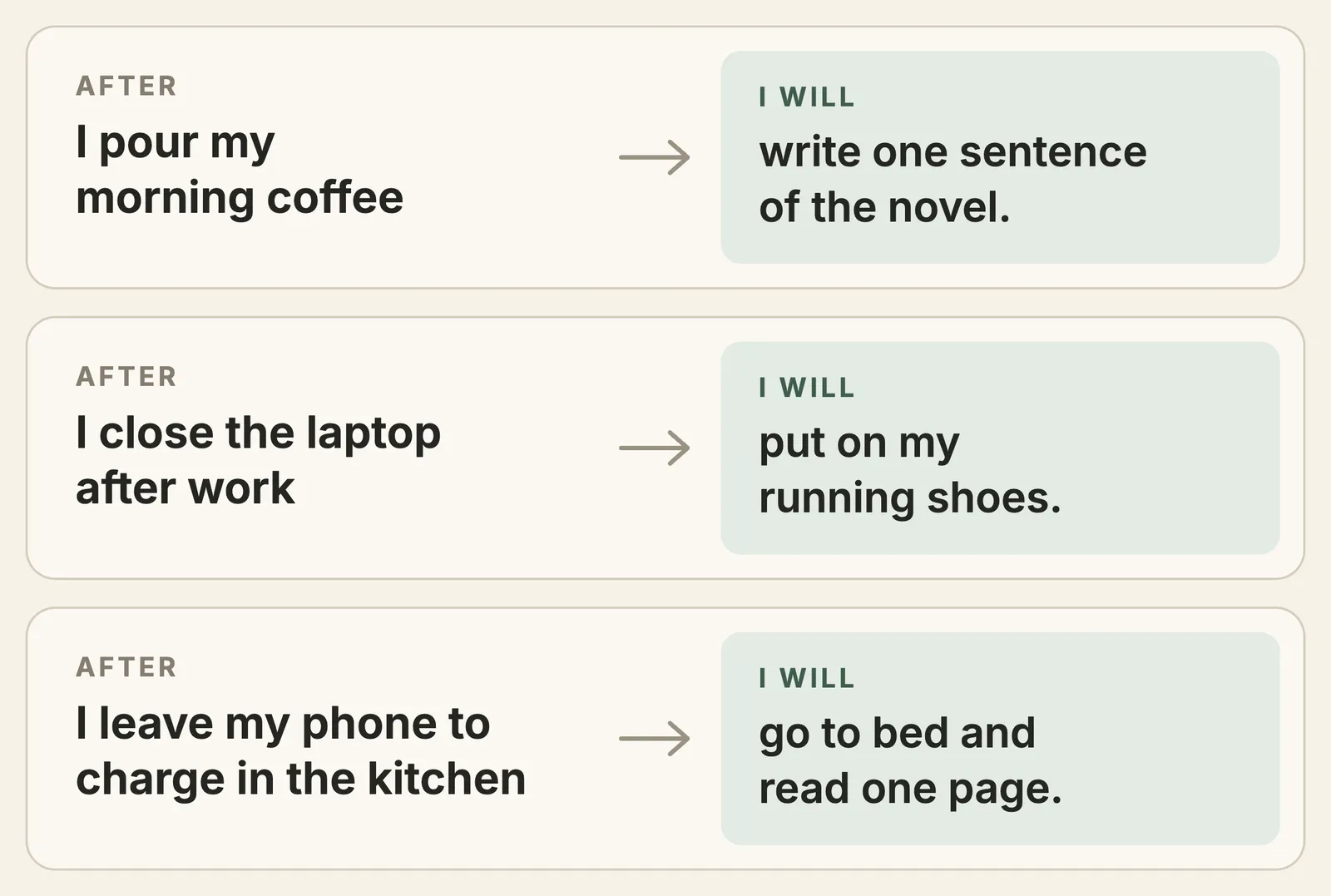
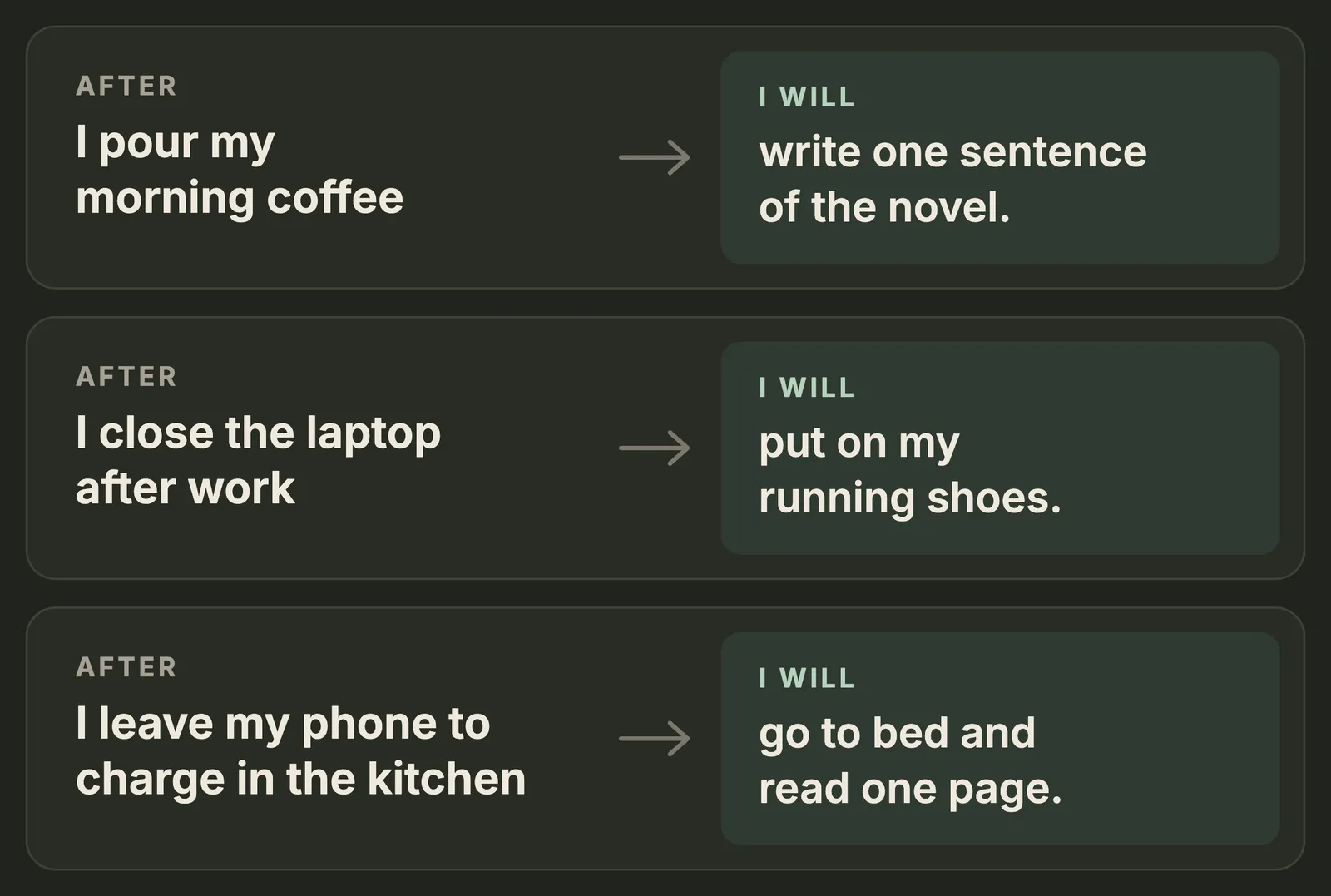
Habit stacking links a new habit to one you already do every day:
After [current habit], I will [new habit].
Clear credits the idea to BJ Fogg, who calls it anchoring, and the name to S. J. Scott, who wrote a book called Habit Stacking. The trick is to pick an anchor that happens at the same time and place as the new habit, every day.
More habit stacking examples:
- After I sit down on the train, I’ll do one Spanish lesson.
- After I start the dishwasher, I’ll wipe the counter.
- After I brush my teeth at night, I’ll floss.
- After I sit down at my desk, I’ll write down today’s one important task.
- After dinner, I’ll lay out tomorrow’s gym clothes.
What the research says. It works, though the anchor matters less than the repetition. In a flossing study by Gaby Judah and colleagues, people told to floss after brushing formed stronger flossing habits than those told to floss before, and they still flossed more eight months later. In a randomized trial with 192 adults by Jan Keller and colleagues, tying a new eating habit to an existing routine and tying it to a set time worked equally well. What predicted the habit was doing it consistently. Habit stacking is one good way to give a habit a cue; a set time and place is another.
The 2-minute rule, with examples
The Two-Minute Rule: when you start a new habit, it should take less than two minutes to do. Scale the habit down to its first step, master showing up, and grow it later. His point: you can’t improve a habit that doesn’t exist yet.
| Habit you want | Two-minute version |
|---|---|
| Run a 10K | Put on running shoes after work |
| Read 20 books this year | Read one page before bed |
| Write a novel | Write one sentence after morning coffee |
| Learn Spanish | Do one lesson in the app |
| Keep the kitchen clean | Wipe one counter after dinner |
| Stretch every day | Sit on the floor for one minute |
The two-minute version is a starting point, not the goal. Once showing up is automatic, add the next small step.
Advanced tactics: talent, the Goldilocks Rule and the downside of habits
The last three chapters are about staying with habits once they’re built.
- Talent. Genes matter, Clear writes, so choose habits that suit your nature and play games where the odds are in your favor. Research agrees that genes matter: across fifty years of twin studies covering thousands of traits, about half of the variation (49% on average) was heritable.
- The Goldilocks Rule. People stay motivated when they work on tasks of just manageable difficulty, not too easy and not too hard. Research on flow supports a balance between challenge and skill, with moderate effects.
- The downside of habits. Once a habit is automatic, you stop paying attention and stop improving. Clear’s answer is reflection and review, such as an annual review. That has good support: in a meta-analysis of 46 samples, structured debriefs improved performance by about 25% on average (d = .67).
Atomic Habits chapter summaries
| Chapter | In one line |
|---|---|
| 1. The Surprising Power of Atomic Habits | Small improvements compound; systems matter more than goals. |
| 2. How Your Habits Shape Your Identity (and Vice Versa) | Build habits around who you want to be; each action is a vote. |
| 3. How to Build Better Habits in 4 Simple Steps | The habit loop and the four laws. |
| 4. The Man Who Didn’t Look Right | Habits run unnoticed; the Habits Scorecard makes them visible. |
| 5. The Best Way to Start a New Habit | Implementation intentions and habit stacking. |
| 6. Motivation Is Overrated; Environment Often Matters More | Make the cues for good habits obvious in your surroundings. |
| 7. The Secret to Self-Control | Avoid temptation instead of resisting it; hide the cues of bad habits. |
| 8. How to Make a Habit Irresistible | Anticipation drives action; temptation bundling. |
| 9. The Role of Family and Friends in Shaping Your Habits | We copy the close, the many and the powerful; join the right group. |
| 10. How to Find and Fix the Causes of Your Bad Habits | Habits serve deeper motives; reframe them. |
| 11. Walk Slowly, but Never Backward | Repetitions matter more than planning or time. |
| 12. The Law of Least Effort | Reduce friction; prime the environment. |
| 13. How to Stop Procrastinating by Using the Two-Minute Rule | Shrink a habit until starting takes two minutes. |
| 14. How to Make Good Habits Inevitable and Bad Habits Impossible | Commitment devices and automation. |
| 15. The Cardinal Rule of Behavior Change | What is immediately rewarded is repeated. |
| 16. How to Stick with Good Habits Every Day | Habit tracking; never miss twice. |
| 17. How an Accountability Partner Can Change Everything | Make bad habits cost something now; habit contracts. |
| 18. The Truth About Talent (When Genes Matter and When They Don’t) | Pick habits that fit your strengths. |
| 19. The Goldilocks Rule: How to Stay Motivated in Life and Work | Work at the edge of your ability; boredom is the enemy. |
| 20. The Downside of Creating Good Habits | Habits plus deliberate practice; review and reflect. |
Is Atomic Habits based on science?
Mostly, yes. Clear draws on real research and publishes his endnotes on his site. But he writes as a practitioner, and some of the studies and stories have aged differently.
- Holds up well: planning when and where you’ll act; habits running on cues from your surroundings; tracking progress; immediate rewards; the finding that one missed day doesn’t undo a habit; reviewing what you did.
- Thinner than the book suggests: the Two-Minute Rule, which has never been tested directly; habit stacking compared with any other fixed cue; starting with identity, where the evidence is mostly correlational and the voter study didn’t replicate; temptation bundling and commitment contracts at scale.
- Contested: the 1% curve as a model of progress; British Cycling as proof (see Clear’s own update); obesity “spreading” through friends; the size of nudge effects; the marshmallow test as a predictor of success; the “quantity vs quality” photography class, which is a parable.
On the last two: in a 2018 replication by Tyler Watts and colleagues, the link between delaying gratification as a child and later achievement was about half as large as in the original studies and shrank further after accounting for family background. And Clear’s class that was graded on quantity rather than quality is, by his own endnote, adapted from a story in the book Art & Fear, not an experiment.
How to apply Atomic Habits this week
- Pick one habit, tied to something you want, and name the identity it votes for: “I’m someone who writes.”
- Write its two-minute version: one sentence.
- Stack it on something you do every day, at the same time and place: “After I pour my morning coffee, I’ll write one sentence.”
- Make the cue obvious and the path easy: the notebook open next to the coffee machine, the phone in another room.
- Track it, and never miss twice. On Sunday, look back at the week and decide whether to grow it.
One habit is enough. A new habit takes about two months to feel automatic, often longer, and adding three at once is the most common way to keep none; we covered the research in how long it takes to form a habit.
Atomic Habits in Plannedo
Plannedo is built around the same idea as the book: a goal for the direction, and small daily habits as the system that gets you there.
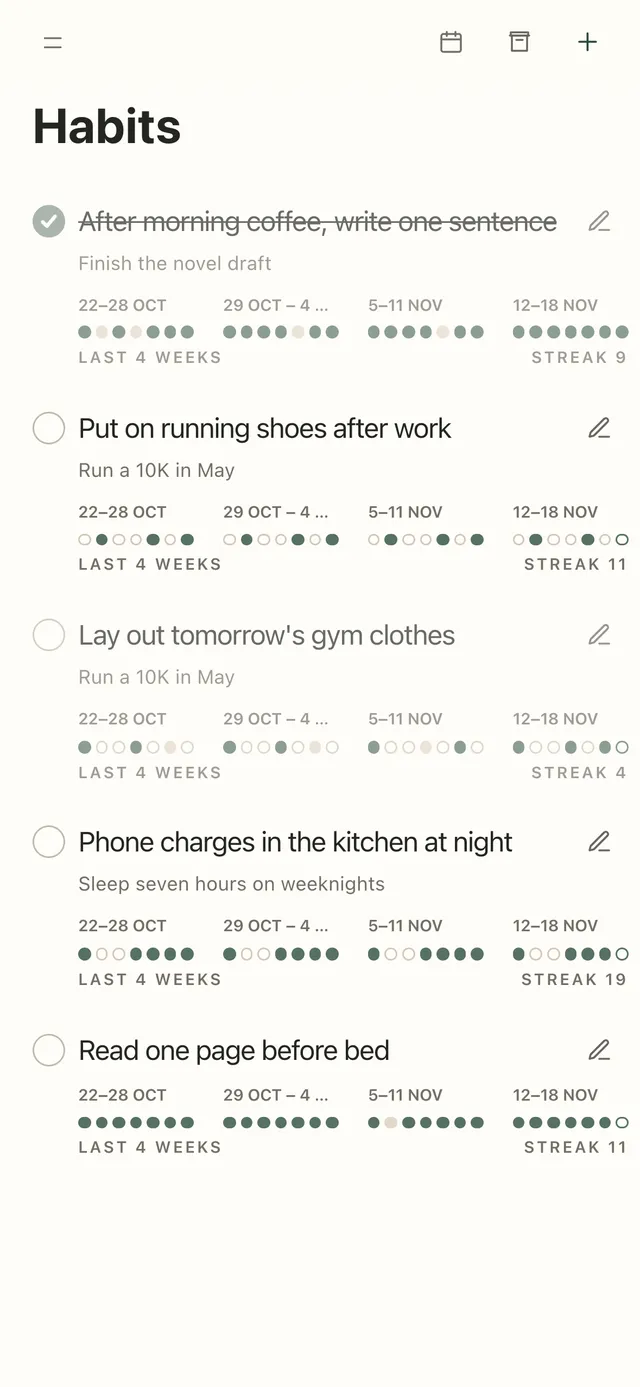
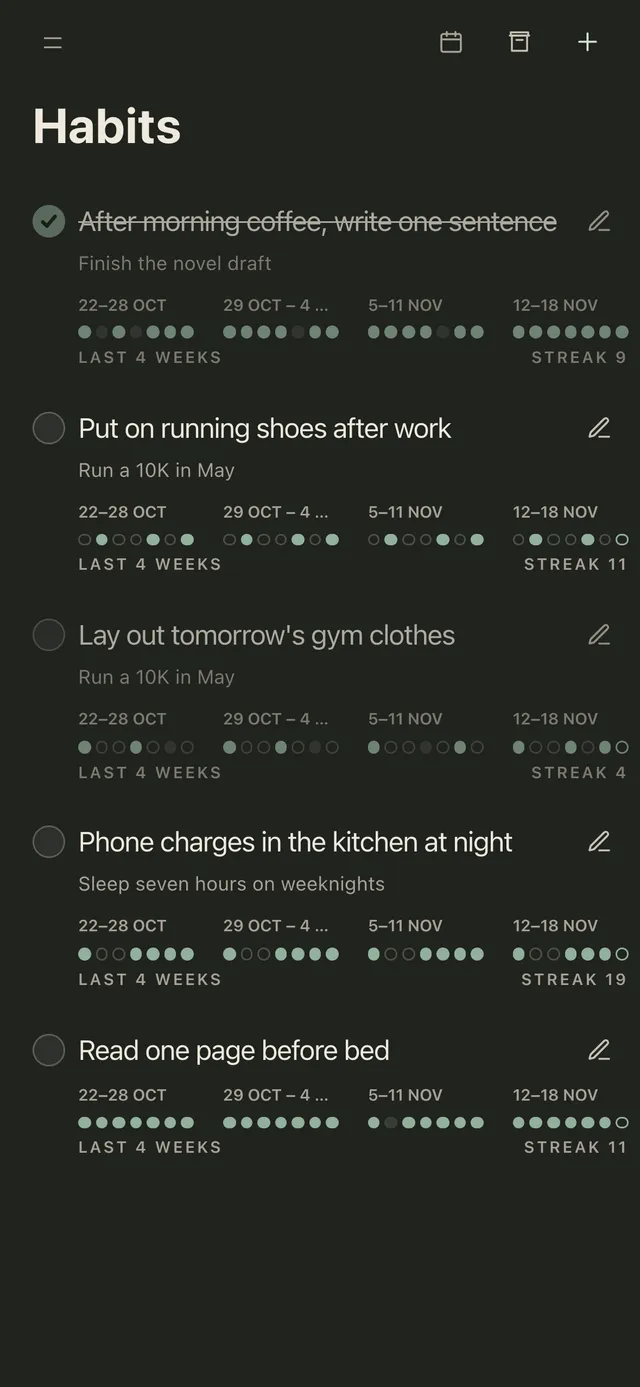
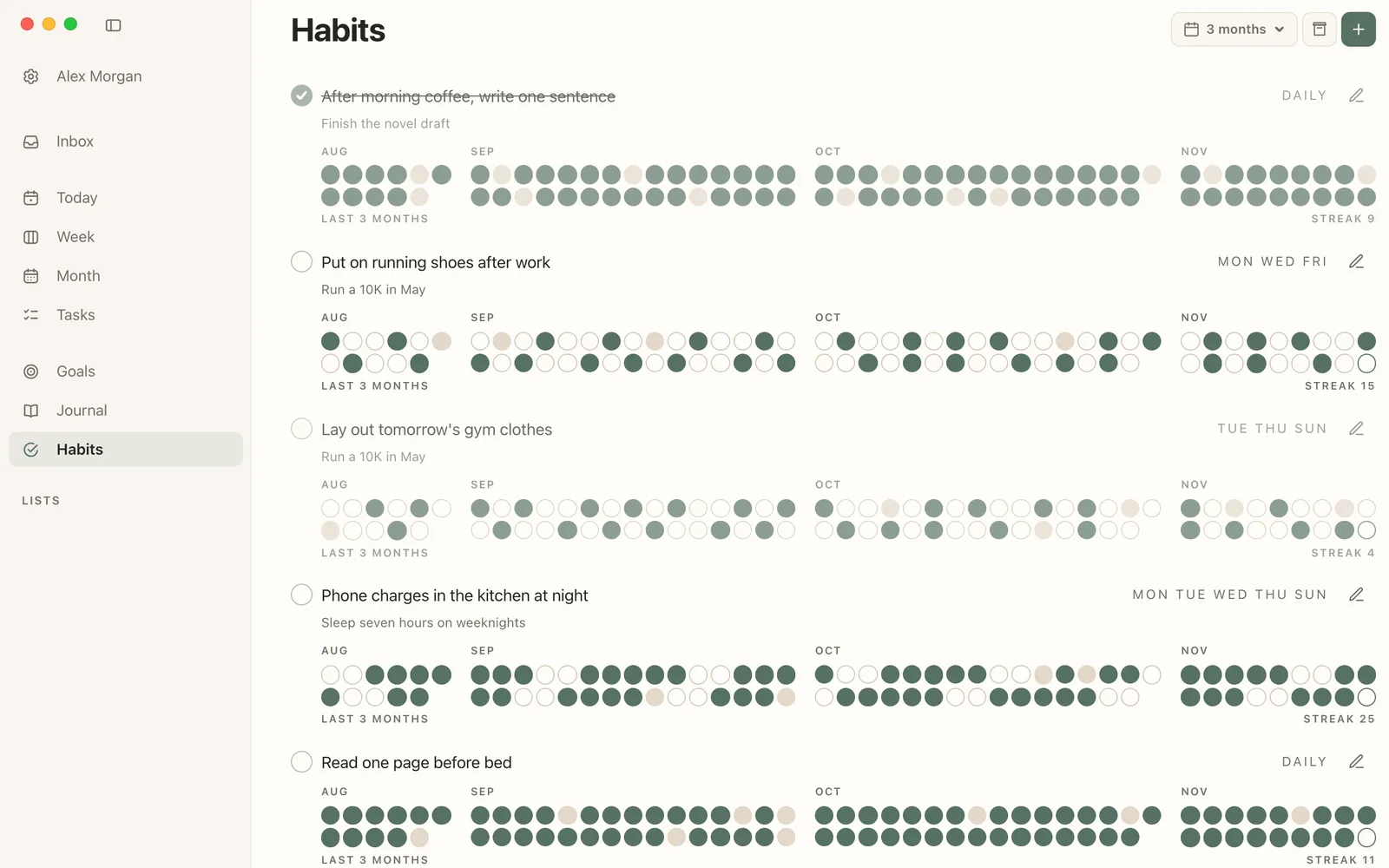
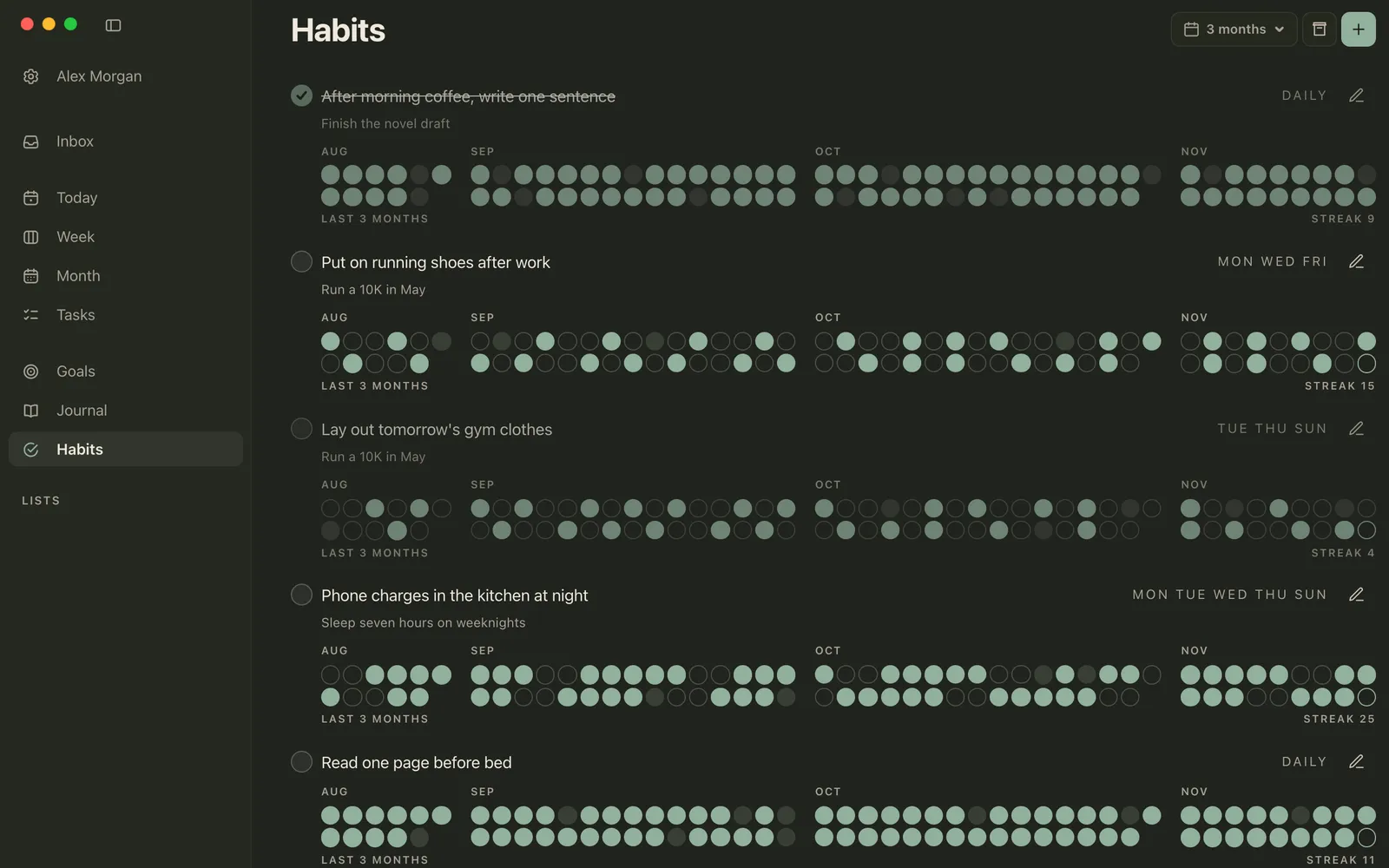
- Give each habit a schedule: daily, weekdays, weekends or the exact days you choose, like “Put on running shoes after work” on Mondays, Wednesdays and Fridays.
- Link it to the goal it serves. Ticking the habit marks the goal as moved for the day, so the vote for who you want to be is counted where you’ll see it.
- Write the cue into the title, habit-stacking style: “After morning coffee, write one sentence.”
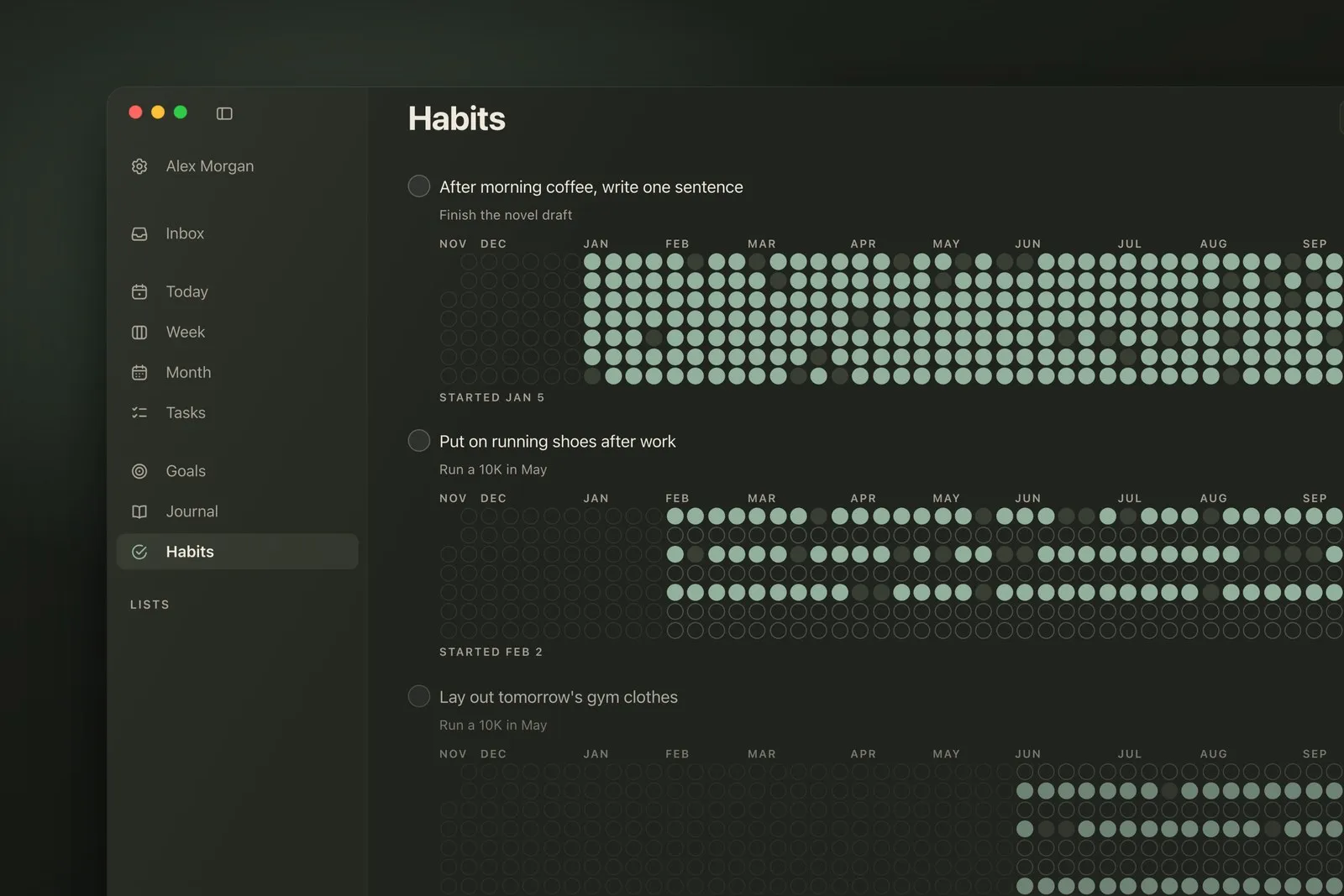
- Watch the dots. Each habit shows four weeks, three months or a whole year at a glance, with its streak. A missed day stands out as a single grey dot, which makes “never miss twice” easy to keep.
- Tick habits where you are: on Today, in the habit tracker itself, or from the iPhone and Mac widgets. And at night, Log the day is a one-line review.
Is Atomic Habits worth reading?
Yes. It’s readable, practical and well organized, and its most useful ideas are the ones with the best evidence: decide when and where, shape your surroundings, make the habit small, track it and get back on track fast. Read the stories as illustrations rather than proof, and the 1% curve as a metaphor. If you only have an hour, the four laws and their tactics (chapters 3 to 17) carry most of the value.
FAQ
What are the 4 laws of Atomic Habits?
Make it obvious, make it attractive, make it easy and make it satisfying. Each law matches a step of the habit loop: cue, craving, response and reward. To break a bad habit, invert them: make it invisible, unattractive, difficult and unsatisfying.
What is the 2-minute rule in Atomic Habits?
When you start a new habit, it should take less than two minutes to do. “Run a 10K” becomes “put on running shoes after work”, and “read more” becomes “read one page”. The point is to master showing up first and grow the habit once it’s automatic. It’s a rule of thumb that hasn’t been tested directly.
What is habit stacking?
Linking a new habit to one you already do every day, in the form “After [current habit], I will [new habit]”: “After I pour my morning coffee, I’ll write one sentence.” Clear credits the idea to BJ Fogg and the name to S. J. Scott. Studies suggest it works about as well as tying a habit to a set time; doing it consistently matters most.
What is the 1% rule in Atomic Habits?
The idea that getting 1% better every day adds up to about 37 times better in a year. It’s arithmetic used as a metaphor: real skills and habits improve fastest at first and then level off. The useful part is the message that small, repeatable steps beat occasional big efforts.
Is Atomic Habits based on science?
Mostly. The core tactics, such as planning when and where, shaping your environment, tracking and quick rewards, have good research behind them. Some examples are weaker: the voter-identity study didn’t replicate, the effects of nudges are smaller than early studies suggested, and a few stories, like the photography class, are parables.
How long does it take to form a habit, according to Atomic Habits?
Clear doesn’t give a number of days. He argues that habits form through repetitions, not time, so the question is how often you do it rather than for how long. In the best-known study, a simple daily habit took a median of 66 days to feel automatic, from 18 to an estimated 254.
Is Atomic Habits worth reading?
Yes, especially if you’ve tried to build habits on willpower and given up. It’s quick to read, and the four laws give you a checklist for any habit. Read it with a critical eye on the stories, which illustrate the ideas more than they prove them.
Does Atomic Habits work for ADHD?
The book isn’t written for ADHD, but several of its tactics suit it well: cues you can’t miss, two-minute versions that make starting easier, less friction, and quick rewards. Habits may take longer to settle, so lean on outside cues and be patient with misses. We wrote more in how to set up an ADHD planner.
Studies and sources
- Clear, J. (2018). Atomic Habits: An Easy & Proven Way to Build Good Habits & Break Bad Ones. Avery. Endnotes: jamesclear.com/atomic-habits/endnotes. Sales figure from jamesclear.com/about, seen November 18, 2026. British Cycling update.
- Heathcote, A., Brown, S., & Mewhort, D. J. K. (2000). The power law repealed: The case for an exponential law of practice. Psychonomic Bulletin & Review, 7(2), 185-207.
- Lally, P., van Jaarsveld, C. H. M., Potts, H. W. W., & Wardle, J. (2010). How are habits formed: Modelling habit formation in the real world. European Journal of Social Psychology, 40(6), 998-1009.
- Williamson, O., Swann, C., Bennett, K. J. M., Bird, M. D., Goddard, S. G., Schweickle, M. J., & Jackman, P. C. (2024). The performance and psychological effects of goal setting in sport: A systematic review and meta-analysis. International Review of Sport and Exercise Psychology, 17(2), 1050-1078.
- Locke, E. A., & Latham, G. P. (2002). Building a practically useful theory of goal setting and task motivation: A 35-year odyssey. American Psychologist, 57(9), 705-717.
- Rise, J., Sheeran, P., & Hukkelberg, S. (2010). The role of self-identity in the theory of planned behavior: A meta-analysis. Journal of Applied Social Psychology, 40(5), 1085-1105.
- Bryan, C. J., Walton, G. M., Rogers, T., & Dweck, C. S. (2011). Motivating voter turnout by invoking the self. PNAS, 108(31), 12653-12656.
- Gerber, A. S., Huber, G. A., Biggers, D. R., & Hendry, D. J. (2016). A field experiment shows that subtle linguistic cues might not affect voter behavior. PNAS, 113(26), 7112-7117. Reply: Bryan, C. J., Walton, G. M., & Dweck, C. S. (2016). Psychologically authentic versus inauthentic replication attempts. PNAS, 113(43).
- Sheeran, P., Listrom, O., & Gollwitzer, P. M. (2025). The when and how of planning: Meta-analysis of the scope and components of implementation intentions in 642 tests. European Review of Social Psychology, 36(1), 162-194.
- Wood, W., Quinn, J. M., & Kashy, D. A. (2002). Habits in everyday life: Thought, emotion, and action. Journal of Personality and Social Psychology, 83(6), 1281-1297.
- Wood, W., Tam, L., & Witt, M. G. (2005). Changing circumstances, disrupting habits. Journal of Personality and Social Psychology, 88(6), 918-933.
- Verplanken, B., & Roy, D. (2016). Empowering interventions to promote sustainable lifestyles: Testing the habit discontinuity hypothesis in a field experiment. Journal of Environmental Psychology, 45, 127-134.
- Thorndike, A. N., Sonnenberg, L., Riis, J., Barraclough, S., & Levy, D. E. (2012). A 2-phase labeling and choice architecture intervention to improve healthy food and beverage choices. American Journal of Public Health, 102(3), 527-533.
- Mertens, S., Herberz, M., Hahnel, U. J. J., & Brosch, T. (2022). The effectiveness of nudging: A meta-analysis of choice architecture interventions across behavioral domains. PNAS, 119(1), e2107346118. Correction.
- Maier, M., Bartoš, F., Stanley, T. D., Shanks, D. R., Harris, A. J. L., & Wagenmakers, E.-J. (2022). No evidence for nudging after adjusting for publication bias. PNAS, 119(31), e2200300119.
- Szaszi, B., Higney, A., Charlton, A., Gelman, A., Ziano, I., Aczel, B., Goldstein, D. G., Yeager, D. S., & Tipton, E. (2022). No reason to expect large and consistent effects of nudge interventions. PNAS, 119(31), e2200732119.
- DellaVigna, S., & Linos, E. (2022). RCTs to scale: Comprehensive evidence from two nudge units. Econometrica, 90(1), 81-116.
- Jachimowicz, J. M., Duncan, S., Weber, E. U., & Johnson, E. J. (2019). When and why defaults influence decisions: A meta-analysis of default effects. Behavioural Public Policy, 3(2), 159-186.
- Milkman, K. L., Minson, J. A., & Volpp, K. G. M. (2014). Holding the Hunger Games hostage at the gym: An evaluation of temptation bundling. Management Science, 60(2), 283-299.
- Kirgios, E. L., Mandel, G. H., Park, Y., Milkman, K. L., Gromet, D. M., Kay, J. S., & Duckworth, A. L. (2020). Teaching temptation bundling to boost exercise: A field experiment. Organizational Behavior and Human Decision Processes, 161, 20-35.
- Wing, R. R., & Jeffery, R. W. (1999). Benefits of recruiting participants with friends and increasing social support for weight loss and maintenance. Journal of Consulting and Clinical Psychology, 67(1), 132-138.
- Christakis, N. A., & Fowler, J. H. (2007). The spread of obesity in a large social network over 32 years. New England Journal of Medicine, 357(4), 370-379.
- Cohen-Cole, E., & Fletcher, J. M. (2008). Detecting implausible social network effects in acne, height, and headaches: Longitudinal analysis. BMJ, 337, a2533.
- Giné, X., Karlan, D., & Zinman, J. (2010). Put your money where your butt is: A commitment contract for smoking cessation. American Economic Journal: Applied Economics, 2(4), 213-235.
- Halpern, S. D., French, B., Small, D. S., et al. (2015). Randomized trial of four financial-incentive programs for smoking cessation. New England Journal of Medicine, 372(22), 2108-2117.
- Woolley, K., & Fishbach, A. (2017). Immediate rewards predict adherence to long-term goals. Personality and Social Psychology Bulletin, 43(2), 151-162.
- Harkin, B., Webb, T. L., Chang, B. P. I., Prestwich, A., Conner, M., Kellar, I., Benn, Y., & Sheeran, P. (2016). Does monitoring goal progress promote goal attainment? A meta-analysis of the experimental evidence. Psychological Bulletin, 142(2), 198-229.
- Milkman, K. L., Gromet, D., Ho, H., et al. (2021). Megastudies improve the impact of applied behavioural science. Nature, 600, 478-483.
- Judah, G., Gardner, B., & Aunger, R. (2013). Forming a flossing habit: An exploratory study of the psychological determinants of habit formation. British Journal of Health Psychology, 18(2), 338-353.
- Keller, J., Kwasnicka, D., Klaiber, P., Sichert, L., Lally, P., & Fleig, L. (2021). Habit formation following routine-based versus time-based cue planning: A randomized controlled trial. British Journal of Health Psychology, 26(3), 807-824.
- Polderman, T. J. C., Benyamin, B., de Leeuw, C. A., Sullivan, P. F., van Bochoven, A., Visscher, P. M., & Posthuma, D. (2015). Meta-analysis of the heritability of human traits based on fifty years of twin studies. Nature Genetics, 47(7), 702-709.
- Fong, C. J., Zaleski, D. J., & Leach, J. K. (2015). The challenge-skill balance and antecedents of flow: A meta-analytic investigation. The Journal of Positive Psychology, 10(5), 425-446.
- Tannenbaum, S. I., & Cerasoli, C. P. (2013). Do team and individual debriefs enhance performance? A meta-analysis. Human Factors, 55(1), 231-245.
- Watts, T. W., Duncan, G. J., & Quan, H. (2018). Revisiting the marshmallow test: A conceptual replication investigating links between early delay of gratification and later outcomes. Psychological Science, 29(7), 1159-1177.
- Bayles, D., & Orland, T. (1993). Art & Fear. Capra Press.