How to Set Goals and Achieve Them (+ Free Worksheet)
How to set goals you'll actually reach: seven steps backed by goal-setting research, examples for every area of life, and a free two-page worksheet.

To set goals you’ll actually reach, pick one to three that are really yours and write each as a specific, hard result with a deadline. Add closer milestones and weekly actions, plan for the obstacle most likely to stop you, and check your progress every week. The seven steps below follow decades of goal-setting research, with examples and a free worksheet.
Most goals don’t fail in October. They fail on the day they’re written down, as “get fit” or “grow the business”: nothing to aim at, nothing to check, nothing to do on Tuesday. Almost all of the fix is in how you write the goal, and that part takes about half an hour.
How to set goals in 7 steps
| Step | What you write down | Why it works |
|---|---|---|
| 1. Choose goals that are yours | One to three goals you’d want even if nobody ever knew | Goals that fit your own values get more sustained effort |
| 2. Make it specific and hard | “By [deadline], I will [result]” | Specific, hard goals beat “do your best” |
| 3. Give it a deadline | A date, a month, a quarter or a year | You can’t check a goal that never ends |
| 4. Pick an outcome or a learning goal | An outcome if you know how, a learning goal if you don’t yet | On new, complex tasks, learning goals work better |
| 5. Add milestones and weekly actions | Closer goals on the way, actions with days, a first step on a date | Near goals keep a far one moving |
| 6. Plan for the obstacle | The likeliest obstacle and an if-then plan | If-then plans have a medium-to-large effect |
| 7. Track it and review it | A daily or weekly check, written down | Monitoring progress makes reaching the goal more likely |
1. Choose goals that are really yours
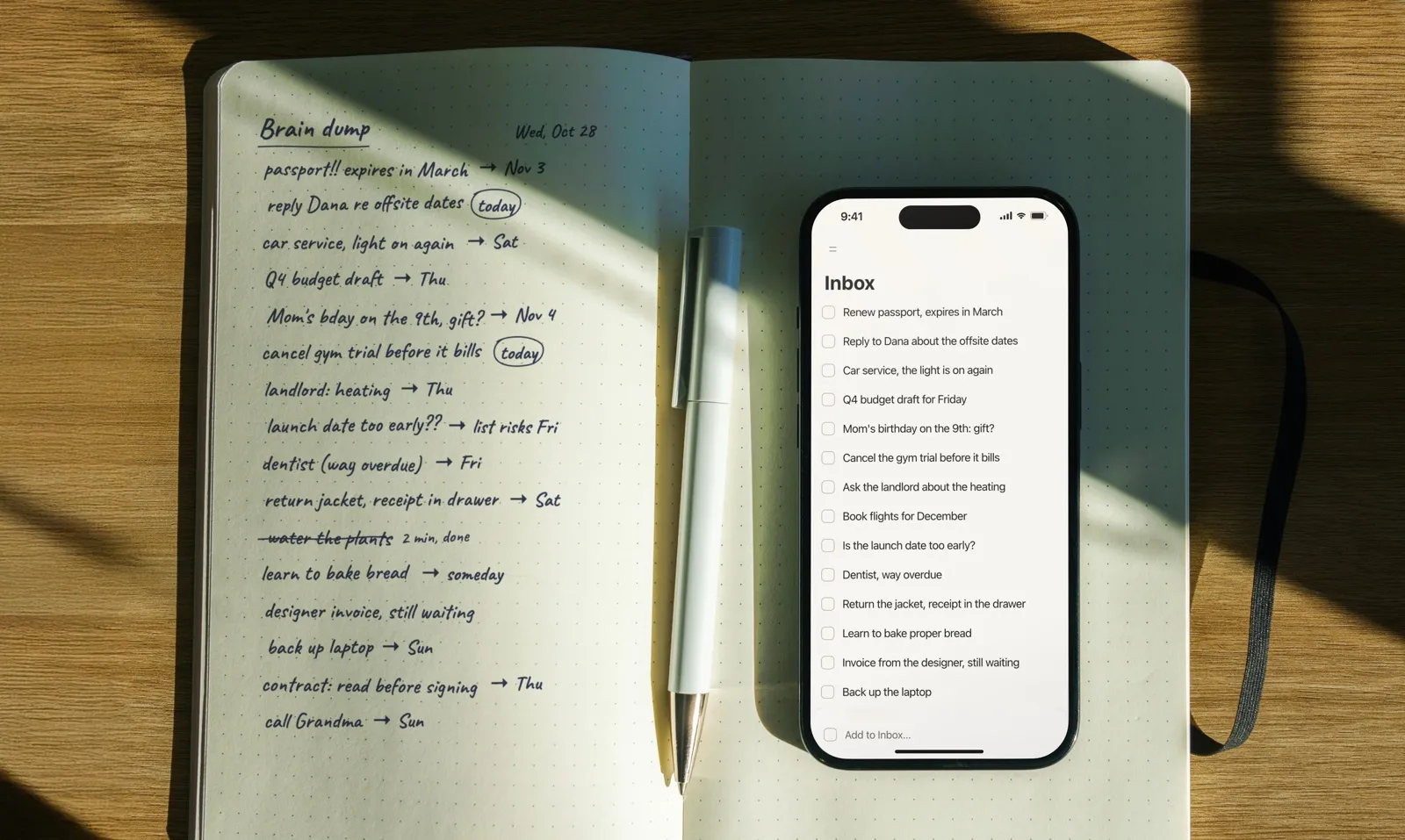
Start wide. Go through eight areas of life, health, work, money, people, learning, home, fun and inner life, and write one line for each: what would make it better by the end of the year? Skip the areas that are fine. If you’re not sure what you want, start from what isn’t working, or do a year in review first: it turns last year into a list of what to keep, stop and start.
Then pick one to three, and test each with one question: would I want this even if nobody ever knew? Kennon Sheldon and Andrew Elliot call goals that fit a person’s own interests and core values self-concordant. In their longitudinal studies, people put more sustained effort into self-concordant goals and were more likely to reach them, and reaching them did more for their well-being. A goal you chose because it looks good on someone else’s feed fails the test, and it usually fails in practice too.
2. Make it specific and hard
Write each goal as a result you could check on the day: By [deadline], I will [result].
- Not “get fit”, but “By October 10, I will run a half marathon without walking.”
- Not “learn Spanish”, but “By June 30, I will hold a 20-minute conversation in Spanish.”
- Not “save more”, but “By December 31, I will have three months of expenses in a separate account.”
Hard is not a typo. Edwin Locke and Gary Latham, who built goal-setting theory over 35 years of studies, found that specific, difficult goals consistently led to better performance than urging people to do their best. The harder the goal, the more effort and the better the result, up to a point: performance leveled off only when people reached the limit of their ability or stopped being committed to the goal. So aim for a stretch you can still see a path to. “Do your best” feels kind, and it’s the version that gets the least done.
3. Give it a deadline you can see
A goal without an end gives you nothing to check and no reason to start this week. Match the deadline to the goal: a date for an event (the race, the exam, the launch), a month or a quarter for a project, a year for a bigger change. A year is far away, so a one-year goal needs the milestones in step 5.
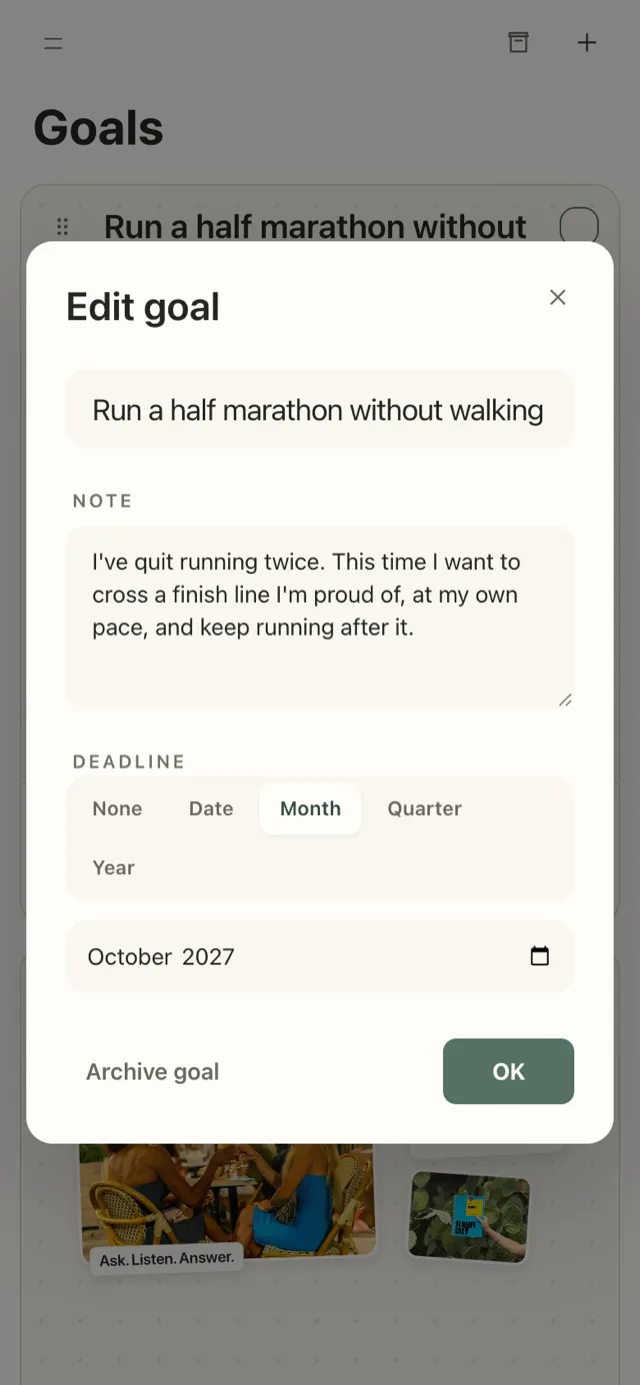
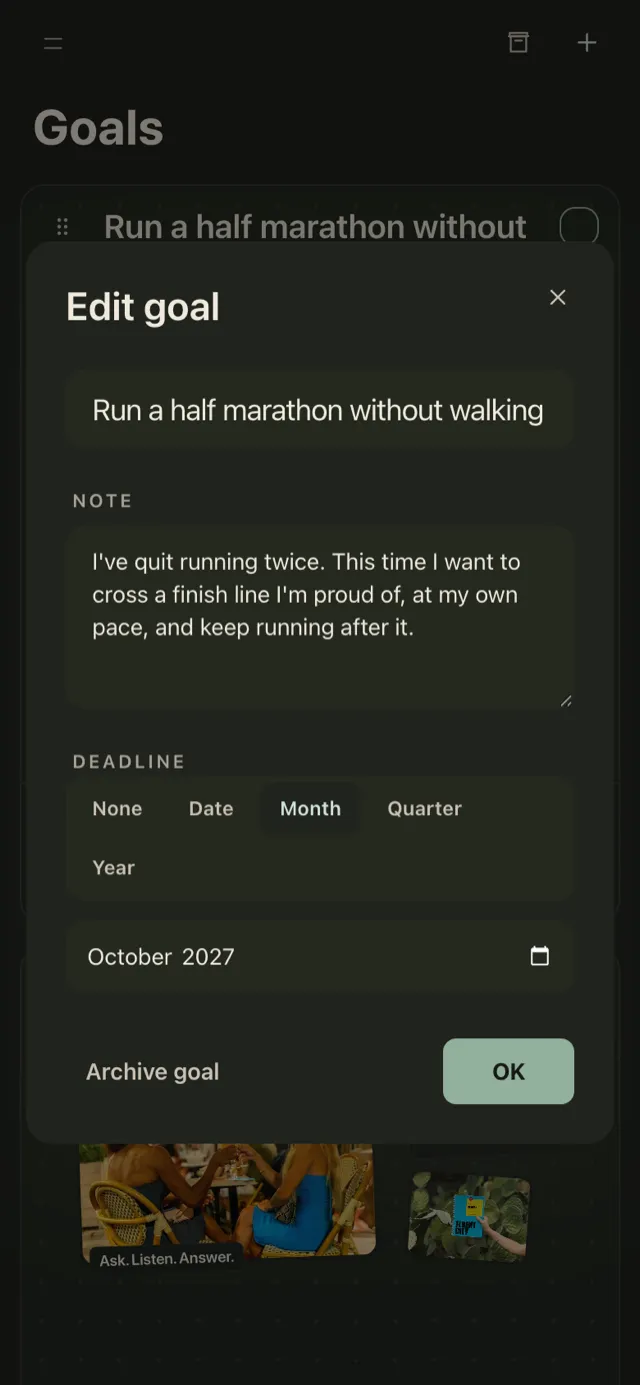
In Plannedo, a goal’s Deadline can be None, Date, Month, Quarter or Year, and the Note field under the title asks Why it matters: the answer from step 1 goes there.
4. Decide: an outcome goal or a learning goal?
If you already know how to do the thing, set an outcome goal, the result itself. If you’ve never done anything like it, start with a learning goal: a number of ways to try, a skill to get, a question to answer.
Dawn Winters and Gary Latham tested this with 114 business school students. On a simple scheduling task, an outcome goal led to more correct schedules than being told to do their best. On a complex one, a learning goal beat both: performance was higher, and the students found and used more effective strategies.
So “start a business by June” is a hard outcome with no known path. “By March 31, talk to 20 potential customers about the problem” is a learning goal you can start on Monday, and its answers tell you what the outcome goal should be.
5. Break it into milestones and weekly actions
A goal a year away doesn’t tell you what to do this week. Two or three milestones do. In a business game described in Locke and Latham’s review, people who had near-term goals on top of a distant one felt more able to succeed and made higher profits than people who had only the distant goal or were told to do their best.
For each goal, write:
- Milestones: two or three closer results, each with a date. For the half marathon: 5 km without stopping by February, 10 km by May, 16 km by August.
- Weekly actions: what you’ll do and on which days. “Run Tuesday, Thursday and Saturday” is a plan; “run more” isn’t. These are usually habits, and they’re where the goal is actually won.
- The first step, on a date: “Saturday: buy shoes and run 2 km, slowly.” A goal with nothing dated stays a wish.
6. Plan for the obstacle
Write down the thing most likely to stop you, and what you’ll do when it happens: “If it’s raining on a run day, then I’ll do 30 minutes on the bike at home.” Plans in the form “if X, then I’ll do Y” are called implementation intentions, and a 2006 meta-analysis of 94 tests by Peter Gollwitzer and Paschal Sheeran found a medium-to-large effect on reaching goals. The WOOP method turns this into a ten-minute exercise, with a worksheet of its own.
7. Track it and review it
Benjamin Harkin, Thomas Webb and colleagues pulled together 138 experiments with 19,951 participants in which people were randomly assigned to an intervention that got them to monitor their progress, or to a control group. Monitoring made people more likely to reach their goals, and the effect was larger when progress was physically recorded and when it was reported to others. Locke and Latham make the same point from the other side: goals work best with feedback that shows progress against them.
In practice that means three rhythms:
- Every evening, one question: did today move it? Yes, I thought about it, or not today. Thirty seconds.
- Every week, a short review: what moved, what didn’t, and what’s next. Our weekly review template takes 20 minutes.
- Every quarter, a reset: keep the goal, change it, or drop it on purpose. If you like working in quarters, the 12 Week Year builds a whole method around them.
Goal setting examples
| Vague wish | Specific, hard goal | First step this week |
|---|---|---|
| Get fit | By October 10, run a half marathon without walking | Saturday: run 2 km, slowly |
| Learn Spanish | By June 30, hold a 20-minute conversation in Spanish | Book a trial lesson for Thursday |
| Save more | By December 31, have three months of expenses in a separate account | Set up an automatic transfer on payday |
| Get promoted | By June 30, lead one client project from kickoff to launch | Tell my manager on Monday which project I want |
| Start a business | By March 31, talk to 20 potential customers about the problem (learning goal) | List ten people to ask |
| Write a book | By April 30, finish a draft of the first three chapters | Write 300 words before breakfast on Tuesday |
| See friends more | Host six dinners by December | Text two friends a date for the first one |
| Get organized | By March 31, turn the spare room into a workspace | Sunday: one hour, one box |
| Travel more | Visit two places I’ve never been by the end of the year | Pick the first one and book the dates |
| Be less stressed | Walk 20 minutes without my phone five days a week until the end of March | Put the walk on Monday’s list |
The last one is a habit dressed as a goal, and that’s fine: some goals are mostly a habit kept for long enough. The habit formation research says to expect about two months, not 21 days.
How many goals should you set?
One to three at a time. Each goal needs a weekly slot and some attention every evening, and past three, some of them get none. Write the goals you didn’t pick on a “not now” list: once they’re written down somewhere, they stop asking for attention, and the next quarter or the next year can take them on.
SMART goals: useful, with one catch
SMART stands for Specific, Measurable, Achievable, Relevant and Time-bound, and it covers steps 2 and 3 well. The catch is the A. “Achievable” is easy to read as “safe”, and the research above points the other way: hard goals get more done than comfortable ones. SMART also says nothing about why the goal is yours, what to learn first, what will get in the way, or how you’ll track it. Use it as a check on the wording, not as the whole method. There’s a side-by-side comparison in WOOP vs SMART goals.
Goals and habits: you need both
James Clear argues for focusing on systems rather than goals: winners and losers often have the same goals, so what decides the result is the daily process. He still keeps goals for direction, and that’s the balance worth copying. A goal with a deadline tells you which habits to build and when to change them; the weekly actions in step 5 do the work. The goal says where, the habits say how. Link them, so every run or lesson shows up as progress toward the thing you chose.
How to set goals in Plannedo
Plannedo keeps each goal on a board you can see and wires it to your day, so the seven steps map onto it directly:
- Write the goal. Open Goals and add a New goal. Put the “By … I will …” result in the title, the reason in Note, and pick the Deadline.
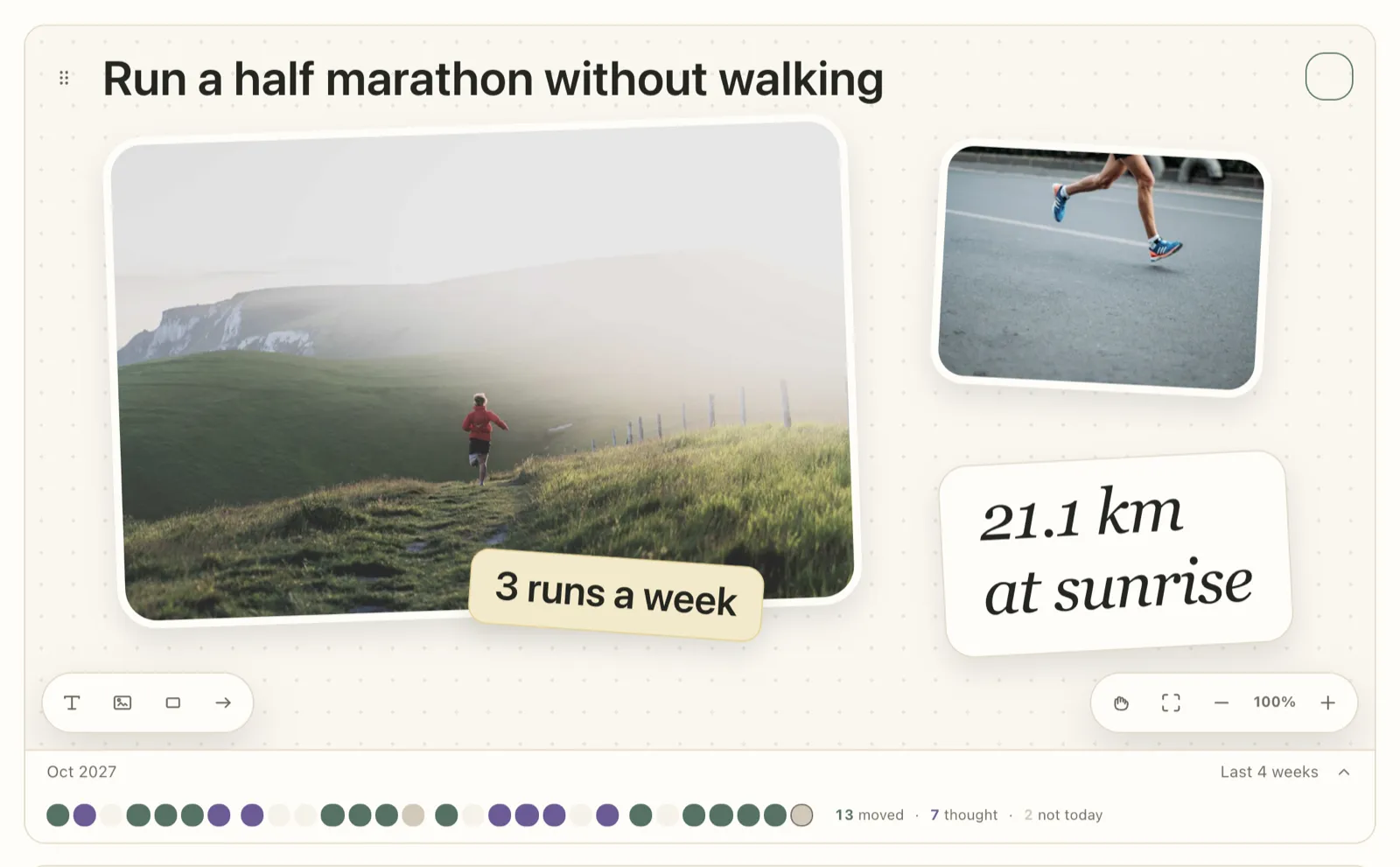
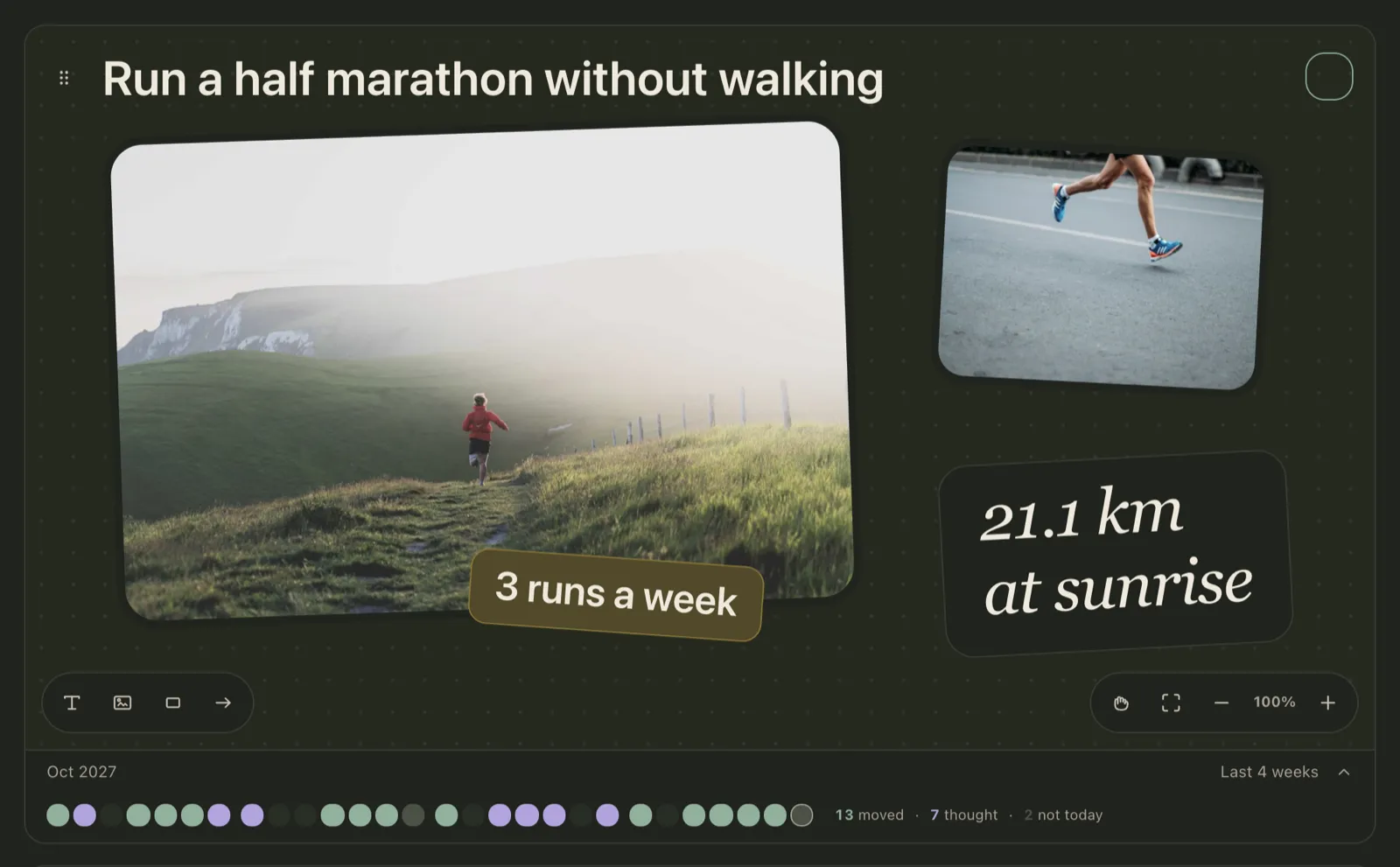
- Picture it. Each goal has a board for photos and short lines: what it looks like when it’s done. Do vision boards work? covers the kind of picturing that helps and the kind that doesn’t.
- Link the weekly actions. Tasks and habits have a Goal field, so the runs, the lessons and the first step all belong to the goal. The steps are in Connect tasks and habits to a goal.
- Check in every evening. Log the day on Today asks about each goal: Moved, Thought or Not today. Finishing a task linked to a goal marks it Moved for you.
- Look at the trend. Open Last 4 weeks under a board and the evening answers show as a row of dots, with a count of moved, thought and not-today days: the feedback step 7 asks for, without a spreadsheet.
When you reach it, Mark completed crosses the goal out, and it stays on the page as a record. More on that in Complete, archive or delete a goal.
FAQ
What are the steps to setting goals?
Choose one to three goals that are really yours, write each as a specific, hard result with a deadline, decide whether it’s an outcome or a learning goal, break it into milestones and weekly actions with a first step on a date, plan for the likeliest obstacle with an if-then plan, and check your progress every evening and every week.
How do I set goals if I don’t know what I want?
Go through eight areas of life, health, work, money, people, learning, home, fun and inner life, and write one line for each about what would make it better by the end of the year. Start with what isn’t working. If one area stands out but you don’t know the way, set a learning goal first, such as trying three approaches in four weeks.
How many goals should I set at once?
One to three. Each goal needs a weekly slot and regular attention, and with more than three, some get neither. Keep the rest on a “not now” list and pick them up next quarter or next year.
What is an example of a good personal goal?
“By October 10, I will run a half marathon without walking.” It’s specific, you can check it on the day, it has a deadline, and it’s hard but possible. Add milestones (5 km by February, 10 km by May), weekly actions (run three days a week) and a first step on a date.
Should goals be realistic?
They should be possible, not easy. Goal-setting research by Edwin Locke and Gary Latham found that specific, difficult goals led to better performance than easy goals or “do your best”, as long as the goal stayed within the person’s ability and they stayed committed to it. Aim for a stretch you can see a path to.
What’s the difference between a goal and a habit?
A goal is a result with an end, like running a half marathon by October. A habit is a repeated action, like running three times a week. The goal sets the direction and the deadline; the habits do the work. Most goals need one to three habits linked to them.
How often should I review my goals?
Briefly every evening (did today move it?), properly every week for about 20 minutes, and every quarter to keep, change or drop each goal on purpose. Research on progress monitoring found that checking more often makes reaching a goal more likely, especially when progress is written down.
Studies mentioned
- Locke, E. A., & Latham, G. P. (2002). Building a practically useful theory of goal setting and task motivation: A 35-year odyssey. American Psychologist, 57(9), 705-717.
- Sheldon, K. M., & Elliot, A. J. (1999). Goal striving, need satisfaction, and longitudinal well-being: The self-concordance model. Journal of Personality and Social Psychology, 76(3), 482-497.
- Winters, D., & Latham, G. P. (1996). The effect of learning versus outcome goals on a simple versus a complex task. Group & Organization Management, 21(2), 236-250.
- Gollwitzer, P. M., & Sheeran, P. (2006). Implementation intentions and goal achievement: A meta-analysis of effects and processes. Advances in Experimental Social Psychology, 38, 69-119.
- Harkin, B., Webb, T. L., Chang, B. P. I., Prestwich, A., Conner, M., Kellar, I., Benn, Y., & Sheeran, P. (2016). Does monitoring goal progress promote goal attainment? A meta-analysis of the experimental evidence. Psychological Bulletin, 142(2), 198-229.