How Long Does It Take to Form a Habit? (Not 21 Days)
Not 21 days. In the best-known study a new habit took 66 days on average, from 18 to 254. What the research says, and how to make yours stick sooner.
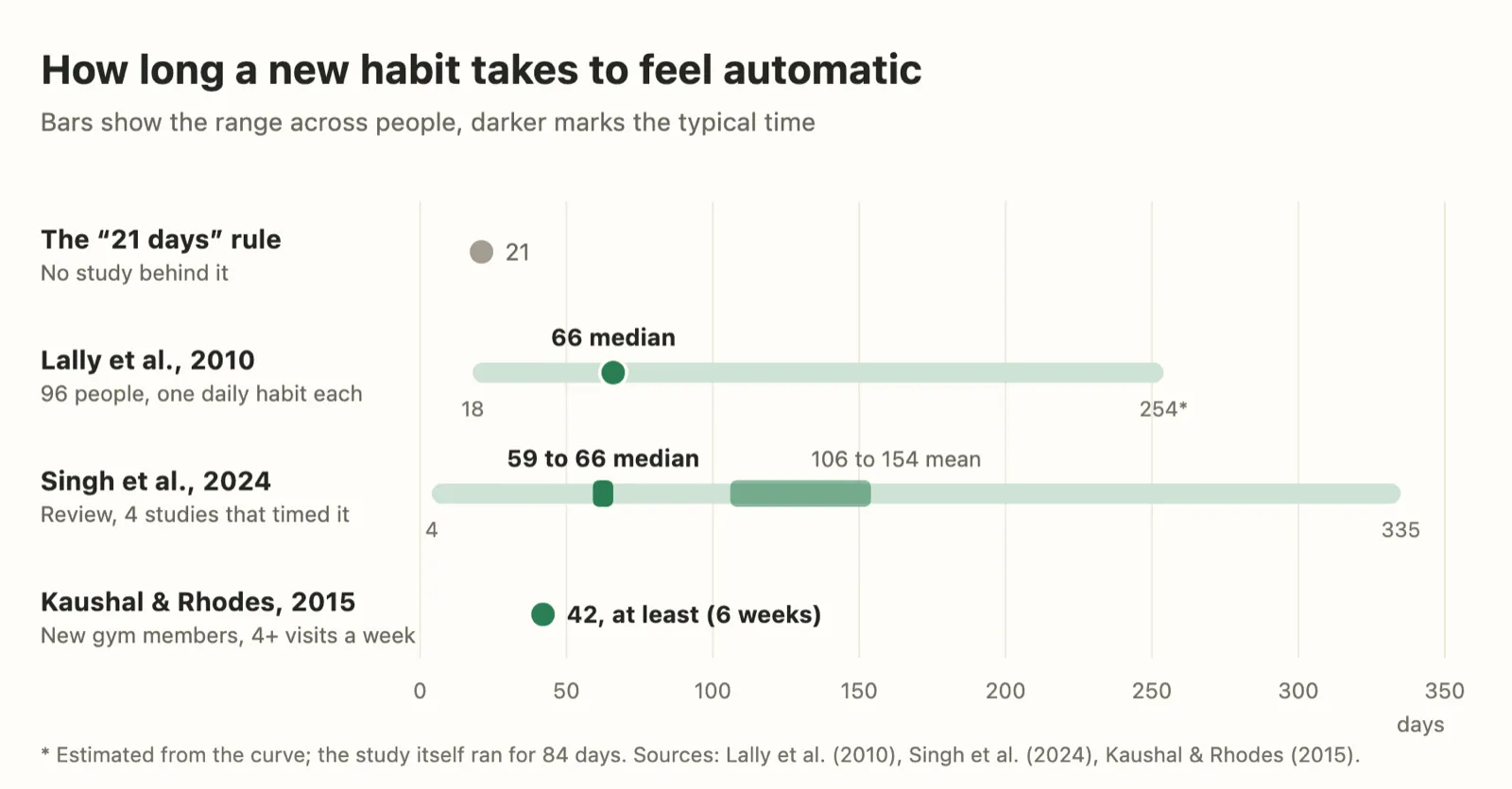
It takes about two months for a new habit to feel automatic, not 21 days. In the best-known study, run at University College London and published in 2010, the median was 66 days, but it ranged from 18 to 254 days depending on the person and the habit. Simple habits, like a glass of water after waking up, form faster than complex ones, like going to the gym.
That gap between 21 and 66 matters. If you expect a habit to stick in three weeks, week four feels like failure, and that’s exactly when most people stop. Below: where the 21-day number came from, what four studies that actually timed habits found, why a missed day matters less than you think, and seven things that make a habit form sooner.
Where the “21 days to form a habit” rule comes from
The number traces back to Maxwell Maltz, a plastic surgeon. In his 1960 book Psycho-Cybernetics, he wrote that his patients seemed to need a minimum of about three weeks to get used to a change: a new face after surgery, or the loss of a limb. That was an observation about adjusting to a new self-image, not an experiment, and it was a minimum, not an average.
Self-help books repeated it for decades, and the word “minimum” fell off along the way. You’ll also see a “21/90 rule” (21 days to build a habit, 90 to make it part of your life). Neither number comes from a study. Colin Camerer, one of the authors of a large 2023 study on habit formation, has said plainly that the 21-day figure was never based on science.
What the research actually found
| Study | What people tried to make a habit | How long it took |
|---|---|---|
| Lally et al., 2010 | One daily eating, drinking or exercise behaviour | Median 66 days, from 18 to an estimated 254 |
| Singh et al., 2024 | Review of 20 studies on health habits | Medians of 59 to 66 days, means of 106 to 154, from 4 to 335 |
| Buyalskaya et al., 2023 | Going to the gym; handwashing in hospitals | Months for the gym, weeks for handwashing |
| Kaushal & Rhodes, 2015 | Exercise for new gym members | At least four sessions a week for six weeks |
The UCL study: 66 days, from 18 to 254
Phillippa Lally and colleagues asked 96 volunteers to pick one new eating, drinking or exercise behaviour and do it every day at the same point in the day, like after breakfast. Every day for twelve weeks, each person rated how automatic it felt. For the participants whose data could be modelled, the median time to reach their plateau of automaticity was 66 days.
The range is the real story. The fastest habit settled in 18 days. The slowest was on course to take 254 days, an estimate from the curve, since the study itself ran for 84. People who chose an exercise habit took about one and a half times as long as people who chose something to eat or drink.
The 2024 review: two months is typical, longer is common
Ben Singh and colleagues in Australia reviewed 20 studies with 2,601 participants. Four of them reported how long habits took to form: medians of 59 to 66 days and means of 106 to 154 days, with individual times from 4 to 335 days. The means are higher than the medians because a minority of people take much longer, which pulls the average up.
The review also listed what made the difference: how often the behaviour was repeated, when in the day it happened, the type of habit, whether people chose it themselves, whether they enjoyed it, and whether they had a routine around it.
Gym habits take months, handwashing takes weeks
In 2023, Anastasia Buyalskaya, Katherine Milkman, Colin Camerer and colleagues used machine learning on two huge data sets: more than 12 million gym check-ins and more than 40 million handwashing records from hospital staff. They measured when each person’s behaviour became predictable. Their conclusion, in their own summary: it typically takes months to form the habit of going to the gym, but weeks to form the habit of handwashing in a hospital.
For exercise: four times a week for six weeks
A smaller 2015 study of 111 new gym members by Navin Kaushal and Ryan Rhodes found that exercising at least four times a week for six weeks was the minimum needed to establish an exercise habit. The habit grew faster for people who were consistent, kept their workouts simple, had a supportive environment and enjoyed it.
Why some habits take longer than others
Put the studies together and the same few factors keep coming up:
- Complexity. Drinking a glass of water is one step. Going to the gym is a dozen: pack the bag, leave on time, get there, change. More steps means more places to stall.
- Frequency. Habits form through repetition in the same situation, so a daily habit gets twice the practice of one you do three times a week.
- A stable cue. Habits attach to context: a time, a place, something you just did. In diary studies by Wendy Wood and colleagues, behaviour that was repeated almost daily in a stable context needed far less conscious thought. Change the context every day and the habit has nothing to hold on to.
- Enjoyment. Both the 2015 gym study and the 2024 review found that liking the behaviour helped. Willpower can start a habit, but it rarely carries it to day 66.
- Choice. The 2024 review lists individual choice among the factors that mattered: a habit you picked yourself has a better chance than one you were handed.
Does missing a day reset a habit?
No. In the UCL study, missing a single opportunity didn’t materially affect how the habit formed. The curve kept rising after a lapse.
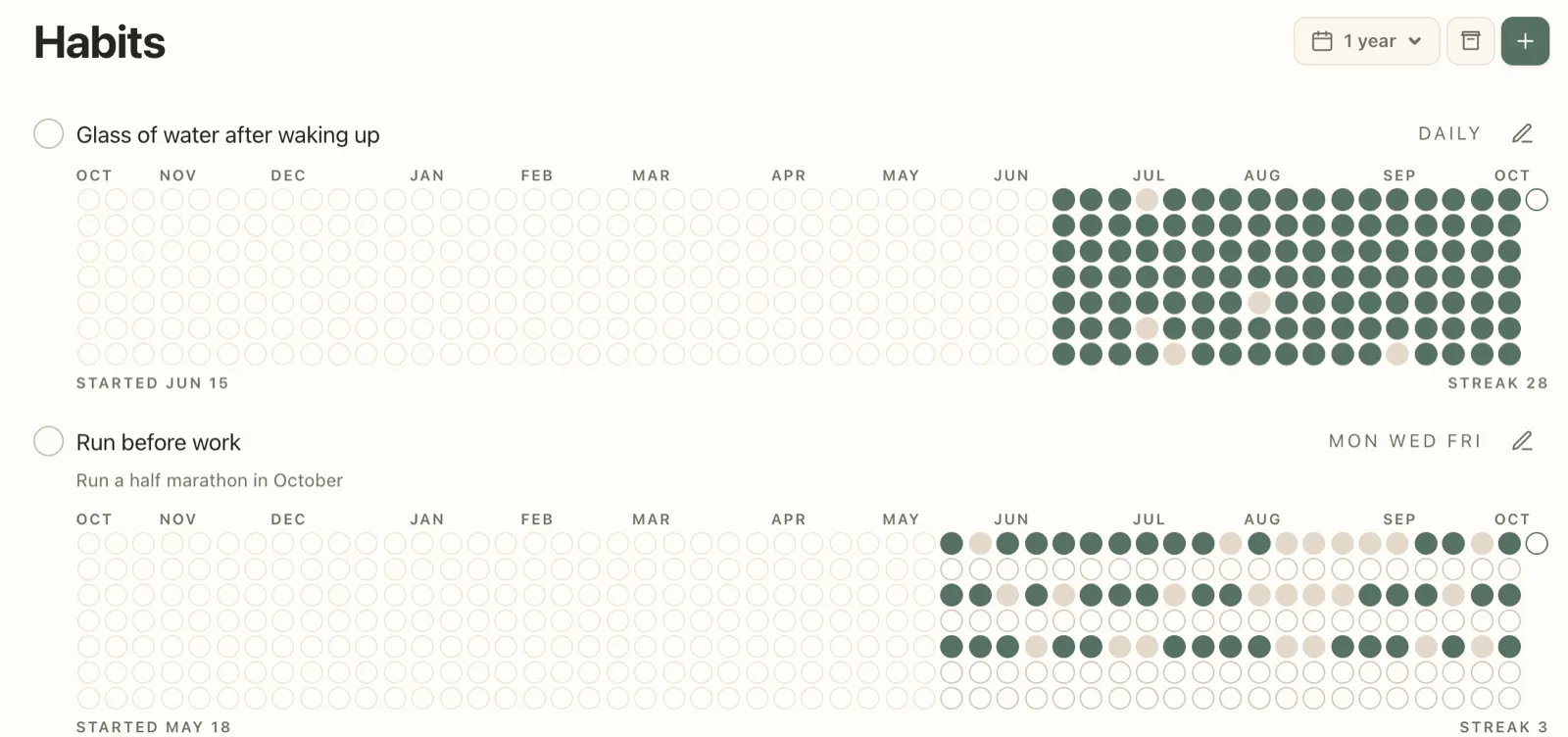
What a missed day does is make the next one easier to skip. A useful rule many people follow is to never miss twice in a row: one gap is a gap, two is the start of a new pattern. A streak counter that drops to zero can make a single miss feel like the end; a history of the last three months shows it for what it is.
How to form a habit faster
There’s no way to make every habit take three weeks, but there’s plenty you can do to stay near the short end of the range.
- Start with one small behaviour. “Run before work” rather than “get fit”. “Read 20 pages” rather than “read more”. Small and specific is what the fast habits in every study had in common. For a hundred examples written this way, see Habit Tracker Ideas.
- Attach it to something you already do. “After I pour my morning coffee, I write three lines.” Plans in this if-then form are among the best-tested tools in goal research, and a fixed cue is what habits form around.
- Keep the same time and place. The more stable the context, the less you have to decide each day. Mornings are a good slot; there’s an example routine in the morning routine checklist.
- Do it often. Daily if you can. For exercise, aim for at least four sessions a week in the first six weeks.
- Make it enjoyable. Pair it with something you like: a podcast only for runs, the good coffee only when you write.
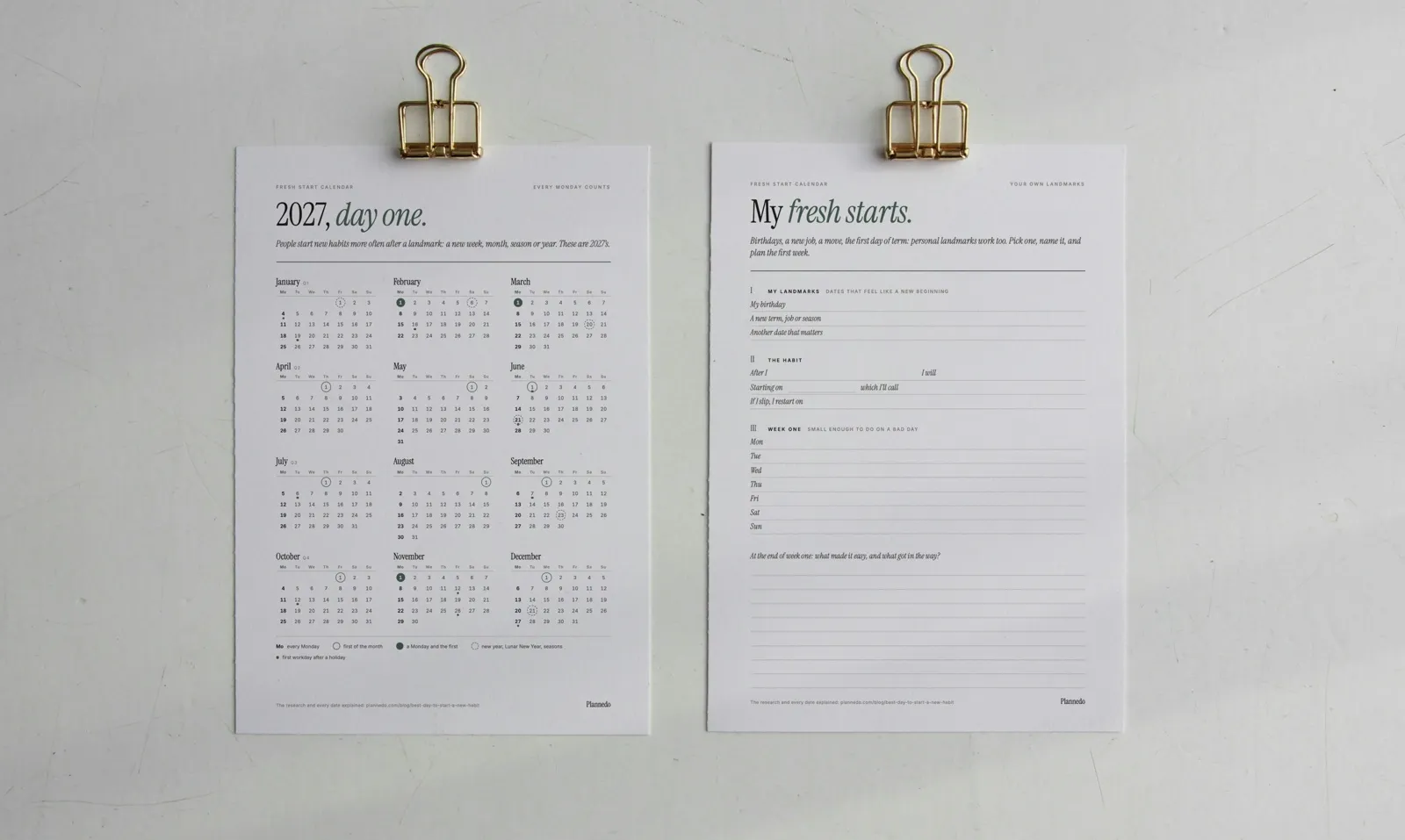
- Track it where you can see it. A visible history is feedback that a habit is forming long before it feels automatic. If you’d rather do it on paper, the free habit tracker printable makes a sheet with the right dates for any month; for an app, see the best habit tracker apps.
- Expect two to three months, and check in at day 66. Put a date in your calendar. If it still feels like effort, that’s normal for a habit at the slow end of the range, not a sign it isn’t working.
If the habit is part of a bigger goal, like a New Year’s resolution, the research on keeping those is in How to Stick to New Year’s Resolutions.
How long does it take to break a habit?
There’s much less research timing how long it takes to break a habit than to build one, and no reliable number. What habit research does suggest is that old habits are triggered by the same cues that build new ones, so the most dependable approach is to change or remove the cue rather than resist it every day: move the phone out of the bedroom instead of trying not to look at it. Replacing the old behaviour with a new one on the same cue tends to work better than leaving a gap.
Tracking a habit in Plannedo
I build Plannedo, a planner where habits sit next to your tasks rather than in a separate app. A few details were designed around the research above:
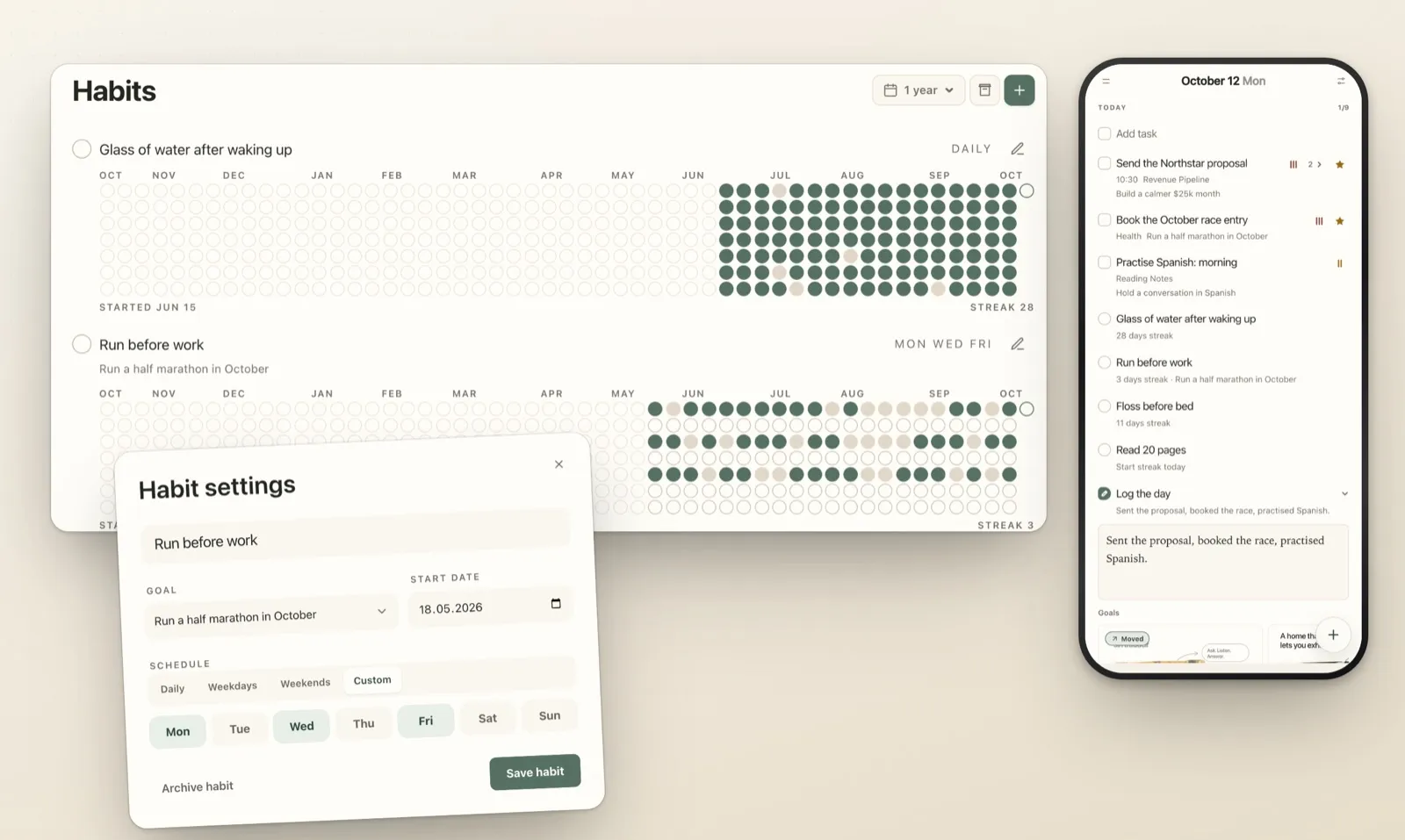
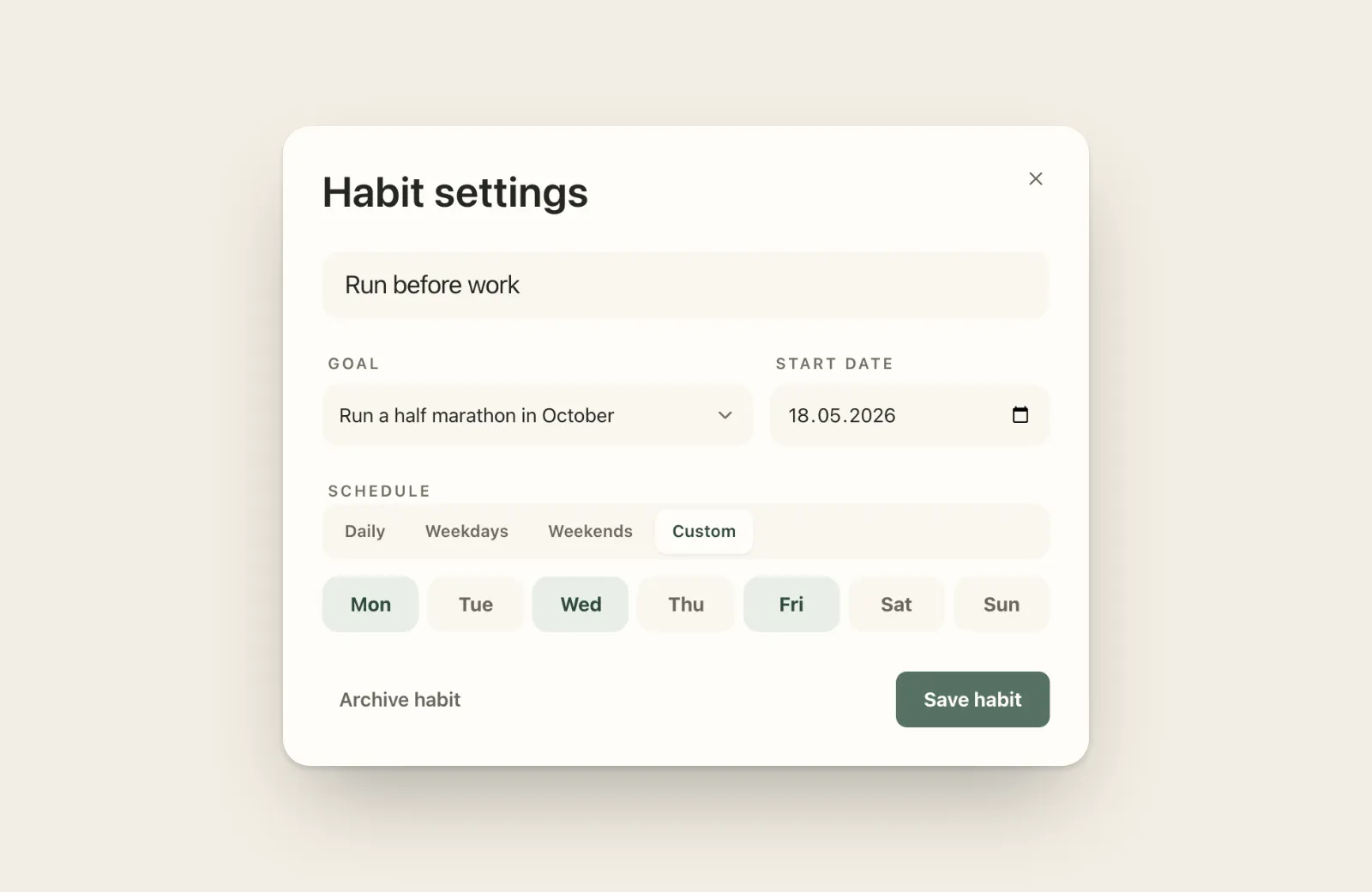
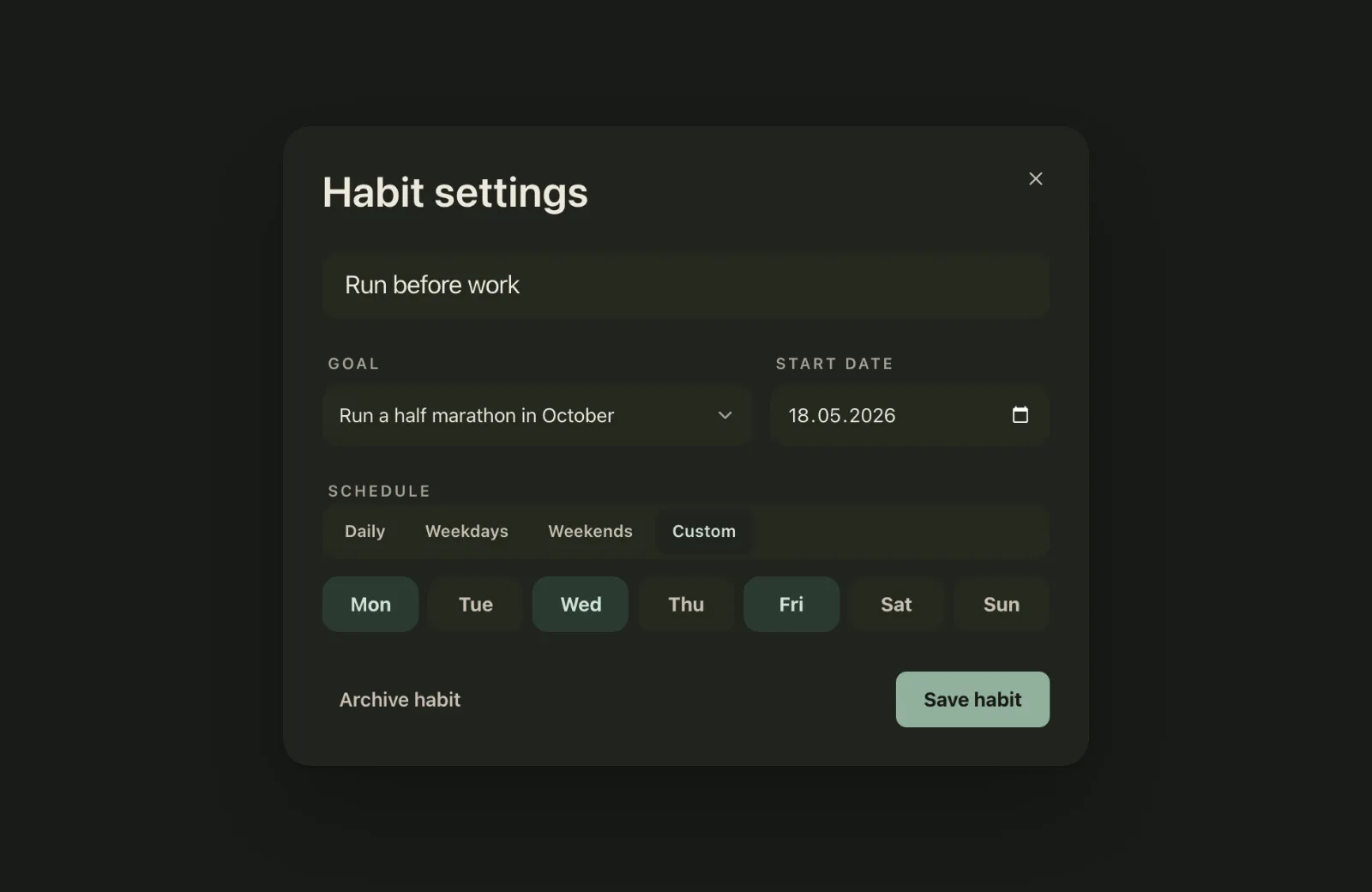
- Each habit has its own days. Daily, weekdays, weekends, or any days you pick. Days a habit isn’t scheduled don’t break its streak.
- The history matters more than the streak. The Habits screen shows four weeks, three months or a whole year at a glance, so a missed day shows up as one pale dot in a long row rather than a counter dropping to zero.
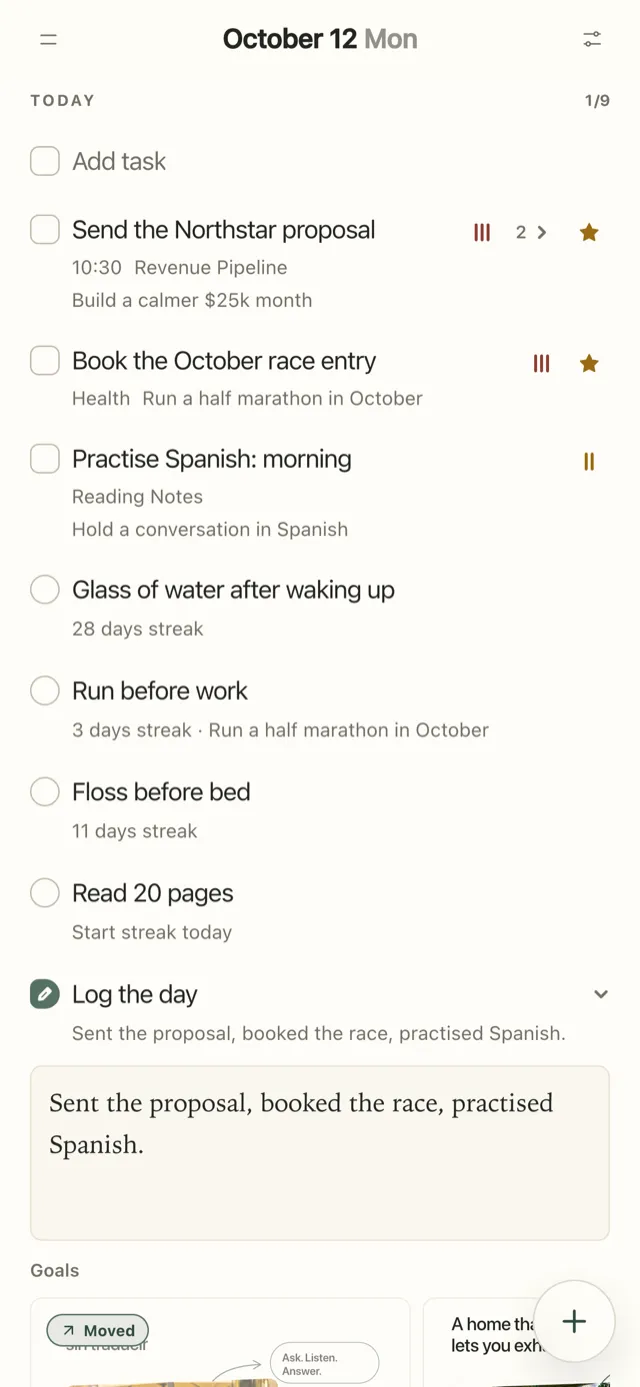
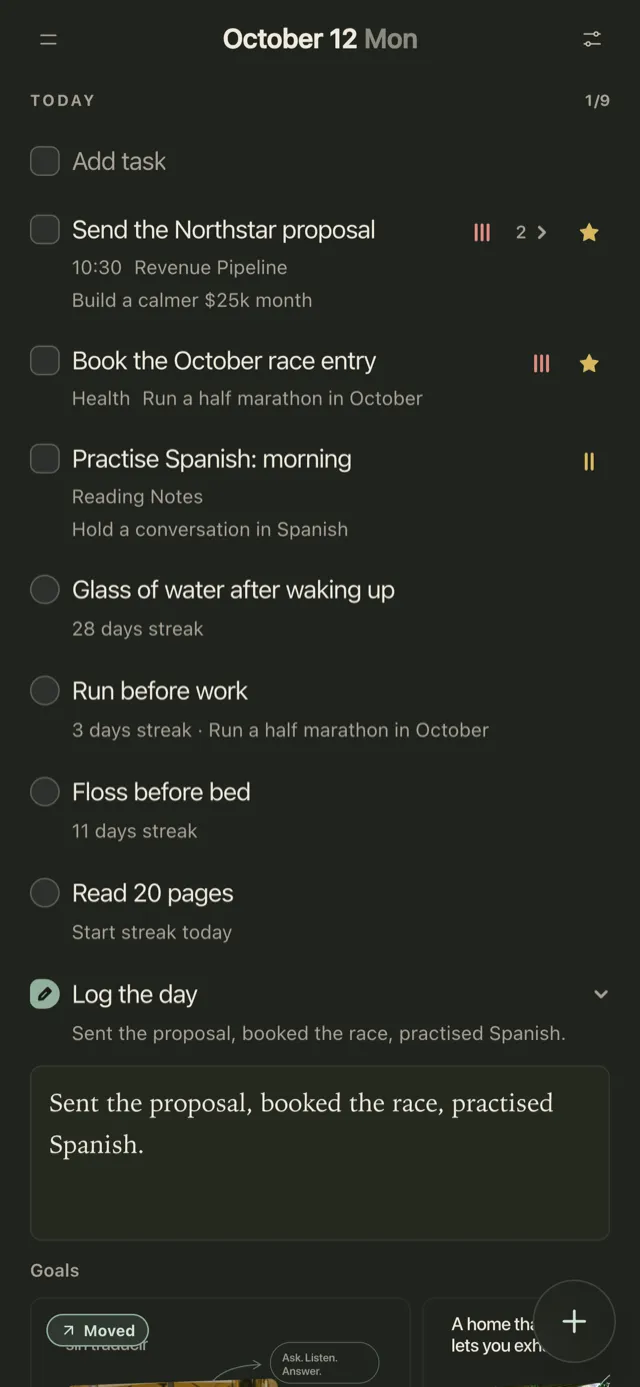
- Habits sit on your Today page with their streak, and on the iPhone and Mac widgets you can tick them off without opening the app.
- A habit can belong to a goal. Ticking “Run before work” also marks “Run a half marathon” as moved for that day.
The Free plan includes three habits with full history; Pro removes the limit. The details are in Habits and streaks, and if you’re choosing an app that keeps tasks, habits and a journal together, I compared the options in A To-Do List, Habit Tracker and Journal in One App.
FAQ
How long does it take to form a habit?
About two months on average. In the best-known study, a 2010 UCL experiment, the median was 66 days, with individual times from 18 to 254 days. A 2024 review of 20 studies found medians of 59 to 66 days and means of 106 to 154 days.
Is 21 days enough to form a habit?
Usually not. The 21-day figure comes from a 1960 self-help book by a plastic surgeon describing how long patients took to adjust to a change in appearance. Studies that measured habit formation directly found a median of around 66 days, though very simple habits can form in about three weeks.
What is the 21/90 rule?
It’s a popular idea that a habit takes 21 days to build and 90 days to become a permanent part of your life. Neither number comes from research. The closest evidence suggests about two months for a simple habit to feel automatic, and longer for complex ones like exercise.
How long does it take to form a habit of working out?
Longer than most habits. In a study of new gym members, exercising at least four times a week for six weeks was the minimum needed to establish the habit, and a 2023 analysis of more than 12 million gym check-ins found that a gym habit typically takes months to form.
Does missing a day reset a habit?
No. In the 2010 UCL study, missing a single day didn’t materially affect how the habit formed. Missing several days in a row is what tends to break the pattern, so after a miss, do it the next time it’s due.
How long does it take to break a habit?
There’s no reliable number, because breaking habits has been timed far less than building them. The most dependable approach is to change or remove the cue that triggers the old habit, and to put a new behaviour on that cue instead.
Studies mentioned
- Lally, P., van Jaarsveld, C. H. M., Potts, H. W. W., & Wardle, J. (2010). How are habits formed: Modelling habit formation in the real world. European Journal of Social Psychology, 40(6), 998-1009.
- Singh, B., Murphy, A., Maher, C., & Smith, A. E. (2024). Time to form a habit: A systematic review and meta-analysis of health behaviour habit formation and its determinants. Healthcare, 12(23), 2488.
- Buyalskaya, A., Ho, H., Milkman, K. L., Li, X., Duckworth, A. L., & Camerer, C. (2023). What can machine learning teach us about habit formation? Evidence from exercise and hygiene. Proceedings of the National Academy of Sciences, 120(17), e2216115120.
- Kaushal, N., & Rhodes, R. E. (2015). Exercise habit formation in new gym members: A longitudinal study. Journal of Behavioral Medicine, 38(4), 652-663.
- Wood, W., Quinn, J. M., & Kashy, D. A. (2002). Habits in everyday life: Thought, emotion, and action. Journal of Personality and Social Psychology, 83(6), 1281-1297.
- Gardner, B., Lally, P., & Wardle, J. (2012). Making health habitual: The psychology of ‘habit-formation’ and general practice. British Journal of General Practice, 62(605), 664-666.
- Maltz, M. (1960). Psycho-Cybernetics. Prentice-Hall.