WOOP Method: How to Use It, with Examples (+ Free Worksheet)
The WOOP method in five minutes: Wish, Outcome, Obstacle, Plan. Step-by-step instructions, ten examples, what the research says it does, and a free printable worksheet.
The WOOP method is a five-minute exercise for turning a wish into action. You name a Wish, imagine the best Outcome, imagine the main Obstacle inside you that could stop you, and make a Plan for it in the form “If [obstacle], then I will [action].” It was developed by psychologist Gabriele Oettingen at New York University from her research on mental contrasting.
The order is the whole trick. Picturing the outcome on its own feels good and, in Oettingen’s studies, tends to drain the energy you need. Picturing the obstacle right after it turns the wish into something you commit to, and the if-then plan tells you exactly what to do when the obstacle shows up. Below: the four steps, ten examples, what the research found, and a one-page worksheet to print.
What does WOOP stand for?
| Step | The question | Tip |
|---|---|---|
| Wish | What do you want? | Challenging, but within your power. Weeks or months away, not a life’s dream. |
| Outcome | What would be the best thing about reaching it? | Imagine it for a moment before you write. One outcome, the one that matters most to you. |
| Obstacle | What in you could stop you? | A habit, a feeling, an excuse. Something inside you, not the weather or your boss. |
| Plan | What will you do when the obstacle shows up? | “If [obstacle], then I will [action].” One small, concrete action. |
How to do WOOP, step by step
Find five quiet minutes. You can do it on paper, in your head or in an app; writing it down helps you come back to it.
1. Wish
Think of something you want in the coming weeks or months. The official WOOP guidance asks for a wish that is challenging but that you can actually fulfill. “Run a 10K in March” works; “be healthy” is too vague to plan for, and “win the Boston Marathon this year” isn’t up to you. Write it in a few words.
2. Outcome
Ask yourself what the single best result of reaching the wish would be, and how it would feel. Then picture it: the finish line, the feeling of not stopping, the quiet early runs that got you there. Give it a moment before you write it down. This step is where the motivation comes from, so don’t rush it.
3. Obstacle
Now ask: what is it in me that could stop me? Not the weather, not your schedule, not other people: your reaction to them. “When I get home late and tired, I tell myself I’ll run tomorrow.” “I open email before I start writing.” “I scroll in bed until midnight.” Find the one that matters most, and picture the moment it usually happens as clearly as you pictured the outcome.
This is the step most people want to skip, because it spoils the nice feeling from step 2. It’s also the step that makes WOOP work.
4. Plan
Decide on one action that gets you past the obstacle, and write it as an if-then plan:
If I get home after 7, then I’ll lay out my kit and run before work the next day.
The “if” is the obstacle, in the situation where it shows up. The “then” is a small, concrete action you can do right then. Keep it short enough to remember without looking.
If two obstacles feel equally strong, write a plan for each. If none of your plans feels doable, that’s useful too: it may be a sign to choose a smaller wish for now.
WOOP examples
| Wish | Obstacle (inside you) | Plan |
|---|---|---|
| Run a 10K in March | When I get home late and tired, I put the run off | If I get home after 7, then I’ll run before work the next day |
| Write the first draft of my thesis chapter | I check email first, and the morning is gone | If I sit down at my desk, then I’ll write for 30 minutes before I open email |
| Sleep by 11 | I take my phone to bed and keep scrolling | If it’s 10:30, then the phone goes on the charger in the kitchen |
| Save $3,000 by summer | I buy things when I’m bored | If I put something in my cart, then I’ll wait 24 hours before buying it |
| Speak up in meetings | I wait for the perfect moment, and it passes | If I have a thought in the first 10 minutes, then I’ll say it, even half-formed |
| Eat less sugar at work | I get a snack at 3 pm when I’m tired | If it’s 3 pm and I’m tired, then I’ll take a five-minute walk and have fruit |
| Call my parents every week | I think I’ll do it later and forget | If it’s Sunday after lunch, then I’ll call before I do anything else |
| Learn Spanish | I skip practice when I feel I’m not getting anywhere | If I feel like skipping, then I’ll do just one five-minute lesson |
| Finish the online course | I start new videos instead of finishing old ones | If I open the course, then I’ll finish the lesson I started before anything new |
| Get stronger | I don’t feel like the gym after work | If I don’t feel like it, then I’ll do 15 minutes of push-ups and squats at home |
Notice that every obstacle is something the person does, thinks or feels, and every plan is an action they can take in that very moment.
Why WOOP works: the research
Positive thinking alone can backfire
Oettingen spent years studying what happens when people fantasize about a future they want. In a 2002 set of studies with Doris Mayer, the people with the most positive daydreams, about landing a job after graduation or recovering from hip-replacement surgery, put in less effort and did worse than those with less rosy daydreams. Positive expectations, judging a good outcome as likely, did the opposite. The fantasy lets your mind enjoy the outcome before you’ve done the work. I wrote about these studies in Do Vision Boards Work?, because a vision board asks for exactly that kind of daydream.
Mental contrasting turns wishes into commitments, or lets them go
In 2001, Oettingen, Hyeon-ju Pak and Karoline Schnetter tested what happens when people imagine the future they want and then the reality standing in its way, which she calls mental contrasting. Across four experiments, people who contrasted committed strongly to wishes they thought they could reach, and only weakly to ones they didn’t. People who only fantasized, or only thought about the obstacles, committed moderately to everything, regardless of their chances.
That’s an underrated benefit: WOOP doesn’t just push you harder. It helps you drop the wishes that aren’t realistic right now and put your energy into the ones that are.
If-then plans make the action automatic
Peter Gollwitzer, also at NYU and Oettingen’s long-time collaborator, studies plans in the form “If situation X, then I’ll do Y”. He calls them implementation intentions. In a 2006 meta-analysis of 94 tests, Gollwitzer and Paschal Sheeran found that people who made plans like this were more likely to reach their goals than people who only set the goal, with a medium-to-large effect. The plan does the deciding in advance, so when the moment comes, you act instead of negotiating with yourself.
Together: what the WOOP studies found
WOOP is the everyday name for mental contrasting with implementation intentions, or MCII in the research papers. A few of the studies:
- Exercise. Gertraud Stadler, Oettingen and Gollwitzer gave 256 women aged 30 to 50 either health information alone or information plus a session on MCII. Over the next four months, the MCII group was about twice as physically active, nearly an hour more a week.
- Studying. Angela Duckworth and colleagues gave 66 high school students preparing for a high-stakes exam either a 30-minute written MCII exercise or a control exercise. The MCII group completed more than 60% more practice questions.
- School. In a study with 77 fifth graders from an urban middle school, children taught MCII improved their report card grades, attendance and conduct compared with children taught positive thinking.
How big is the effect, honestly?
Smaller than the most striking single studies suggest. A 2021 meta-analysis by Guoxia Wang, Yi Wang and Xiaosong Gai pooled 21 studies with 15,907 participants and found a small-to-medium effect on reaching goals (g = 0.34). The effect was larger when someone guided people through the exercise (g = 0.47) than when they did it from a written sheet (g = 0.28), and the authors note that publication bias may make the real effect smaller still.
So WOOP isn’t magic. It’s a five-minute exercise with a modest effect, which is still a very good trade. My reading of the gap between guided and written WOOP: the imagining is the active part, so take the outcome and obstacle steps slowly, and don’t just fill in the boxes.
Common WOOP mistakes
- An outside obstacle. “My job is too busy” can’t be planned for. “When work runs late, I skip my evening plans” can.
- A vague plan. “Then I’ll try harder” isn’t an action. “Then I’ll run before work the next day” is.
- Rushing the outcome. The outcome step is where the energy comes from. Give it a full minute.
- A wish that’s too big. If the wish is years away, WOOP a step of it: this month’s part of it.
- Doing it once. WOOP is meant to be repeated. Read your plan back in the morning, and redo the exercise when the obstacle changes.
WOOP vs SMART goals
| SMART goals | WOOP | |
|---|---|---|
| What it is | A checklist for how to word a goal | A mental exercise for pursuing one |
| Focus | Specific, Measurable, Achievable, Relevant, Time-bound | Wish, best outcome, inner obstacle, if-then plan |
| Deals with obstacles | No | Yes, it’s the core step |
| Research base | Goal-setting research on specific, challenging goals | Studies of mental contrasting and implementation intentions |
| Best for | Writing a clear goal | Making sure you act on it |
They work well together: write the wish as a SMART goal, then do the outcome, obstacle and plan steps. The full sequence, from choosing the goal to tracking it, is in how to set goals and achieve them.
Is WOOP the same as manifestation?
No, it’s closer to the opposite. Manifestation asks you to picture the outcome as if you already have it. WOOP keeps that picture but adds the step manifestation leaves out: the obstacle in you, and a plan for it. In Oettingen’s research, it’s the picture without the obstacle that tends to sap motivation.
How I use WOOP in Plannedo
I build Plannedo, a planner where every goal has a board, so this is how the four steps fit into it:
- Wish: the goal’s title, with a deadline (a date, month, quarter or year).
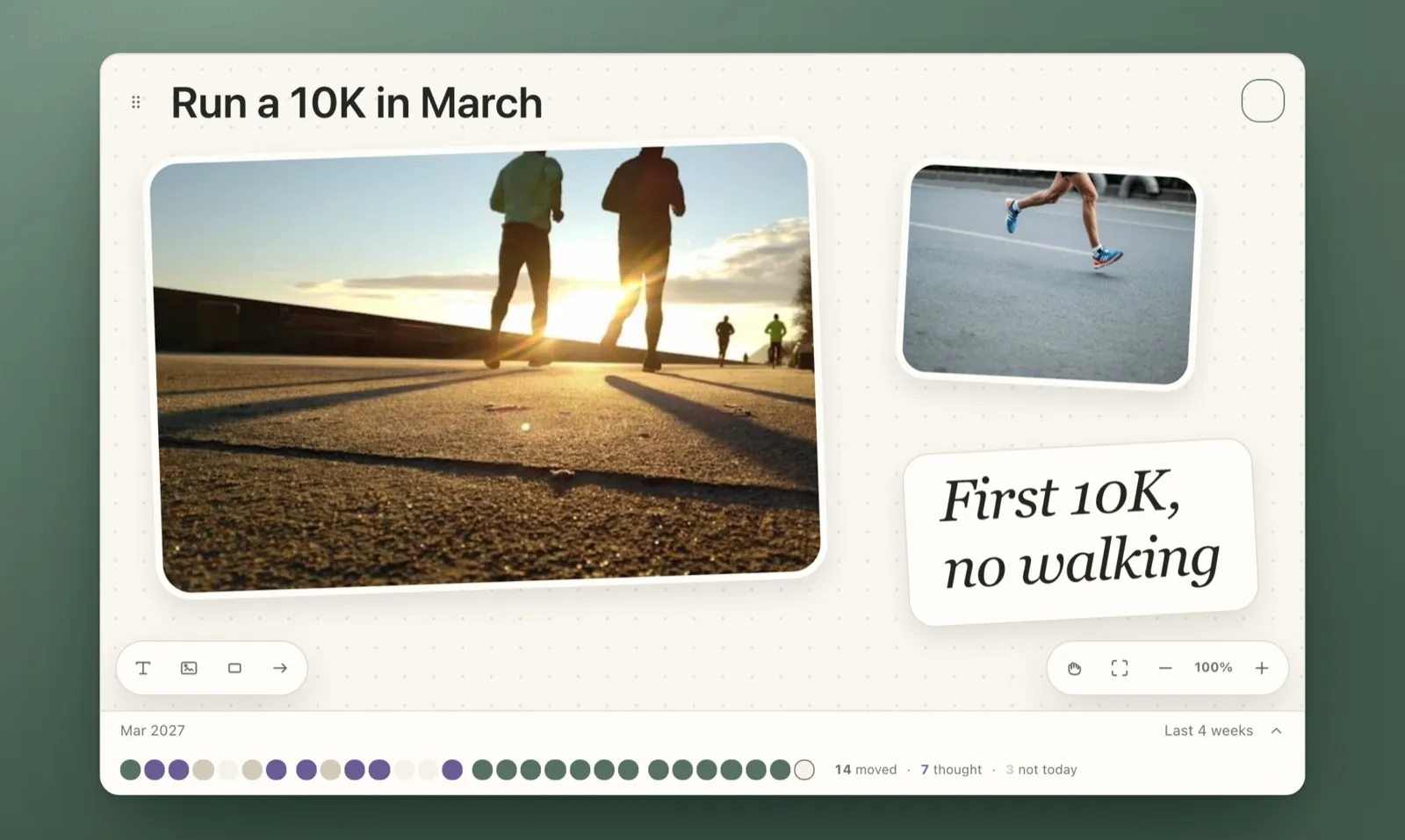
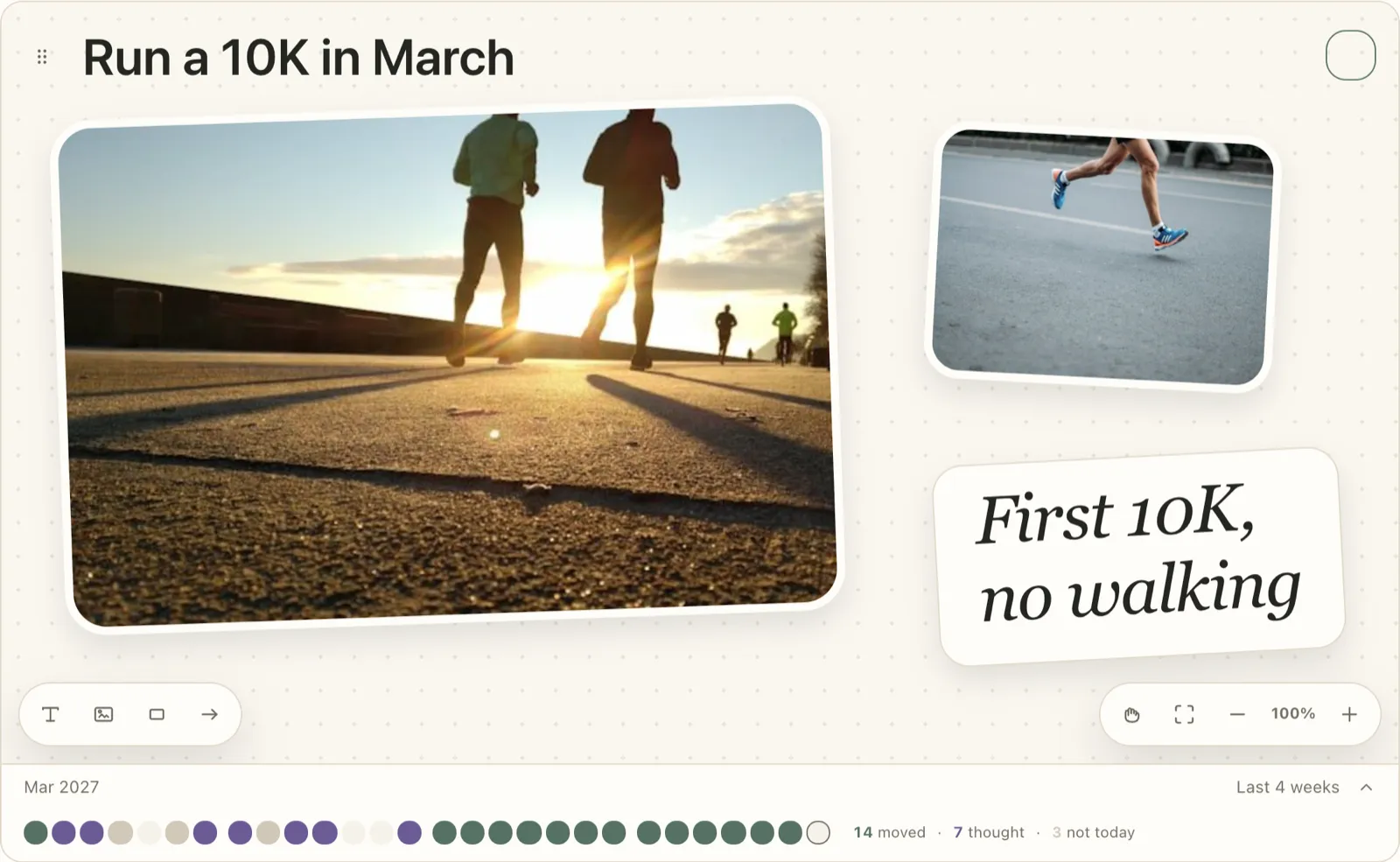
- Outcome: the board itself: a photo or two of the result and one handwritten line. See how to make a digital vision board.
- Obstacle and plan: written in the goal’s note, so they’re there every time you open it.
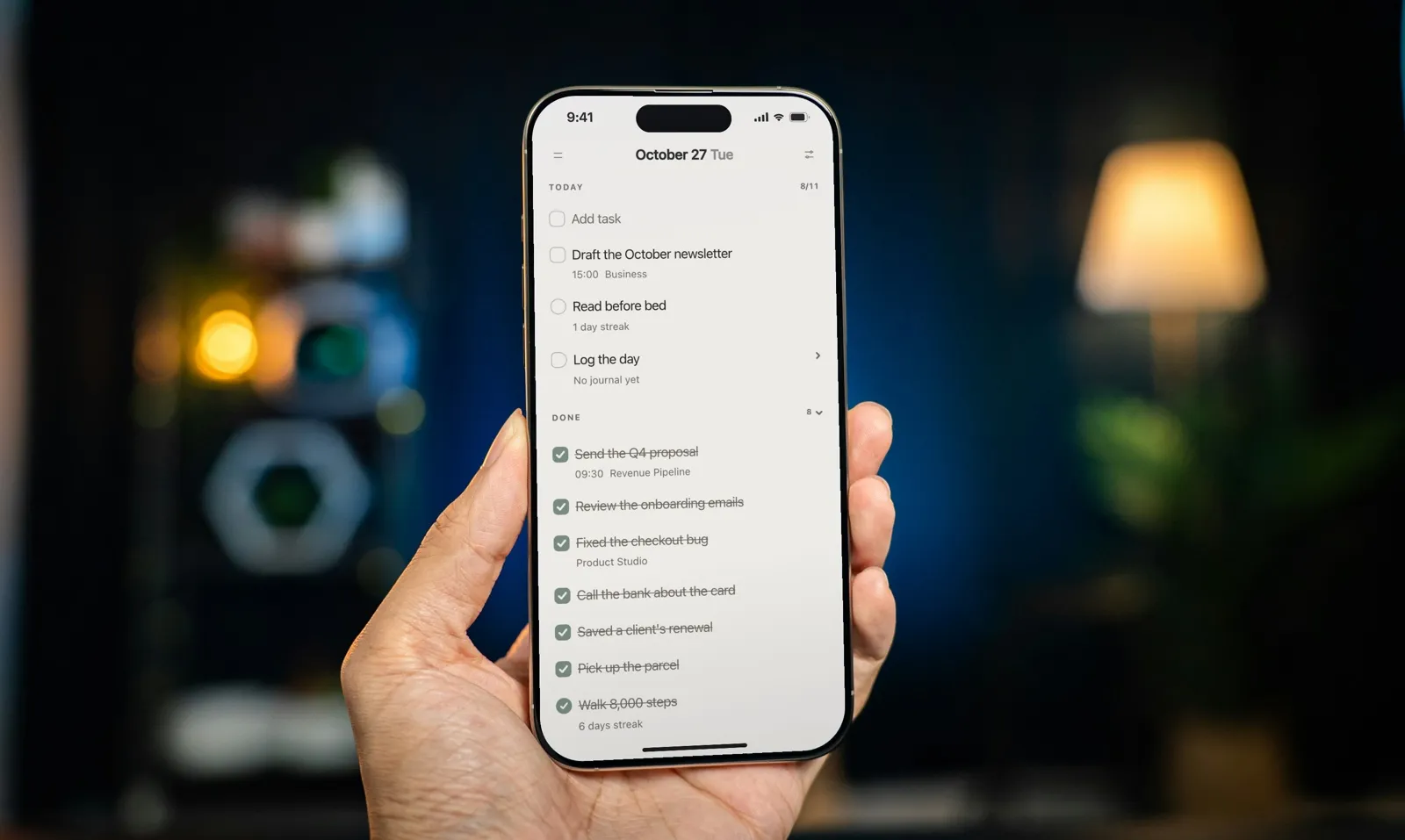
- The plan in action: a habit or task linked to the goal. Ticking it off marks the goal as moved for the day.
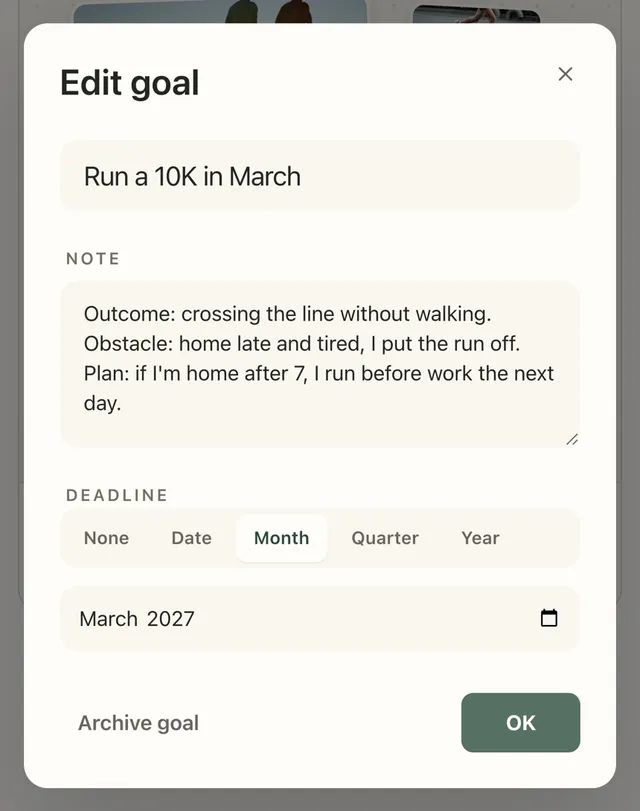
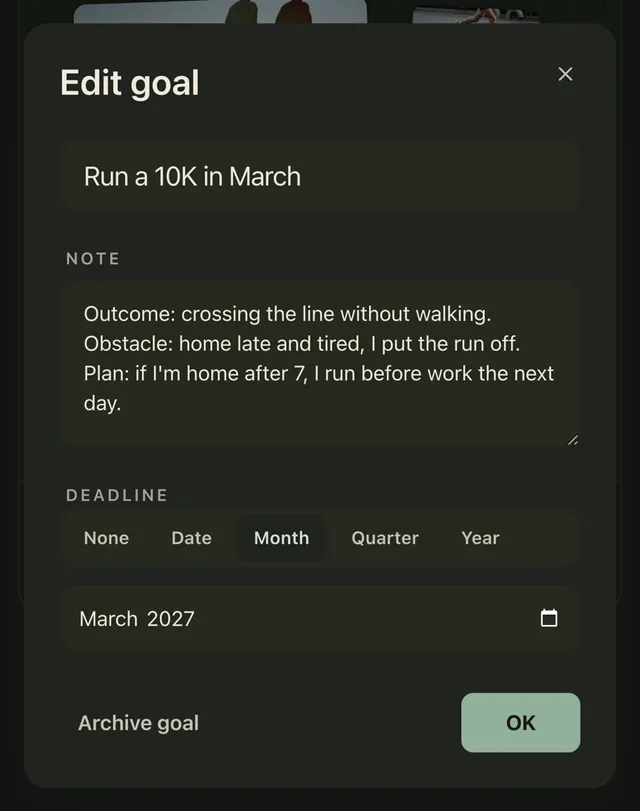
Every evening, Log the day asks whether each goal moved, and the row under the goal keeps four weeks of answers. That’s an honest test of whether your WOOP is working: if a goal shows weeks of “thought” and no “moved”, the obstacle or the plan needs another look.

If you’d like the board without an account, the free vision board maker has a “This week” card under the board with the same if-then line.
FAQ
What does WOOP stand for?
Wish, Outcome, Obstacle, Plan. You name a wish, imagine its best outcome, identify the main obstacle inside you, and make an if-then plan for it.
How long does WOOP take?
About five minutes for a goal you care about. Oettingen’s own guidance says a quick WOOP for a small, immediate problem can take less than a minute, and important decisions deserve more time.
Does the WOOP method work?
Yes, with a modest effect. Studies found more exercise, more studying and better grades after WOOP, and a 2021 meta-analysis of 21 studies with nearly 16,000 people found a small-to-medium effect on reaching goals, larger when someone guided people through it.
What is an example of a WOOP goal?
Wish: run a 10K in March. Outcome: crossing the line without walking. Obstacle: when I get home late and tired, I put the run off. Plan: if I get home after 7, then I’ll run before work the next day.
What is the difference between WOOP and SMART goals?
SMART describes how to word a goal; WOOP is an exercise for acting on it, built around the obstacle in you and an if-then plan. Use SMART to write the wish and WOOP to follow through.
Is there a WOOP app?
Yes. The official WOOP app by Gabriele Oettingen is free on the App Store, and there’s a free WOOP worksheet to print above. In Plannedo, the wish becomes a goal, the obstacle and plan go in its note, and linked habits and the evening check-in show whether the plan is working.
Studies mentioned
- Oettingen, G., & Mayer, D. (2002). The motivating function of thinking about the future: Expectations versus fantasies. Journal of Personality and Social Psychology, 83(5), 1198-1212.
- Oettingen, G., Pak, H., & Schnetter, K. (2001). Self-regulation of goal setting: Turning free fantasies about the future into binding goals. Journal of Personality and Social Psychology, 80(5), 736-753.
- Gollwitzer, P. M., & Sheeran, P. (2006). Implementation intentions and goal achievement: A meta-analysis of effects and processes. Advances in Experimental Social Psychology, 38, 69-119.
- Stadler, G., Oettingen, G., & Gollwitzer, P. M. (2009). Physical activity in women: Effects of a self-regulation intervention. American Journal of Preventive Medicine, 36(1), 29-34.
- Duckworth, A. L., Grant, H., Loew, B., Oettingen, G., & Gollwitzer, P. M. (2011). Self-regulation strategies improve self-discipline in adolescents: Benefits of mental contrasting and implementation intentions. Educational Psychology, 31(1), 17-26.
- Duckworth, A. L., Kirby, T. A., Gollwitzer, A., & Oettingen, G. (2013). From fantasy to action: Mental contrasting with implementation intentions (MCII) improves academic performance in children. Social Psychological and Personality Science, 4(6), 745-753.
- Wang, G., Wang, Y., & Gai, X. (2021). A meta-analysis of the effects of mental contrasting with implementation intentions on goal attainment. Frontiers in Psychology, 12, 565202.
- Oettingen, G. (2014). Rethinking Positive Thinking: Inside the New Science of Motivation. Current. The official guide is at woopmylife.org.
Photo credits
The photos on the example board are from Unsplash: Huckster and sporlab.