Ta-Da List: Why a Done List Works Better Than a To-Do List
A ta-da list is a list of what you got done today. Why it beats a to-do list at the end of the day, what the research says, and a free printable template.
A ta-da list is a list of what you’ve already done today, written as you finish each thing or in two minutes at the end of the day. A to-do list shows what’s left; a ta-da list shows what you got through, including the work that was never on any list: the call that ran long, the bug someone flagged at eleven, the favour for a neighbour. The name is a pun. A to-do becomes a “ta-da!” once it’s done.
It works better than a to-do list at one particular job: ending the day. In a study of nearly 12,000 daily diary entries from 238 people at work, progress happened on 76% of their best days, and a done list is the simplest way to see your own progress. This guide covers where the idea comes from, what the research says (including when not to write one), how to keep it, examples, and a free printable template.
What is a ta-da list?
A ta-da list, also called a done list, an accomplishment list or a reverse to-do list, records finished tasks instead of planned ones. You don’t decide in advance what goes on it. Anything you complete counts: planned work, unplanned work, chores, a difficult conversation, the walk you nearly skipped.
The idea is older than the name. In 2007, Marc Andreessen described an “Anti-Todo List” in the Pmarca Guide to Personal Productivity. The method: each night, write the three to five things you’ll do the next day on a 3x5 index card. On the back of the card, write down everything useful you do, as you do it, and at the end of the day read the card before preparing the next one. Andreessen called it the answer to those exhausting days when you get home and can’t say what you actually did.
In 2017, Gretchen Rubin recommended the same habit on episode 134 of the Happier podcast, for anyone who feels weighed down by their to-do list, and called it a ta-da list. That name stuck.
Ta-da list vs to-do list
| To-do list | Ta-da list | |
|---|---|---|
| What it shows | What’s left | What you did |
| When you write it | Before the work: in the morning or the night before | During the day, or in one sweep at the end |
| What it misses | Everything that wasn’t planned | Nothing, as long as you write it down |
| How it ends the day | With the unfinished items | With a record of the day |
| Best for | Deciding what to do next | Seeing progress, closing the day, remembering at review time |
They aren’t rivals. A to-do list is a plan and a ta-da list is a record; you need a plan to start the day and a record to end it. The trouble is that most of us only keep the plan, so the only feedback a busy day ever gives us is the list of things we didn’t get to. Finished items get crossed out and fade from view, while the unfinished ones stay on top.
Why a done list works
Progress is what makes a good workday
Teresa Amabile and Steven Kramer asked 238 people on 26 project teams in seven companies to fill in a short diary every workday, and collected nearly 12,000 entries. When they compared people’s best days with their worst, one event stood out. Progress in the work happened on 76% of the best-mood days, and setbacks on only 13% of them. On the worst-mood days, it flipped: setbacks on 67%, progress on 25%.
The progress didn’t have to be big. Even ordinary, incremental steps forward could lift people’s engagement and their mood for the day. Amabile and Kramer called this the progress principle. When they asked 669 managers to rank five things that motivate people at work, most put support for progress dead last, and only 5% put it first.
Here is the catch: progress only helps if you notice it. On a crowded day you usually don’t, and a to-do list makes it harder, because it’s built to show what’s missing. A ta-da list puts the progress where you can see it. Amabile and Kramer’s own daily checklist for managers opens the same way, by asking which one or two events of the day were a small win or a possible breakthrough.
It counts the work no plan saw coming
Most days don’t go to plan. A colleague needs an answer, a client calls, a pipe leaks, school sends a form that’s due tomorrow. That work is real, and on a to-do list it’s invisible: it was never written down, so it can never be crossed off.
A ta-da list catches it. This is also why it’s honest about “lost” days. You didn’t write the report, but you fixed the thing that broke, talked a client out of leaving and got the card unblocked. If you mark the unplanned items, a week of ta-da lists shows how much of your time goes to work no plan ever includes, and that’s worth knowing when you plan the next week.
Writing down what went well is a tested habit
In 2005, Martin Seligman, Tracy Steen, Nansook Park and Christopher Peterson tested five short exercises against a placebo in a randomized online study. One of the two exercises with the longest-lasting effects was “Three Good Things”: every night for one week, write down three things that went well that day and their causes. It raised happiness and lowered depressive symptoms long after the week ended.
A 2012 replication by Myriam Mongrain and Tracy Anselmo-Matthews is worth knowing too. The exercises raised happiness again, but so did a “positive placebo” that simply had people bring positive information about themselves to mind, and the effect on depression was no better than the control’s. A fair reading: noticing what went well lifts mood, and the exact format matters less than doing it. A ta-da list is a version of that habit with the bar set lower. It doesn’t ask for good things, only done things.
One caveat: don’t write it in bed
Timing matters. In a 2018 sleep-lab study, Michael Scullin and colleagues had 57 young adults write for five minutes before lights out. Those who wrote a to-do list for the coming days fell asleep about nine minutes faster than those who wrote about tasks they had already completed.
So write the ta-da list when the working day ends or early in the evening, then finish with one line for tomorrow. If you write anything in bed, make it a short, specific to-do list; planning your day the night before covers that routine.
How to keep a ta-da list
- Keep it where you already are. A sheet on the desk, a note on your phone, your planner. If writing something down takes more than ten seconds, you’ll stop doing it.
- Write as you go, or in one sweep. Writing as you go catches more. The end-of-day sweep takes two minutes: scroll through your calendar, sent mail and messages, and write what got done.
- Write results, in the past tense. “Sent the Q4 proposal”, not “proposal”. “Got the card unblocked”, not “bank”. The past tense turns a reminder into a record, and specific results are easier to find later.
- Count everything, then mark what mattered. The dishwasher and the awkward email both go on. Then circle the one item that moved something important forward, because the progress principle is about meaningful work.
- Star what wasn’t planned. After a week, the stars show where your time really goes.
- Read it back, then close the day. Read the whole list before you look at tomorrow, then write one line: tomorrow, first thing.
- Read the week on Friday or Sunday. Five minutes. Pick the week’s best ta-da and carry it into your weekly review.
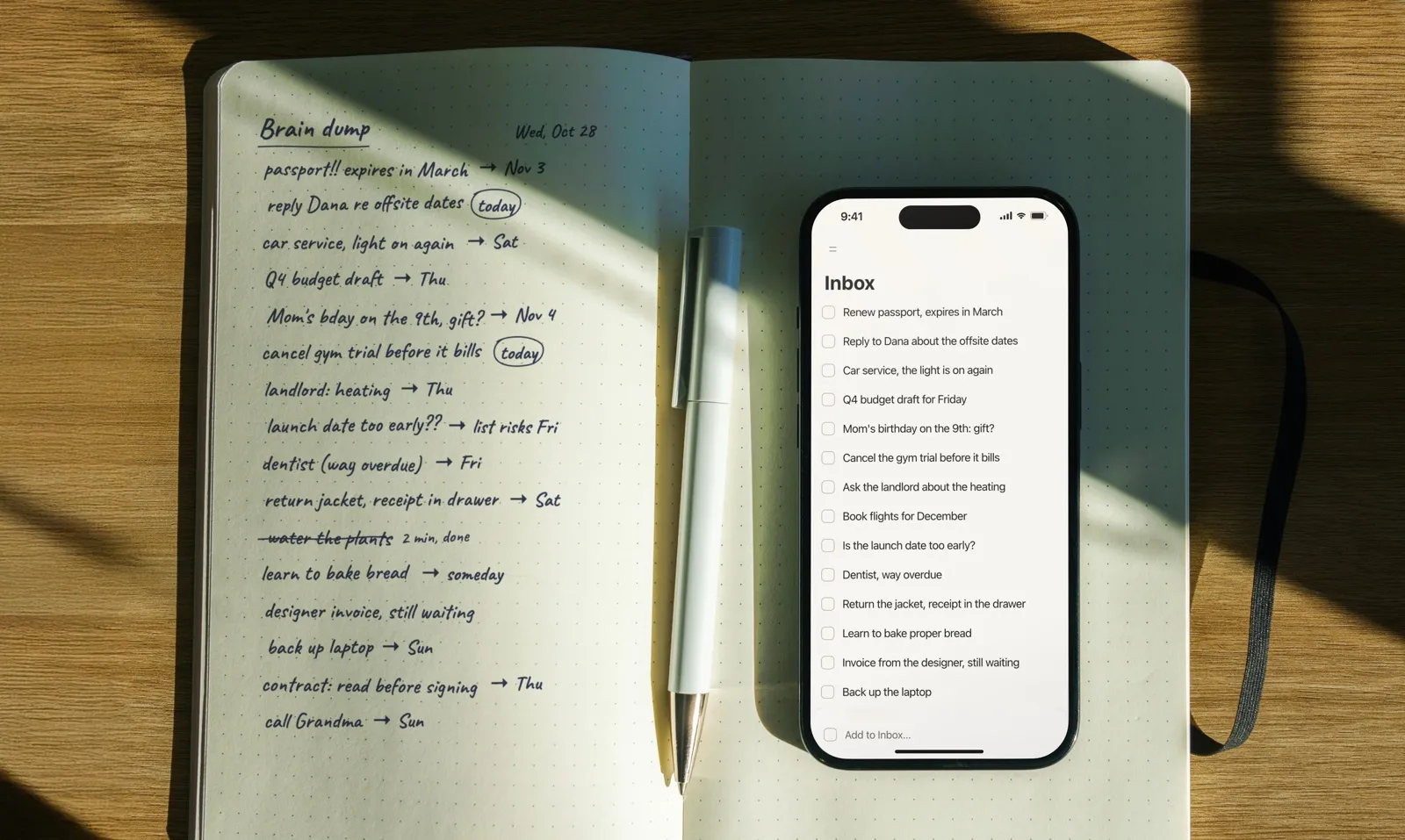
If your to-do list has grown into a heap of everything, a brain dump sorts it back into a plan. A few things to avoid. Don’t turn it into a scoreboard: twelve items isn’t a better day than four if one of the four was the hard one. Don’t keep it for work only. And don’t drop your to-do list; a record of the day is no substitute for a plan for it.
Ta-da list examples
Anything finished counts. Some lines from real days:
- Work: Sent the proposal two days early. Fixed the bug support flagged. Cleared 40 emails. Said no to a meeting with no agenda. Wrote the first 300 words of the report.
- Home: Booked the dentist. Paid the electricity bill. Fixed the wobbly chair. Cooked instead of ordering in.
- Health: Walked 20 minutes at lunch. In bed by eleven. Took the stairs all day.
- People: Called my mother. Helped a neighbour carry a sofa. Answered the message I’d been putting off for a week.
- You: Read ten pages. Started the tax form. Rested for an hour without feeling guilty about it.
Ta-da list template (free printable)
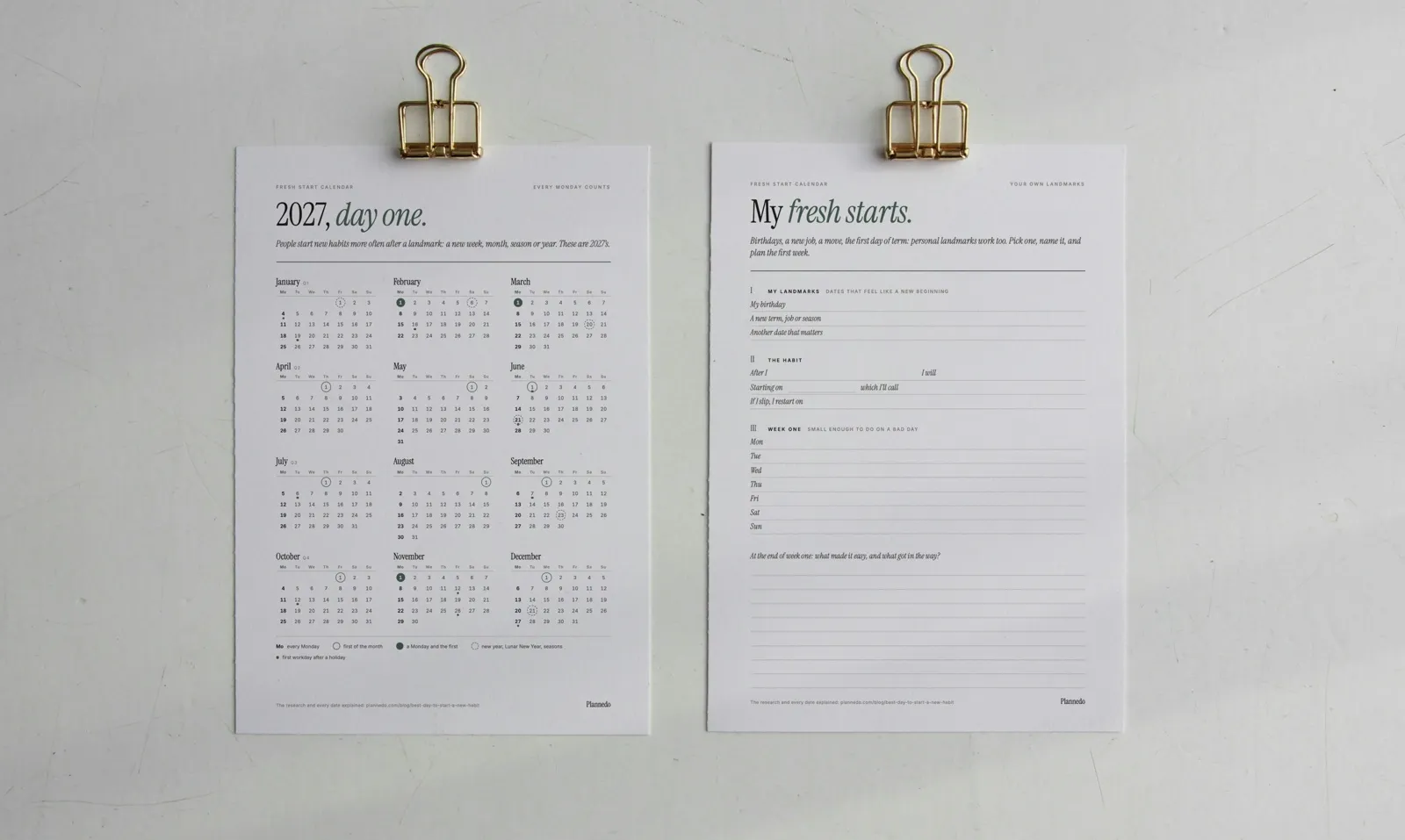
Our ta-da list template is one sheet with two sides. The front is a day, “Look what got done”: two or three things that matter at the top, a numbered ta-da list in two columns, and three lines for the evening: the one that mattered most, what made it possible, and tomorrow’s first thing. The back is a week: three lines for each day, the week’s best, and four questions for reading the week back. You can print it or type straight into the PDF.
When a ta-da list helps most
- On days that went off the plan. The to-do list says you failed; the ta-da list shows what you did instead.
- For work that doesn’t show. Managing people, support, admin and caring for someone are mostly invisible on a to-do list, because the job is responding, not ticking off.
- Before a review or a one-on-one. In the 2019 post “Get your work recognized: write a brag document”, software engineer Julia Evans argues for keeping a running record of what you did at work, because by review time nobody remembers it, including you. A month of ta-da lists is that record, already written.
- On long projects. When the finish line is months away, the days in between can feel like nothing happened. A ta-da list shows the steps. For goals with distant deadlines, how to set goals covers breaking them into weekly steps.
- When the to-do list has become a weight. That’s the case Rubin made for it: some days the list of what’s left is the last thing you need.
If you prefer to end the day with a sentence rather than a list, a one line a day journal does a similar job in prose.
A ta-da list in Plannedo
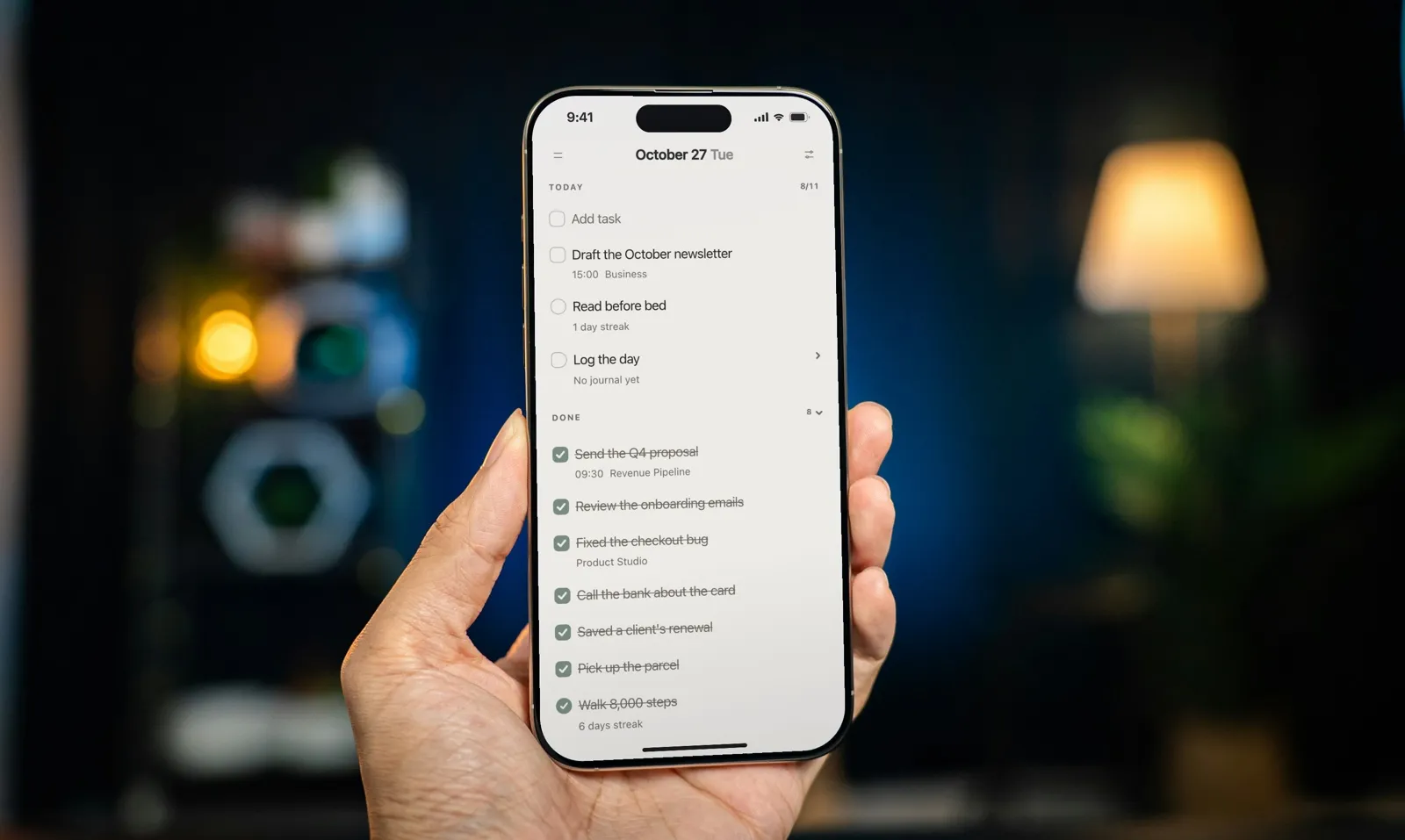
In Plannedo, the Today screen keeps a ta-da list for you as the day goes. Tick a task or a habit and it moves into Done at the bottom of the day, with a count, so the open part of the list stays short and what you finished stays in view. When you do something that was never planned, add it and tick it straight away: it joins the rest in Done.
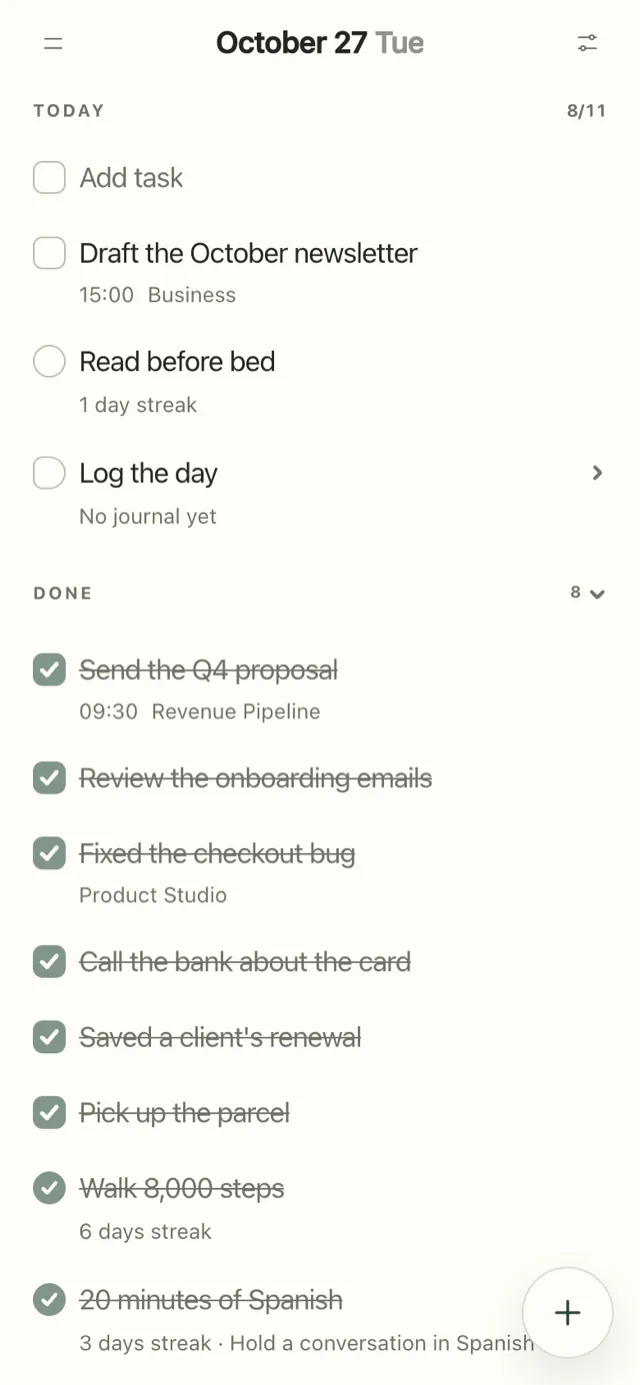
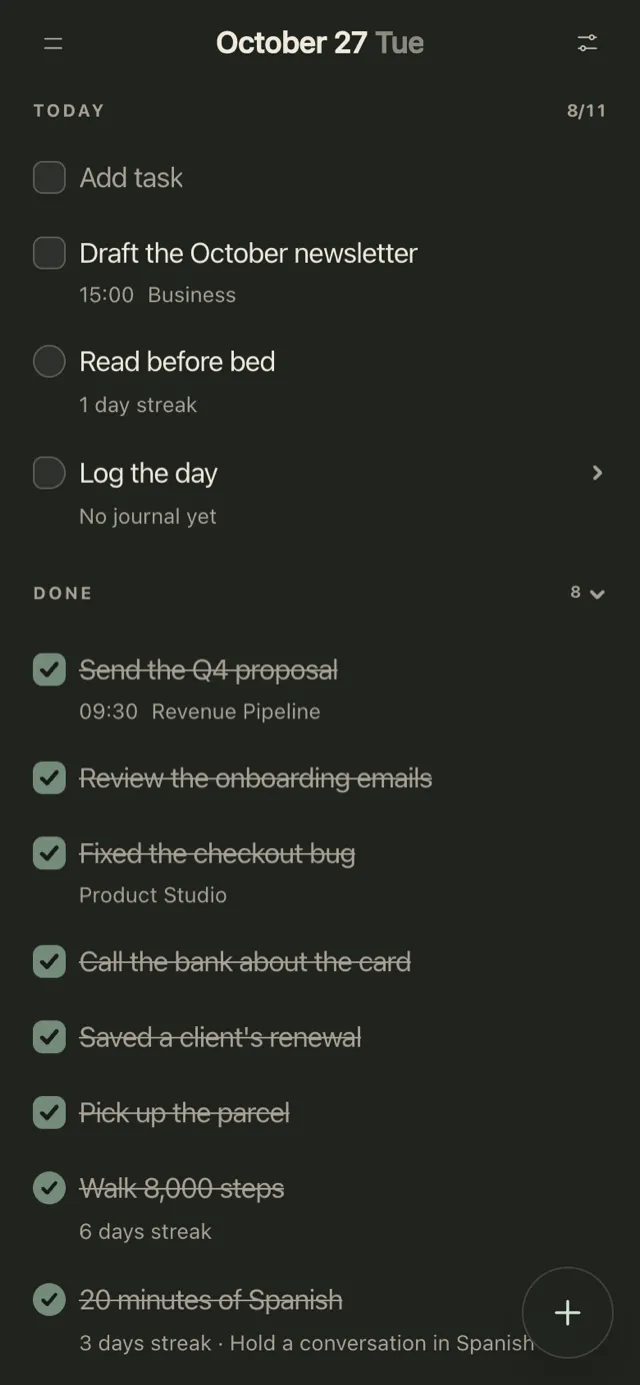
In the evening, Log the day on Today opens a short reflection. On the Journal page, the same entry sits next to that day’s tasks and habits, with the finished ones crossed out, so the record and your note about it share one page, and you can go back to any day later. Writing the entry as a ta-da list takes two minutes, and on an empty day the Journal’s prompt already asks the right question: what did you do today?
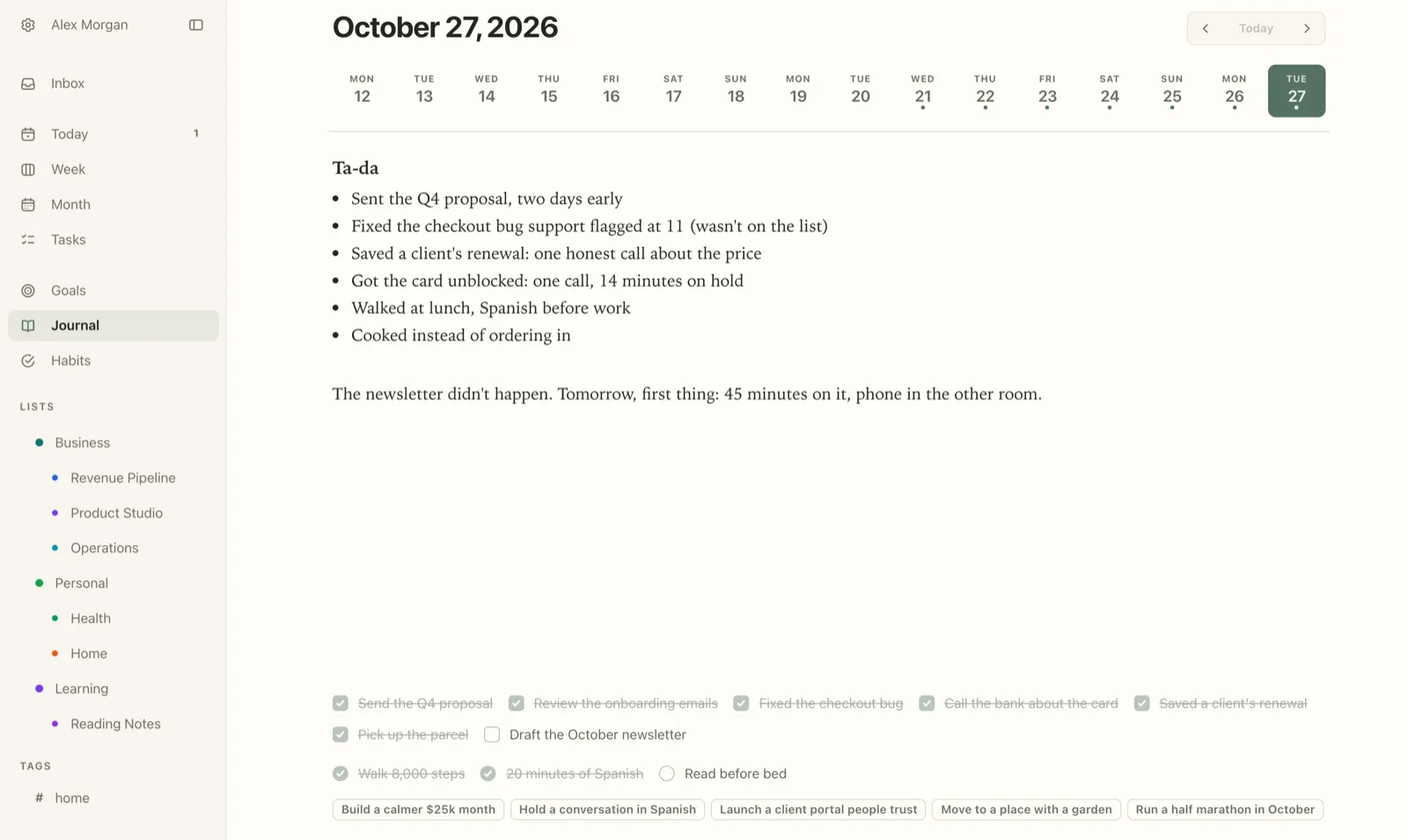
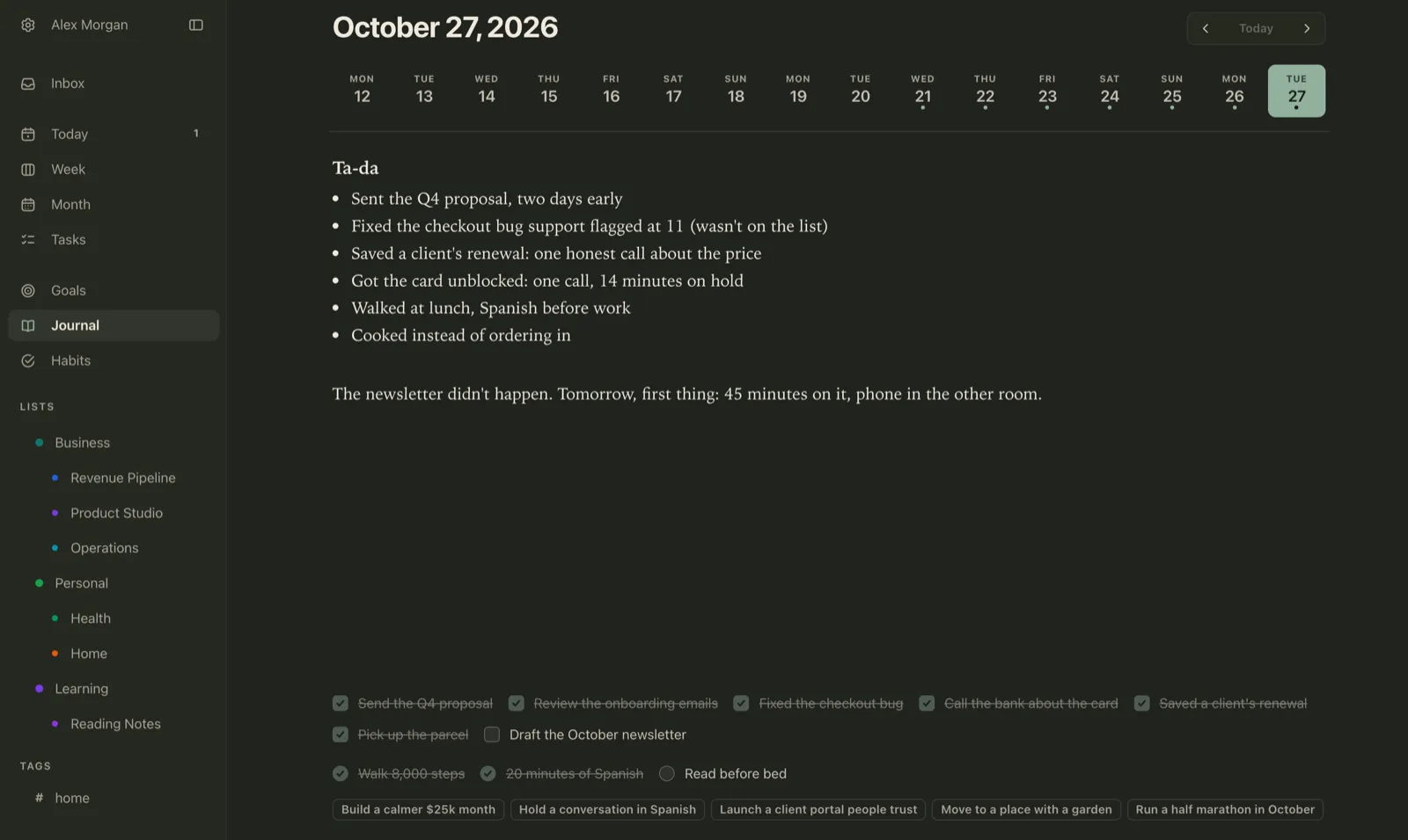
More on both screens in the help centre: Today and Journal.
FAQ
What is a ta-da list?
A ta-da list is a list of things you’ve already done, written as you finish them or at the end of the day. It’s the opposite of a to-do list: instead of showing what’s left, it shows what you got through, planned or not. The name plays on “to-do” and the “ta-da!” of a finished trick.
What’s the difference between a to-do list and a ta-da list?
A to-do list is written before the work and shows what’s left; a ta-da list is written during or after the work and shows what you did. The to-do list helps you decide what to do next. The ta-da list helps you see your progress and end the day, and it includes the unplanned work a to-do list never shows.
Is a ta-da list the same as a done list?
Yes. Done list, accomplishment list, reverse to-do list and Marc Andreessen’s “anti-todo list” all describe the same habit: writing down what you’ve completed instead of what you plan to do.
When should I write a ta-da list?
As you go during the day, or in a two-minute sweep when work ends. Avoid writing it in bed: in a sleep-lab study, people who wrote about completed tasks before lights out fell asleep about nine minutes later than people who wrote a to-do list for the coming days.
What should I put on a ta-da list?
Everything you finished: planned tasks, unplanned work, chores, calls, errands, exercise, a hard conversation. Write results in the past tense, like “Sent the proposal”, then circle the one item that mattered most and star anything that wasn’t planned.
Should a ta-da list replace my to-do list?
No. Use both. The to-do list plans the day and the ta-da list records it. A good rhythm is a short to-do list in the morning or the night before, a ta-da list through the day, and one line for tomorrow when you read the ta-da list back.
Is a ta-da list good for ADHD?
There’s no research on ta-da lists and ADHD specifically. The habit is popular in ADHD communities, and ADDitude magazine has published a guest post calling the ta-da list the antidote to to-do list shame, because it shows the day’s work instead of the gaps. It costs nothing to try, and it doesn’t replace treatment or support.
Is there an app for a ta-da list?
Any notes app works. In Plannedo, ticked tasks and habits move into a Done section on Today with a count, unplanned things can be added and ticked on the spot, and the Journal keeps each day’s note next to that day’s tasks.
Sources
- Amabile, T. M., & Kramer, S. J. (2011). The power of small wins. Harvard Business Review, May 2011.
- Seligman, M. E. P., Steen, T. A., Park, N., & Peterson, C. (2005). Positive psychology progress: Empirical validation of interventions. American Psychologist, 60(5), 410-421.
- Mongrain, M., & Anselmo-Matthews, T. (2012). Do positive psychology exercises work? A replication of Seligman et al. (2005). Journal of Clinical Psychology, 68(4), 382-389.
- Scullin, M. K., Krueger, M. L., Ballard, H. K., Pruett, N., & Bliwise, D. L. (2018). The effects of bedtime writing on difficulty falling asleep: A polysomnographic study comparing to-do lists and completed activity lists. Journal of Experimental Psychology: General, 147(1), 139-146.
- Andreessen, M. (2007, June 4). Pmarca guide to personal productivity.
- Rubin, G. (2017, September 13). Podcast 134: Write a “ta-da” list. Happier with Gretchen Rubin.
- Evans, J. (2019, June 28). Get your work recognized: write a brag document.
- The ta-da list is the antidote to to-do list shame. ADDitude.