Do Vision Boards Work? What the Research Says
A vision board on its own can drain the energy you need to reach a goal. Here is what the studies found, and six changes that make a board pull its weight.
Short answer: not on their own. A board full of pictures of the life you want can make you feel good tonight and slightly less likely to get there. That isn’t a guess. It follows from about thirty years of research on how people think about the future, much of it by the psychologist Gabriele Oettingen at New York University and the University of Hamburg.
The longer answer is more useful. The same research shows which kind of picturing does help, and a board can be rebuilt around it in one evening.
I’m Paul. I build Plannedo, a planner where every goal is a board, so I’ve spent a lot of time with this question. The product gets one section near the end. Everything before it works just as well with a cork board and sticky notes.
Where vision boards came from
The modern vision board took off after The Secret, Rhonda Byrne’s 2006 film and book about the “law of attraction”: picture what you want, often and vividly, and it comes to you. Pinterest did the rest, and every January brings a new wave of templates and apps.
The law of attraction has no scientific support. A softer version sounds reasonable, though: if you look at your goal every day, you’ll stay motivated. That version can be tested, and psychologists have tested it many times.
What the research says about picturing your goal
Nobody has run a large trial on vision boards as such. What researchers have studied, again and again, is the thing a vision board asks you to do: imagine the finished result in pleasant detail. Oettingen calls this positive fantasy, and the findings line up.
Graduates looking for work. In a 2002 study, Oettingen and Doris Mayer asked German university students how often they had pleasant daydreams about graduating and landing a job. Two years later, the students with the rosiest daydreams had sent out fewer applications, received fewer job offers and were earning less. The same paper found the pattern in three other groups: students with a crush on someone, students facing an exam, and patients recovering from hip replacement surgery.
Experiments, not just surveys. A link like that could have other explanations, so in 2011 Heather Kappes and Oettingen ran experiments in which they told people what to imagine. Participants asked to picture an ideal outcome ended up with less energy than those asked to picture something neutral, something negative, or the same outcome with doubts about it. In one study energy was measured through blood pressure, and it dropped. In another, people who fantasized about a perfect week got less of that week’s plans done. The drop was larger when the fantasy concerned something the person badly needed at that moment.
Why it happens. When you picture a goal as already reached, part of you relaxes as though you had reached it. You get a small taste of the reward, and the effort the real goal needs never gets switched on. That pleasant, settled feeling is exactly what makes a vision board nice to look at.
A board isn’t useless, then. The trouble is the default board, a collage of finished outcomes, because it trains you to enjoy the goal rather than prepare for it.
The kind of picturing that does help
Four findings point the other way, and together they describe a better board.
Picture the process, not only the prize. In a 1999 study at UCLA, Lien Pham and Shelley Taylor asked students in the run-up to an exam to rehearse one of two mental pictures. One group imagined getting a high grade. The other imagined themselves studying in the way that would earn one. The students who pictured the process planned more, felt less anxious about the exam and got better grades than those who pictured the result.
Picture the obstacle right after the prize. Oettingen’s own remedy for positive fantasy is called mental contrasting. You imagine the outcome you want, then straight away imagine the main thing in you that stands in its way: a habit, a fear, the time of day when you always give up. Holding both pictures, in that order, connects the wish to the reality you’ll have to push through. In her studies this raised commitment to goals that were realistic, and it helped people let go of goals that weren’t.
Decide in advance what you’ll do when it happens. Peter Gollwitzer, also at NYU, studies plans written in an if-then form, such as “If it’s raining at 7, I’ll run on the treadmill.” He calls them implementation intentions. A 2006 meta-analysis by Gollwitzer and Paschal Sheeran pooled 94 tests and found an average effect of d = 0.65 on reaching goals, which counts as medium to large in psychology. Oettingen later packaged mental contrasting and if-then planning into a four-step routine called WOOP: Wish, Outcome, Obstacle, Plan.
Notice progress, however small. Teresa Amabile and Steven Kramer of Harvard Business School collected nearly 12,000 daily diary entries from 238 people doing project work. Of everything that lifted people’s mood and motivation on a given day, the biggest factor was making progress on work that mattered to them, even a small step. They wrote it up in The Progress Principle (2011).
What a typical vision board is missing
Put those findings next to the usual board and the gaps are easy to spot.
- Only outcomes. The house, the finish line, the book cover. Nothing shows the work.
- No obstacle. Looking at it is pure positive fantasy in Oettingen’s sense.
- No next step. It will never tell you what to do on Tuesday.
- No feedback. Nothing asks whether this week moved the goal, so small progress goes unnoticed.
- Out of sight. A board on a bedroom wall or in a Pinterest folder gets looked at less each week, until it turns into wallpaper.
How to make a vision board that works
Keep the pictures, since they do one job well: reminding you what you want. Then add the parts the research says are missing, roughly in this order.
- Give each goal its own board. A single collage of twenty dreams has no room for an obstacle and a plan per dream. Make one board for each goal you are actually working on, and keep the active ones to three or four.
- Add a picture of the work. Next to the finish line, put the route you’ll run on Tuesday mornings, your desk at 6 a.m., the textbook. If all you have is outcome photos, write one line about what the work looks like on an ordinary day.
- Write the main obstacle on the board. One honest sentence, about you rather than the world: “I skip runs when I get home after 7.” “I open email before I start writing.” This is the mental contrasting step. Most people leave it off because it spoils the look of the board, and that is a bad reason.
- Put one if-then plan under the obstacle. “If I get home after 7, I run before work the next day.” Keep it short enough to remember without looking.
- Connect the board to this week. Pick one to three tasks or habits that belong to the goal and put them on real days. A board with no dated tasks stays a wish.
- Ask one question every evening: did today move it? Yes, no, or “I thought about it”. It takes thirty seconds, and over a few weeks the answers show which goals you work on and which you only think about.
Once a week, read back the answers. If a goal has had weeks of thinking and no doing, give it one small task for tomorrow, or admit it isn’t this season’s goal and take it off the board. All six steps work on paper too: a sticky note for the obstacle, a card for the plan, a notebook by the bed for the evening question.
How I set this up in Plannedo
I built Plannedo because my own boards kept turning into wallpaper, so the app follows the steps above fairly closely.
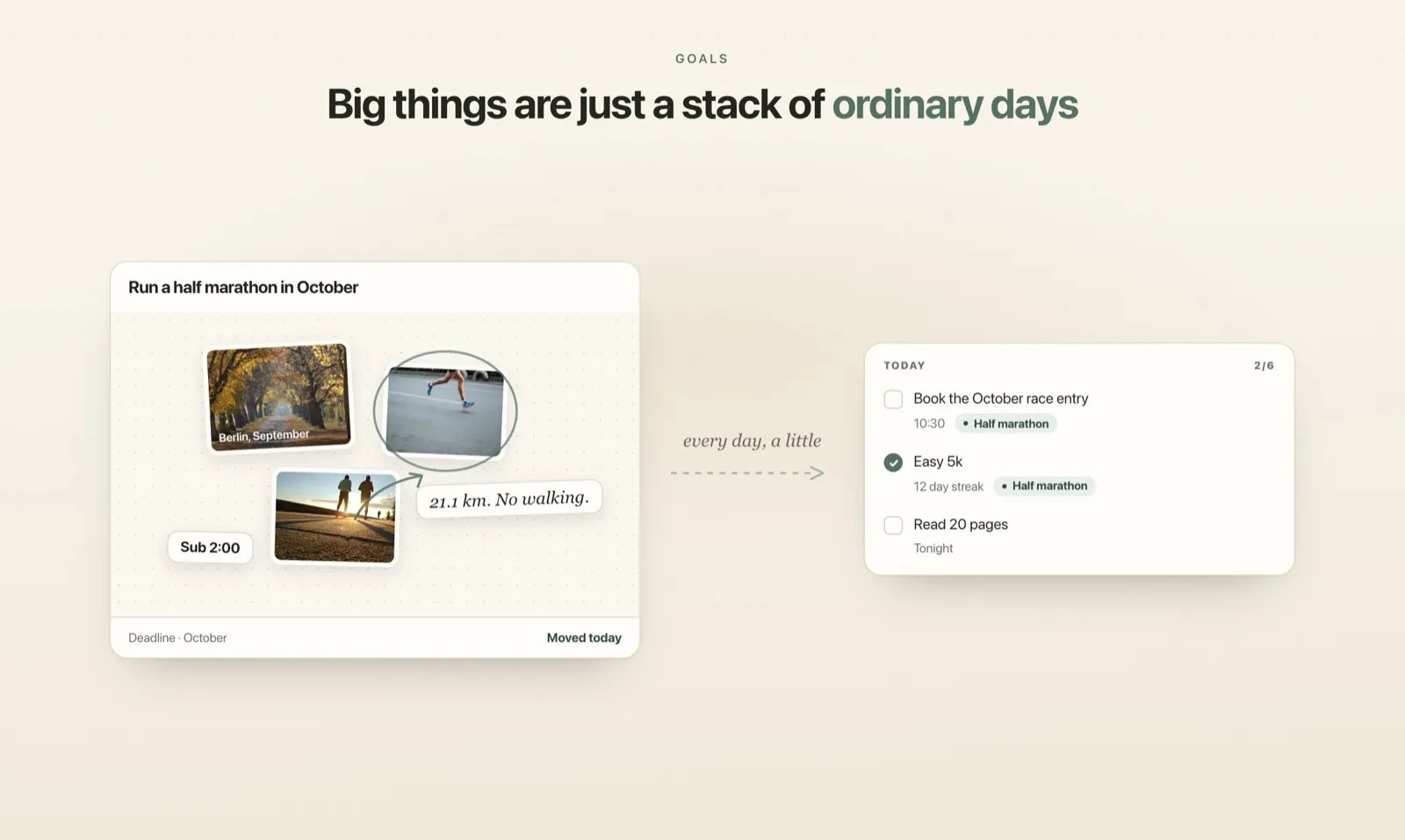
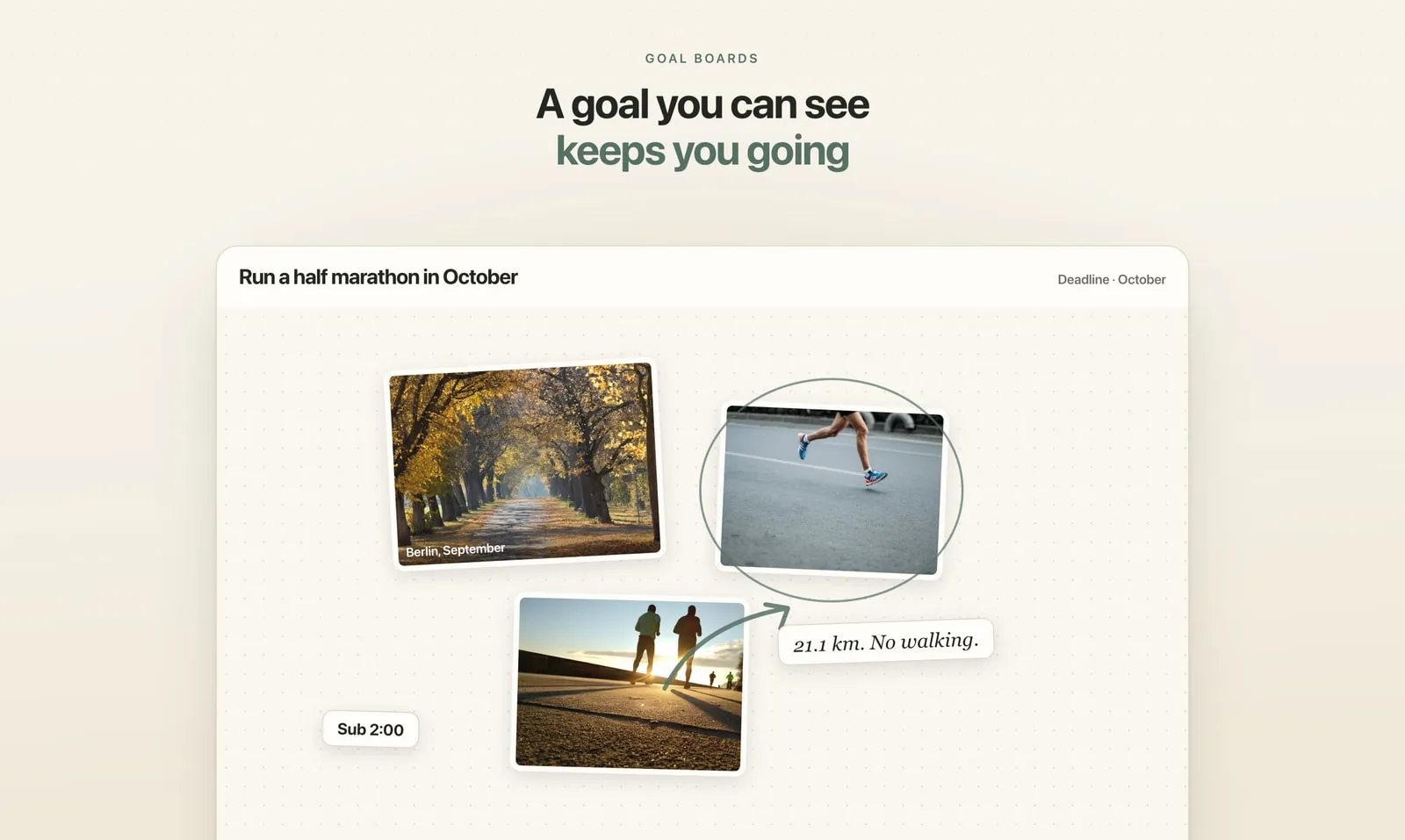
- Every goal is its own board of photos, text, shapes and arrows, with a deadline (a date, a month, a quarter or a year) and a Why it matters line. See Goal boards.
- The obstacle and the plan are notes on the board. Plannedo has no special field for them. I use a sticky note for the obstacle and a card under it for the if-then plan.
- Tasks and habits link to a goal through their Goal field. Ticking one off marks the goal as moved for that day. See Connect tasks and habits to a goal.
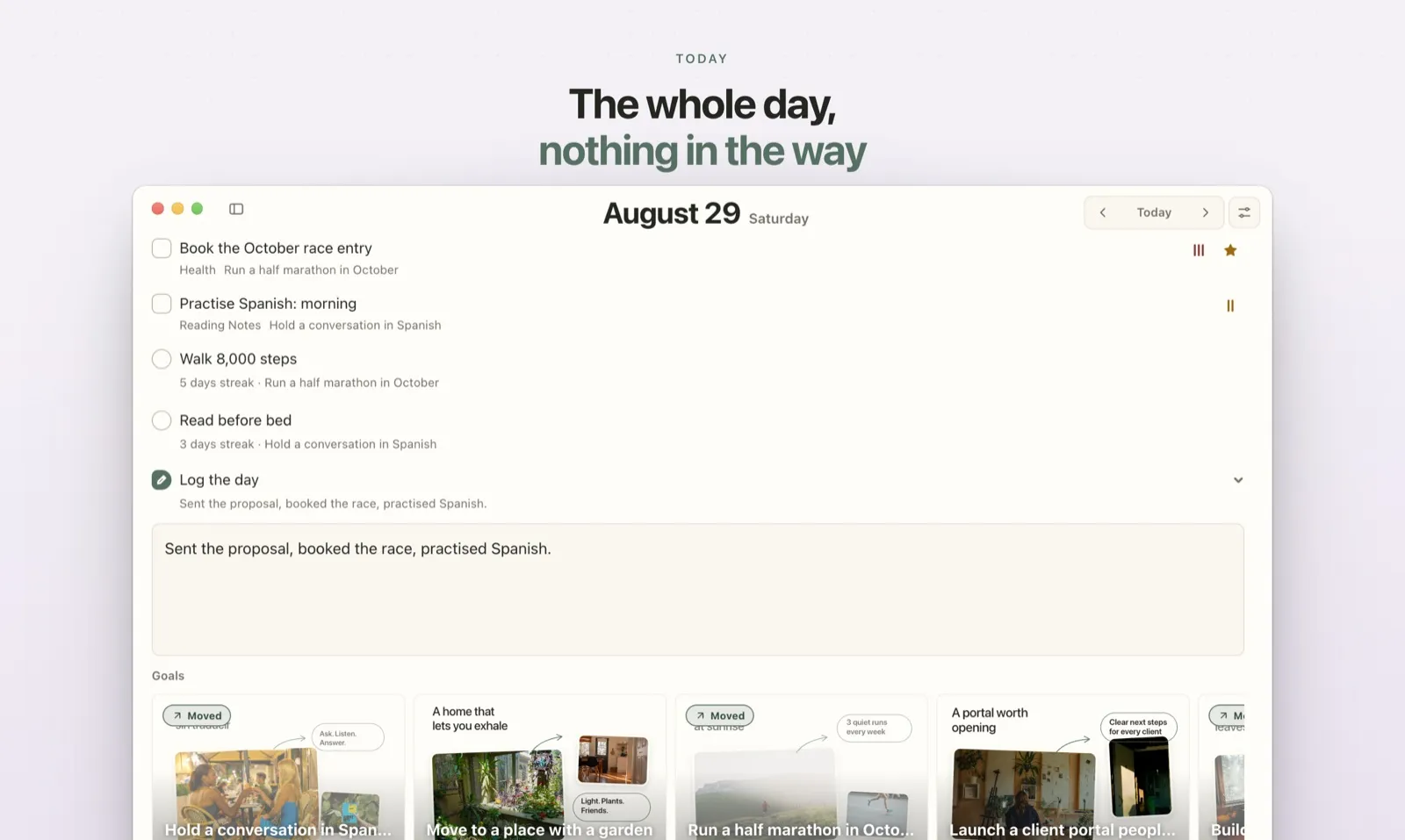
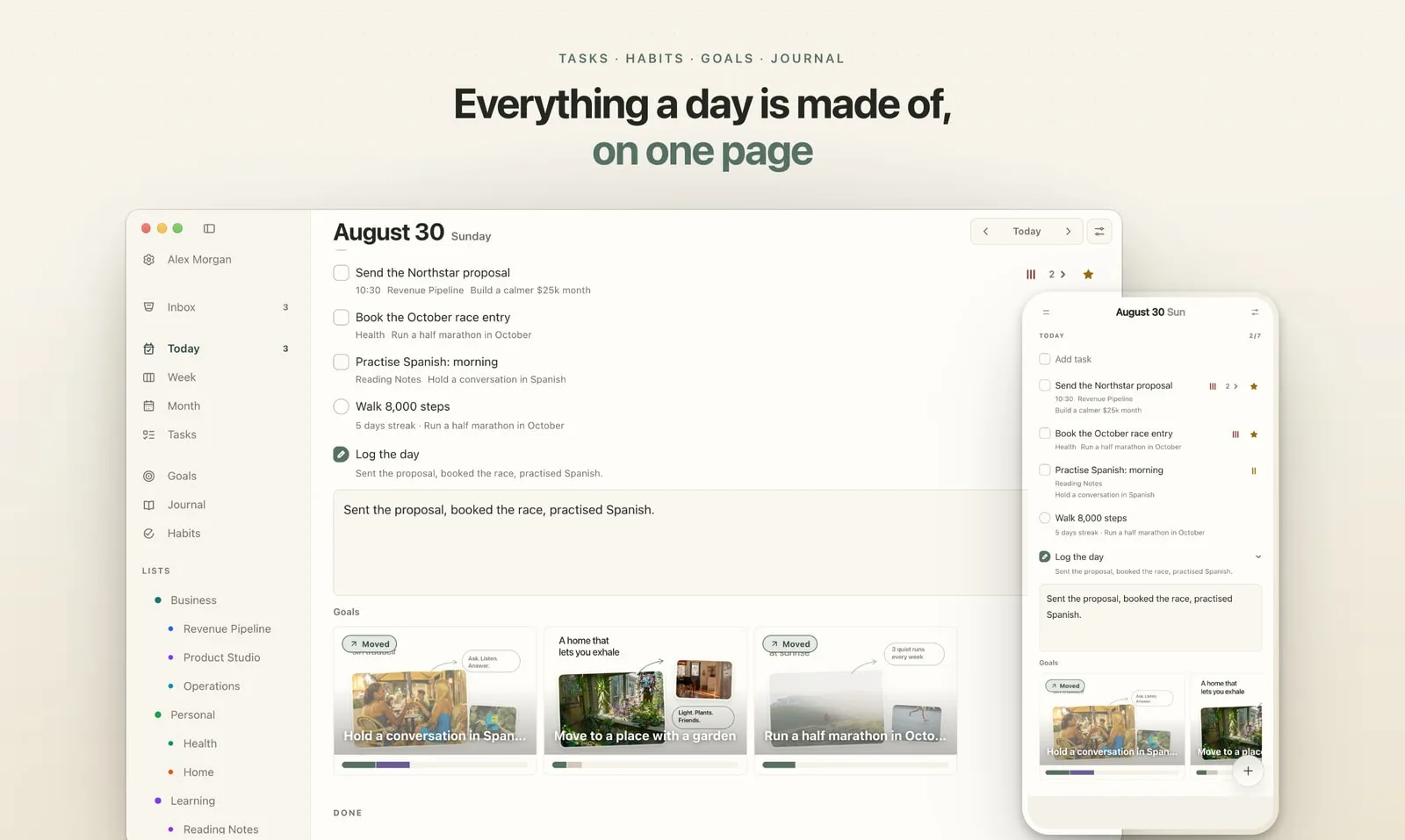
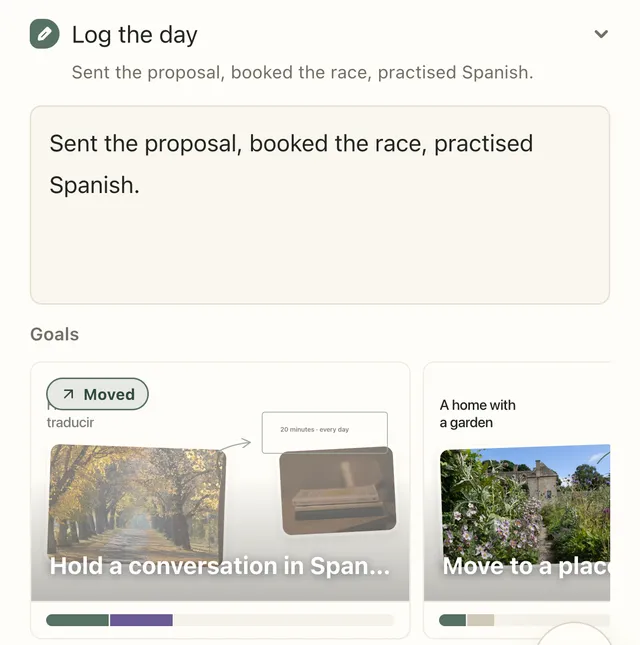
- The evening question is built in. In Log the day on the Today page, you write a line about the day and answer each goal with Moved, Thought or Not today. On most evenings the linked tasks have already answered for you.
- The record separates thinking from doing. Under each board, a line says something like Moved 2 days ago or On your mind 3 days, and a ribbon shows the last 28 days. A goal that stays On your mind for weeks with no green is the positive-fantasy pattern from the studies, visible on your own screen. More in See which goals are moving.
- The boards sit where you already look. Small versions of your goal boards are on Today, the page you open every morning.
Goals have no score and no streak. Skip an evening and that day stays empty, nothing more. The Free plan includes one goal with a full board, unlimited tasks and three habits, enough to try the whole loop on the goal that matters most right now. For a longer tour, read Meet Plannedo.
Studies mentioned
- Oettingen, G., & Mayer, D. (2002). The motivating function of thinking about the future: Expectations versus fantasies. Journal of Personality and Social Psychology, 83(5), 1198-1212.
- Kappes, H. B., & Oettingen, G. (2011). Positive fantasies about idealized futures sap energy. Journal of Experimental Social Psychology, 47(4), 719-729.
- Pham, L. B., & Taylor, S. E. (1999). From thought to action: Effects of process- versus outcome-based mental simulations on performance. Personality and Social Psychology Bulletin, 25(2), 250-260.
- Gollwitzer, P. M., & Sheeran, P. (2006). Implementation intentions and goal achievement: A meta-analysis of effects and processes. Advances in Experimental Social Psychology, 38, 69-119.
- Amabile, T., & Kramer, S. (2011). The Progress Principle. Harvard Business Review Press. A short version is in their article The Power of Small Wins.
- Oettingen, G. (2014). Rethinking Positive Thinking: Inside the New Science of Motivation. Current. WOOP is described at woopmylife.org.
FAQ
Do vision boards actually work?
Not on their own. Research on positive fantasy, which is what a vision board asks for, links vivid daydreams about a finished goal with less effort and weaker results. A board starts to help when you add the main obstacle, an if-then plan for it, a few tasks on real days and a regular check on whether those days moved the goal.
Is there scientific evidence for vision boards?
There is no large controlled study of vision boards themselves. The closest evidence comes from studies of how people imagine the future. In work by Gabriele Oettingen and colleagues, imagining only the desired outcome lowered energy and achievement. Imagining the process, the obstacles and a concrete plan improved results.
What should I put on a vision board?
Use one board per goal. Put a few pictures of the outcome on it, at least one picture or line about the everyday work, the main obstacle in one sentence, an if-then plan for that obstacle, a deadline, and a line about why the goal matters to you.
Is a digital vision board better than a paper one?
The format matters less than where the board lives and whether it connects to your days. A paper board you pass every morning beats a digital one in a folder you never open. A digital board inside your planner has one extra advantage: tasks and habits can be linked to it. I compared the main options in Best Vision Board Apps in 2026.
How often should I look at my vision board?
Briefly every day, ideally in the place where you plan the day, and properly once a week. The daily look keeps the goal in mind. The weekly look is when you check which goals actually moved and decide what to change.
What is the WOOP method?
WOOP stands for Wish, Outcome, Obstacle, Plan. It is a short exercise developed by Gabriele Oettingen that combines her research on mental contrasting with Peter Gollwitzer’s if-then plans. You name a wish, imagine the best outcome, imagine the main inner obstacle, and write an if-then plan for that obstacle.