12 Week Year: How It Works (+ Free Template)
How the 12 Week Year works: vision, 12-week goals, tactics and a weekly score with the 85% line, a worked example, the research, and a free template.
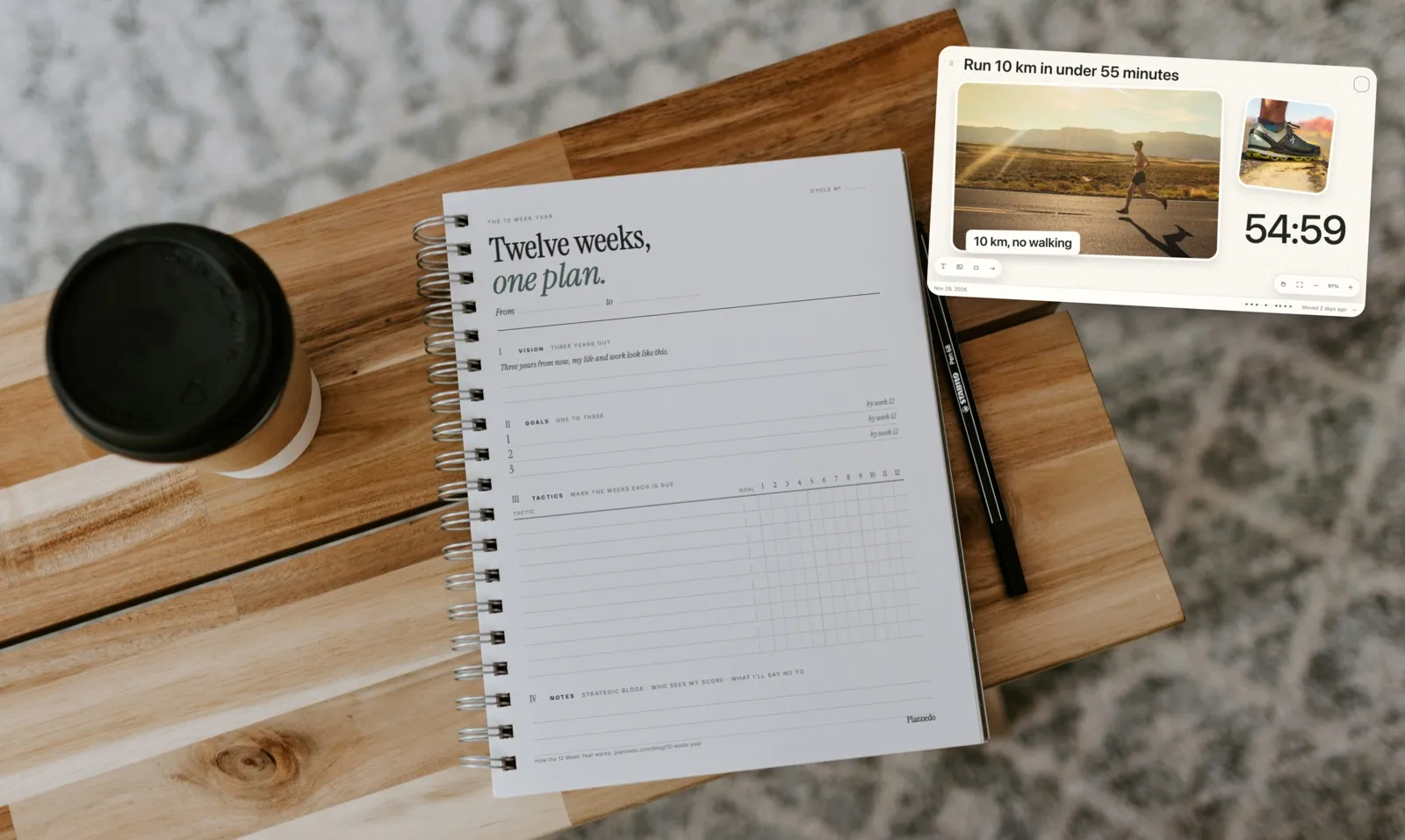
The 12 Week Year is a planning method from Brian Moran and Michael Lennington’s 2013 book of the same name: you treat 12 weeks as a whole year. You set one to three goals for those 12 weeks, break them into weekly tactics, score each week by the share of tactics you finished, and aim for 85% or more. Below: how it works, a worked example, what the research supports, and a free template.
The idea lands because everyone knows the pattern it’s built against. In January a year looks enormous, so nothing feels urgent until October, and then everything does. Moran and Lennington call this annualized thinking. Shrink the year to 12 weeks and every week starts to count.
How the 12 Week Year works
| Part | What you do | How often |
|---|---|---|
| Vision | Describe the life and work you want, about three years out | Once, then reread |
| 12 week goals | Pick one to three results you can check at the end of week 12 | Every 12 weeks |
| 12 week plan | List the tactics that reach each goal and the weeks they’re due | Every 12 weeks |
| Weekly plan | Take this week’s tactics from the plan | Every week, 15 to 20 minutes |
| Weekly score | Tactics done ÷ tactics planned, aiming for 85% | Every week |
| Time blocks | One 3-hour strategic block a week, short buffer blocks, a 3-hour breakout block | Every week |
| Accountability | A short weekly meeting with two to four people, or a partner | Every week |
| Week 13 | Review, celebrate, rest, plan the next 12 weeks | Between cycles |
1. Start with a vision
The book starts further out than most planning systems: with a vision of the life you want, personal and professional, in three time frames: long-term aspirations, about three years from now, and the next 12 weeks. The point isn’t the poster on the wall. A goal that’s connected to something you actually want is the one you’ll still work on in week 8, when the novelty is gone.
Write a few lines about three years from now: work, money, health, people, where you live. Then ask which part of it the next 12 weeks can move.
2. Set one to three 12-week goals
Fewer than you think. The book’s own advice is to pick the one to three things with the biggest impact and pursue them hard, because too many goals mean too many tactics to carry out. Write each goal as a result you can check at the end of week 12: not “grow the business”, but “sign three new clients at $4,000 or more”. If the goal still feels vague, how to set goals covers making it specific and hard.
3. Write the tactics and give each one a week
Tactics are the actions that reach the goal: “email five past clients”, “send two proposals”, “run intervals on Tuesday”. Brainstorm all of them, then keep the smallest set that would reach the goal if you actually did them. Each tactic gets the weeks it’s due: every week, weeks 1 to 2, every other week from week 3.
Don’t put everything in the first three weeks. A plan that’s spread across all 12 weeks survives a bad week; a front-loaded one starts the cycle behind.
4. Plan every week, score every week
At the start of each week, take 15 to 20 minutes to score the week that ended and plan the one ahead from your 12 week plan. Then spend five minutes each morning with the weekly plan to decide what today needs.
The score is simple: tactics done divided by tactics planned. It measures what you did, not what happened. A week where you sent both proposals and nobody signed still scores well, because over 12 weeks, results follow the actions you control. The authors’ rule of thumb, from their coaching work rather than a study, is that if you complete 85% of your weekly plan, you’ll most likely reach your goals. Below 85% isn’t failure; it’s a signal to look at what got in the way.
5. Block your time
The book’s “performance time” has three kinds of blocks:
- Strategic block: three uninterrupted hours a week for the work that moves your goals. No email, no calls.
- Buffer blocks: 30 to 60 minutes for email, messages and small tasks, so they don’t leak into everything else.
- Breakout block: at least three hours away from work, during normal working hours, to come back with more energy. The authors suggest starting with one a month until the rest of the system works.
6. Meet once a week, or find one person
Moran and Lennington recommend a weekly accountability meeting: two to four people, usually on Monday morning after everyone has planned their week, 15 to 30 minutes, where each person reports their results so far, last week’s score and their plans for the coming week. If you’re doing this alone, a partner works, and so does a written weekly review that you actually do every week.
7. Use week 13
A calendar quarter has 13 weeks, so 12-week cycles leave one week over. Use it to review the cycle, celebrate what you reached, rest, and plan the next 12 weeks; the book suggests planning the next cycle in week 12 or 13. In our experience, skipping it is how people burn out by the third cycle. A year in review is the same exercise on a bigger scale.
A 12 Week Year example
Here’s one cycle for a freelance designer, from Monday, September 7 to Sunday, November 29. Two goals:
- Sign three new design clients at $4,000 or more.
- Run 10 km in under 55 minutes.
| Tactic | Goal | Weeks |
|---|---|---|
| Email 5 past clients (Monday) | 1 | 1 to 12 |
| Strategic block, 3 hours (Tuesday morning) | 1 | 1 to 12 |
| Write two case studies | 1 | 1 to 2 |
| Update the portfolio page | 1 | 2 |
| Publish a case study post | 1 | 3, 5, 7, 9, 11 |
| Send 2 proposals (Friday) | 1 | 4 to 12 |
| Easy run, 5 km (Thursday) | 2 | 1 to 12 |
| Track intervals (Tuesday evening) | 2 | 3 to 12 |
| Long run, one kilometre longer each week (Saturday) | 2 | 1 to 11 |
| 10 km race-pace test | 2 | 12 |
That’s six or seven tactics in a typical week, which is about right. Scoring two weeks from the middle of the cycle:
- Week 5: 7 planned, 6 done: 86%. The client emails slipped on a busy Monday.
- Week 6: 6 planned, 4 done: 67%. A client deadline ate Thursday and Friday, so the easy run and the proposals didn’t happen. The fix for week 7: move proposals to Thursday morning, before deadlines pile up.
Notice that the fix is to the week, not to the goal. That’s the habit the weekly score builds.
What the research says about the 12 Week Year
We found no controlled study of the 12 Week Year as a whole, so it’s fair to ask whether the method is more than a good book. Its main parts, though, rest on some of the best-replicated findings about goals.
Near-term goals keep a distant one moving. Edwin Locke and Gary Latham’s review of 35 years of goal-setting research describes a business game in which people who had near-term goals on top of a distant one felt more able to succeed and made higher profits than people who had only the distant goal or were told to do their best. A 12-week goal is a near-term goal, and the weekly plan is an even nearer one.
Specific, hard goals beat “do your best”. The same review found that specific, difficult goals consistently led to better performance than urging people to do their best. “Sign three clients by November 29” is a goal of that kind; “this year I’ll grow the business” isn’t.
Tracking progress raises the odds of reaching a goal. Benjamin Harkin, Thomas Webb and colleagues pulled together 138 experiments with 19,951 participants and found that getting people to monitor their progress made them more likely to reach their goals, with larger effects when progress was physically recorded or reported to others. A written weekly score shared at a weekly meeting does both.
Short plans fight the planning fallacy. In a 1994 study by Roger Buehler, Dale Griffin and Michael Ross, students predicted they’d finish their honours thesis in 33.9 days on average; it took them 55.5. People underestimate how long things take, and a year-long plan has a year’s worth of room for that error. A 12-week plan with a weekly score shows the gap after seven days.
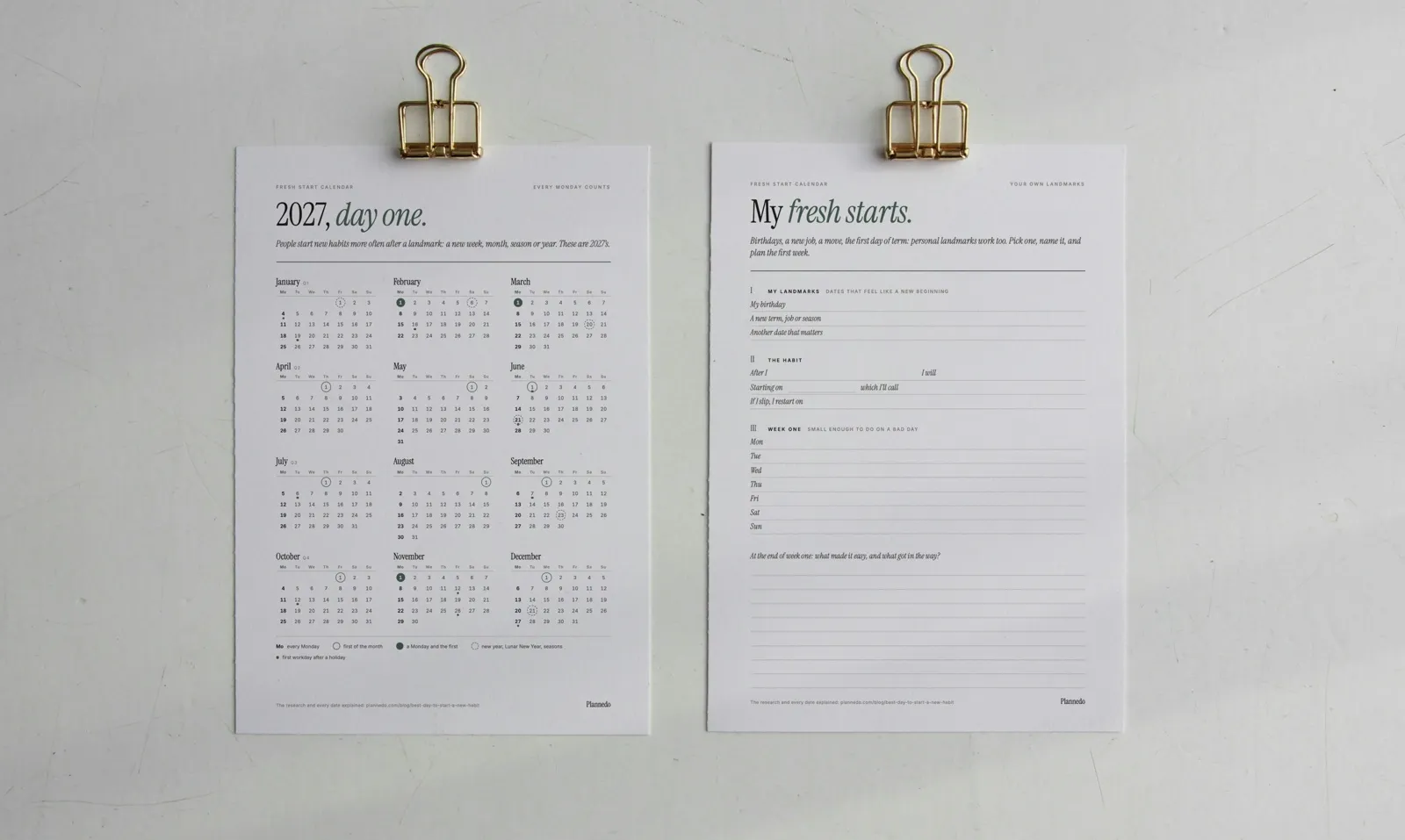
A new cycle is a natural fresh start. Hengchen Dai, Katherine Milkman and Jason Riis found that people are more likely to work on their goals after temporal landmarks like the start of a new week, month or year. Every 12 weeks the method hands you one, and the 2027 fresh start calendar shows which dates make the best starts.
The 85% figure is different: it’s the authors’ rule of thumb from their coaching work, not a research finding. It’s a useful line, as long as you treat it as a signal rather than a grade.
12 Week Year vs annual goals vs OKRs
| Annual goals | OKRs | 12 Week Year | |
|---|---|---|---|
| Time frame | A year | Usually a quarter | 12 weeks, plus a week off |
| What gets scored | Usually nothing until December | Key results, the outcomes | Your own tactics, every week |
| Built for | Individuals and companies | Mostly teams and companies | Individuals first, teams too |
| Weakness | Urgency arrives in the autumn | Outcomes can lag a whole quarter | Easy to overplan in week 1 |
Common mistakes
- Too many goals. Three goals with four tactics each is twelve things a week before your normal work. Start with one or two.
- Front-loading the plan. Put every big task in weeks 1 to 3 and you’re behind by week 4. Spread the tactics.
- Scoring results instead of actions. You control the proposals, not the signatures. Score the proposals.
- Treating 85% as a pass mark. A 67% week with a clear reason is more useful than a 100% week with a plan that was too easy.
- Skipping week 13. Rolling straight into the next cycle works once. By the third cycle it’s the reason you stop.
How to run a 12 Week Year in Plannedo
Each part of the method has a place in the app:
- Each 12-week goal is a goal. In Goals, add a New goal, write the result as its title, the reason in Note, and set the Deadline to the Date week 12 ends (or Quarter, if your cycle follows the calendar). The board above it is where the vision goes.
- Each tactic is a task with a date, linked to the goal. Set the task’s Goal field so it belongs to the goal. Tactics that happen every week can repeat Weekly on their day.
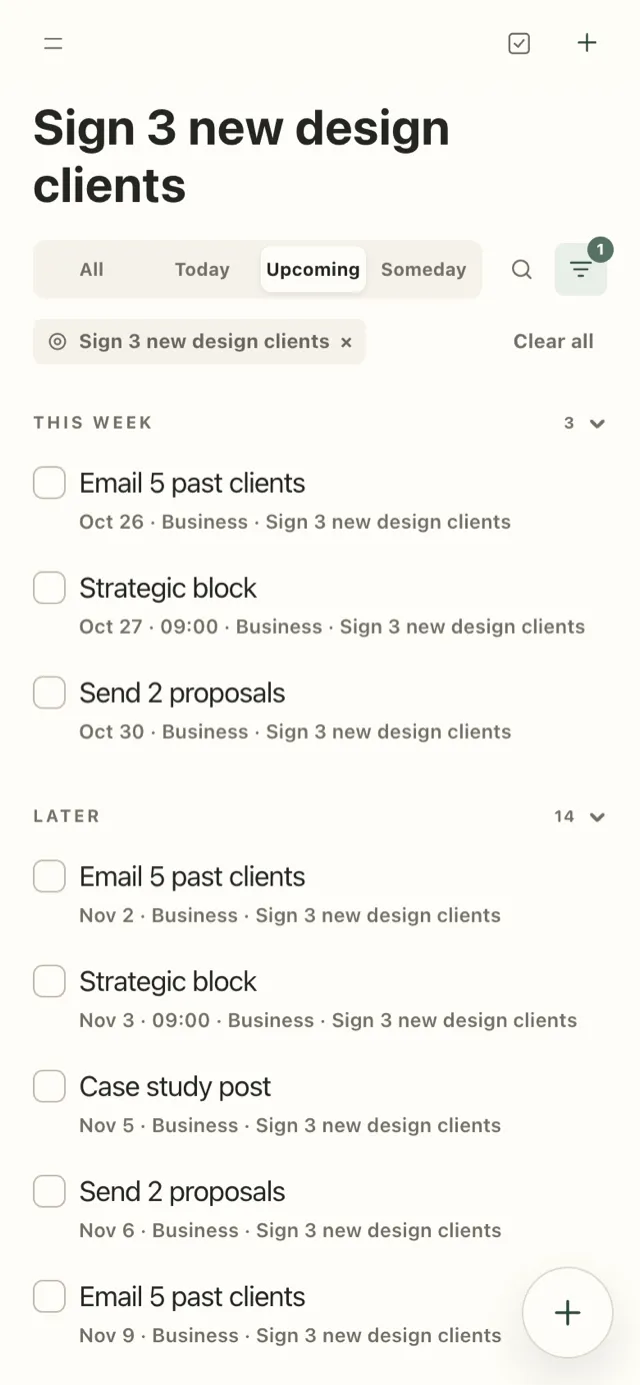
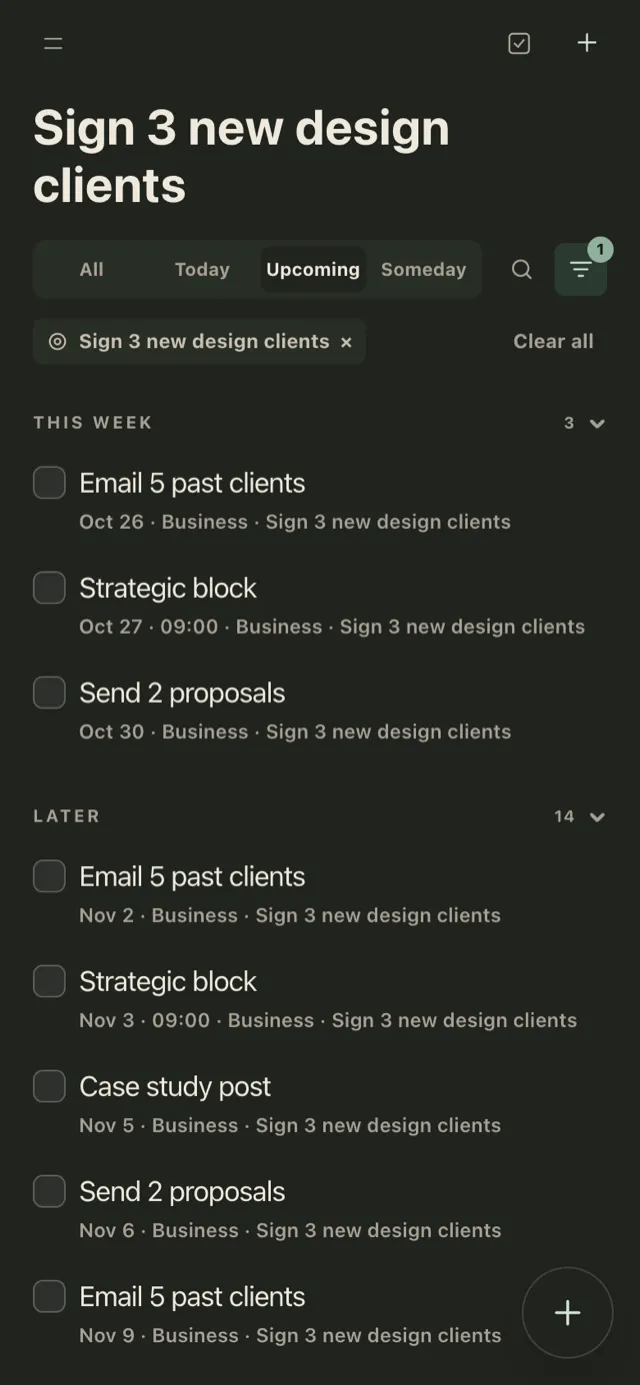
- The 12 week plan is a filtered list. In Tasks, choose Upcoming and filter by the goal: every tactic left in the cycle, in order. The steps are in Connect tasks and habits to a goal.
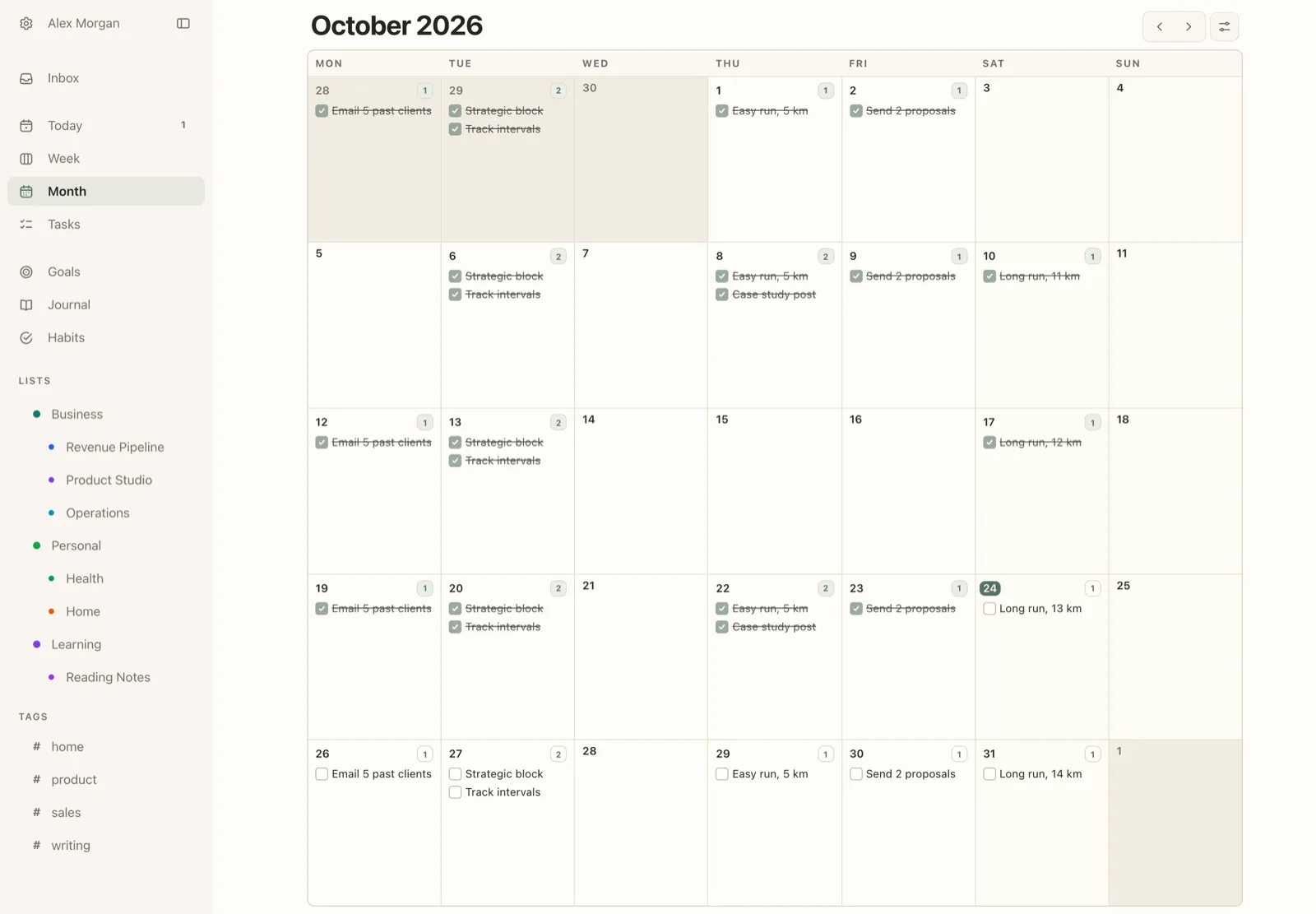
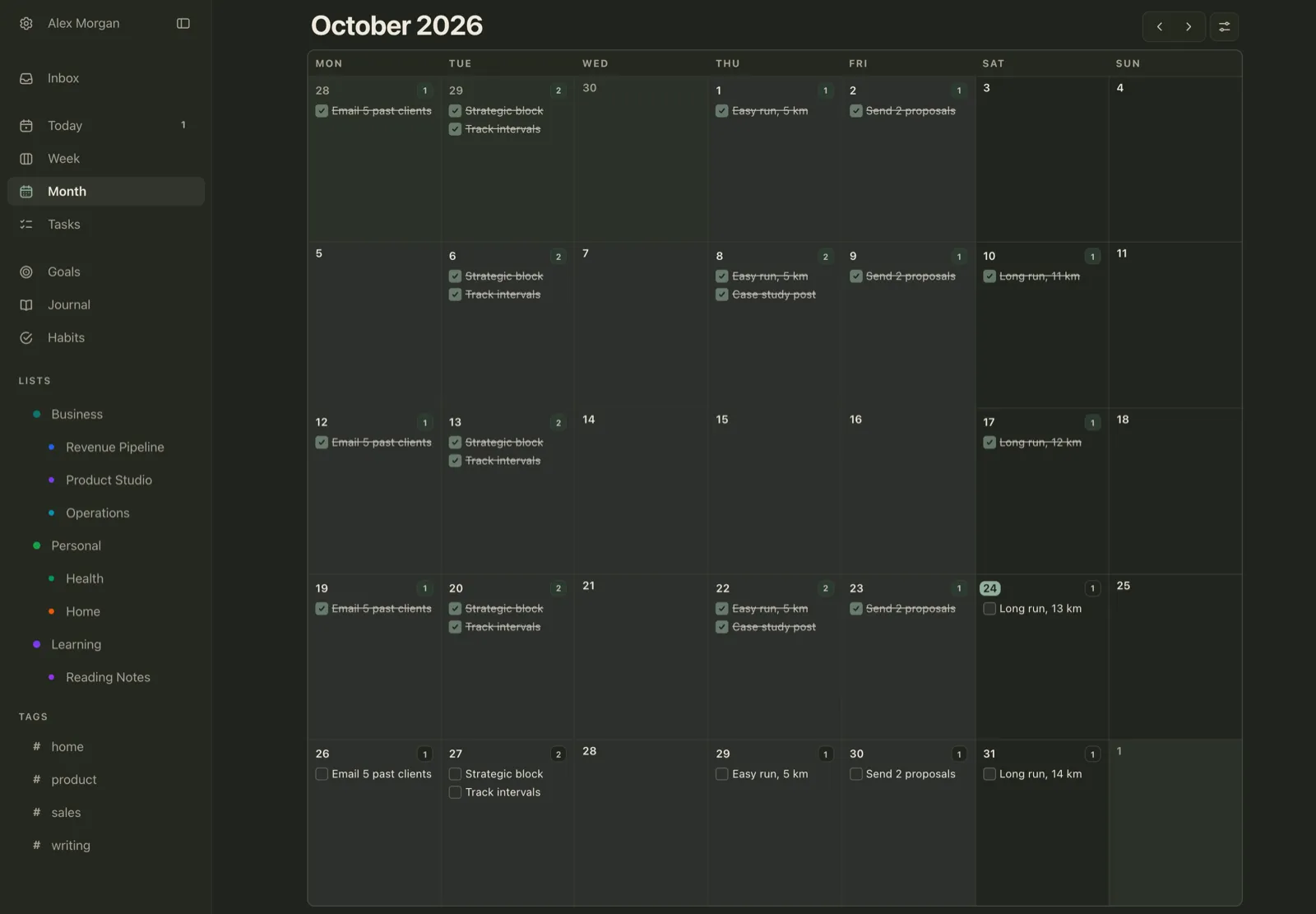
- The weekly plan is Week. Each day shows its tactics, with a small badge for how many there are that fills as you finish them. Scoring the week is counting the crossed-out ones against the total.
- The evening check-in keeps the goal in view. Log the day on Today asks whether each goal moved, and finishing a linked task marks it Moved for you.


FAQ
What is the 12 Week Year?
A planning method from the 2013 book The 12 Week Year by Brian P. Moran and Michael Lennington. You treat 12 weeks as a full year, set one to three goals for that period, break them into weekly tactics, and score each week by the percentage of tactics you completed, aiming for 85%. A 13th week is used to review, rest and plan the next cycle.
Does the 12 Week Year work?
We couldn’t find a controlled study of the method as a whole, but its main parts are well supported: near-term goals help people pursue distant ones, specific and hard goals beat “do your best”, and monitoring progress makes reaching a goal more likely, especially when progress is written down or shared. Whether it works for you mostly depends on scoring every week.
What is a good 12 Week Year score?
The authors recommend aiming for 85% of your weekly tactics: in their experience, people who complete 85% of their weekly plan usually reach their 12-week goals. It’s a rule of thumb, not a research finding. A lower score is a signal to look at what got in the way, not a reason to quit.
What do you do in week 13?
Review the cycle (which goals you reached, your average score, what worked and what didn’t), celebrate, rest, and plan the next 12 weeks. A calendar quarter has 13 weeks, so the spare week fits naturally between cycles.
How many goals should you have in a 12 Week Year?
One to three. The book’s advice is to focus on the few things with the biggest impact, because each goal brings its own weekly tactics. If you’re new to the method, start with one or two.
Can you do the 12 Week Year on your own?
Yes. The book recommends a weekly accountability meeting with two to four people, but a partner who sees your score each week works, and so does a written weekly review you never skip. The key is that someone, even if it’s only you on paper, sees the score every week.
When should you start a 12 Week Year?
On any Monday. Starting with a new month or year adds a fresh-start boost. For 2027, a cycle from Monday, January 4 to Sunday, March 28 leaves March 29 to April 4 as week 13, and the next cycle starts in April.
Sources
- Moran, B. P., & Lennington, M. (2013). The 12 Week Year: Get More Done in 12 Weeks than Others Do in 12 Months. Wiley.
- Locke, E. A., & Latham, G. P. (2002). Building a practically useful theory of goal setting and task motivation: A 35-year odyssey. American Psychologist, 57(9), 705-717.
- Harkin, B., Webb, T. L., Chang, B. P. I., Prestwich, A., Conner, M., Kellar, I., Benn, Y., & Sheeran, P. (2016). Does monitoring goal progress promote goal attainment? A meta-analysis of the experimental evidence. Psychological Bulletin, 142(2), 198-229.
- Buehler, R., Griffin, D., & Ross, M. (1994). Exploring the “planning fallacy”: Why people underestimate their task completion times. Journal of Personality and Social Psychology, 67(3), 366-381.
- Dai, H., Milkman, K. L., & Riis, J. (2014). The fresh start effect: Temporal landmarks motivate aspirational behavior. Management Science, 60(10), 2563-2582.
Photo credits
The photos come from Unsplash: the desk on the cover by Kelly Sikkema; on the example boards, Theme Photos and Julio Lopez (design), and Isaac Wendland (running).