One Line a Day Journal: How to Keep It (+ 60 Prompts)
How to keep a one line a day journal: what to write, 60 prompts, real examples, the 5-year book vs a notebook vs an app, and a free monthly template to print.
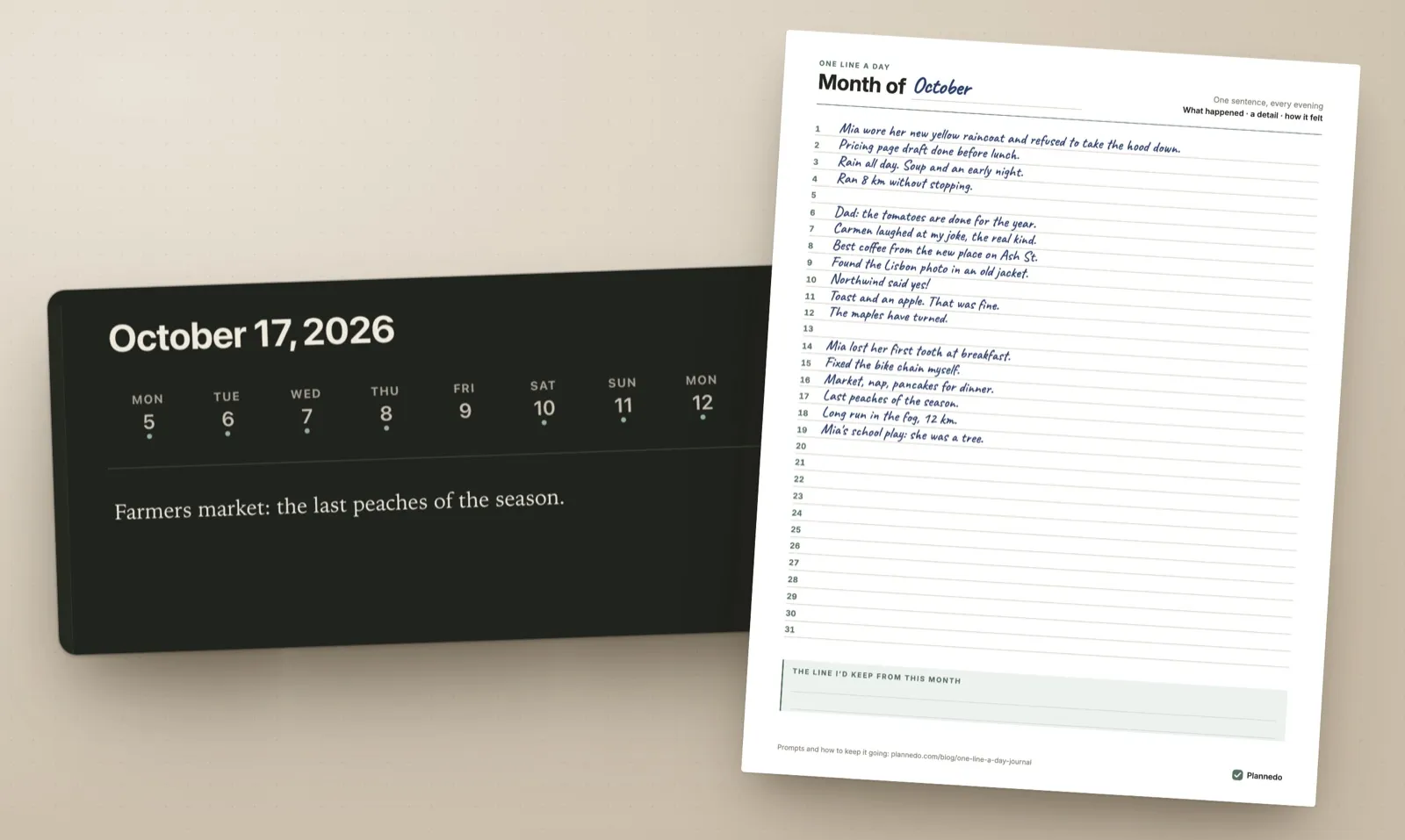
A one line a day journal is a diary where you write a single sentence about each day, usually in the evening. To keep one, pick a fixed moment, like right after brushing your teeth, write one specific detail of the day rather than a summary, skip the days you miss without catching up, and once a month read back what you wrote.
It sounds too small to matter. It isn’t, and there’s research to show why: we badly underestimate how much we’ll enjoy rediscovering ordinary days later. Below: how to start, what to write, sixty prompts for the evenings when nothing comes, the classic five-year book against a notebook and an app, and a free monthly page to print.
What is a one line a day journal?
It’s the smallest possible diary: one line, every day, ideally in the same place. The best-known version is One Line a Day: A Five-Year Memory Book, published by Chronicle Books in 2009. Each page is one date of the year with room for five short entries, one per year, so on March 3 you write your line under the ones from the March 3s before it. A notebook or an app works just as well; the idea is the single line, not the book.
Why one line a day works
It’s small enough to survive a bad day
Most journals die in the second week, because a page a day is a commitment you can only keep on good days. One sentence takes a minute, even on a day when you’re exhausted. A habit you can do on your worst day is one that lasts. If you’re curious how long a new habit takes to stick, the research is in How Long Does It Take to Form a Habit?.
Future you will love reading it
In a set of four studies published in 2014, Ting Zhang, Francesca Gino, Michael Norton and colleagues at Harvard Business School had people record recent experiences in a time capsule and predict how interesting it would be to rediscover them later. People underestimated how curious and interested they would be. The gap was largest for ordinary, mundane experiences, not the extraordinary ones. And it had a cost: people passed up chances to record the present, yet later preferred rediscovering those moments to doing something else fun. The authors link it to our misplaced faith in our memory of everyday events.
That’s the whole case for one line a day: the lines that feel too ordinary to write are the ones you’ll be most glad to find.
It isn’t therapy, and doesn’t need to be
The journaling research you may have heard of, expressive writing, is something different: writing about difficult experiences for around 15 to 20 minutes a day, for a few days in a row. A 2006 meta-analysis of 146 studies by Joanne Frattaroli found a small but real benefit. One line a day doesn’t try to do that job. If something heavy needs writing out, write it out; the one line is for remembering, not processing.
How to start a one line a day journal
- Pick the moment. Attach the line to something you already do every evening: after brushing your teeth, when you plug in your phone, after you close the laptop. A fixed cue helps a new habit become automatic in a way a reminder doesn’t (more on that in Habit Tracker Ideas).
- Pick the place. A five-year book, a notebook on the nightstand, or an app you open every evening anyway. Keep it where the moment happens.
- Write one specific thing. Not “Good day” but “Mia lost her first tooth at breakfast.” One detail beats a summary every time.
- Stop at one line. If you want to write more, fine, but never make more the rule. The rule is one.
- Skip, don’t catch up. A missed day stays empty. Catching up on a week from memory turns a pleasure into homework, and the lines are worse anyway.
- Read back once a month. On the first of the month, read the month before. It takes two minutes and is the part that keeps you going. In December, the whole year of lines is the best material for a year in review.
What to write: six kinds of lines
When you can’t think of anything, pick one of these:
- A detail. “Best coffee from the new place on Ash Street.”
- Something someone said. “Dad called just to tell me the tomatoes are done for the year.”
- A small win. “Northwind said yes to the pilot.” On busy days, a short ta-da list of what got done works too.
- Something you noticed. “The maples have turned.”
- How it felt. “Too tired to cook. Toast and an apple, and that was fine.”
- A first or a last. “Last peaches of the season.” “First cold morning.”
One line a day journal examples
A real-looking week, the way it reads a year later:
| Day | Line |
|---|---|
| Monday | Finished the pricing page draft before lunch. Sam said it finally sounds like us. |
| Tuesday | Rain all day. Soup, two episodes, early night. |
| Wednesday | Ran 8 km without stopping for the first time since June. |
| Thursday | (nothing) |
| Friday | Dad called just to tell me the tomatoes are done for the year. |
| Saturday | Farmers market: the last peaches of the season. |
| Sunday | Long run in the fog, 12 km, couldn’t see the end of the bridge. |
Notice that none of them is a summary, and one day is empty. Both are fine.
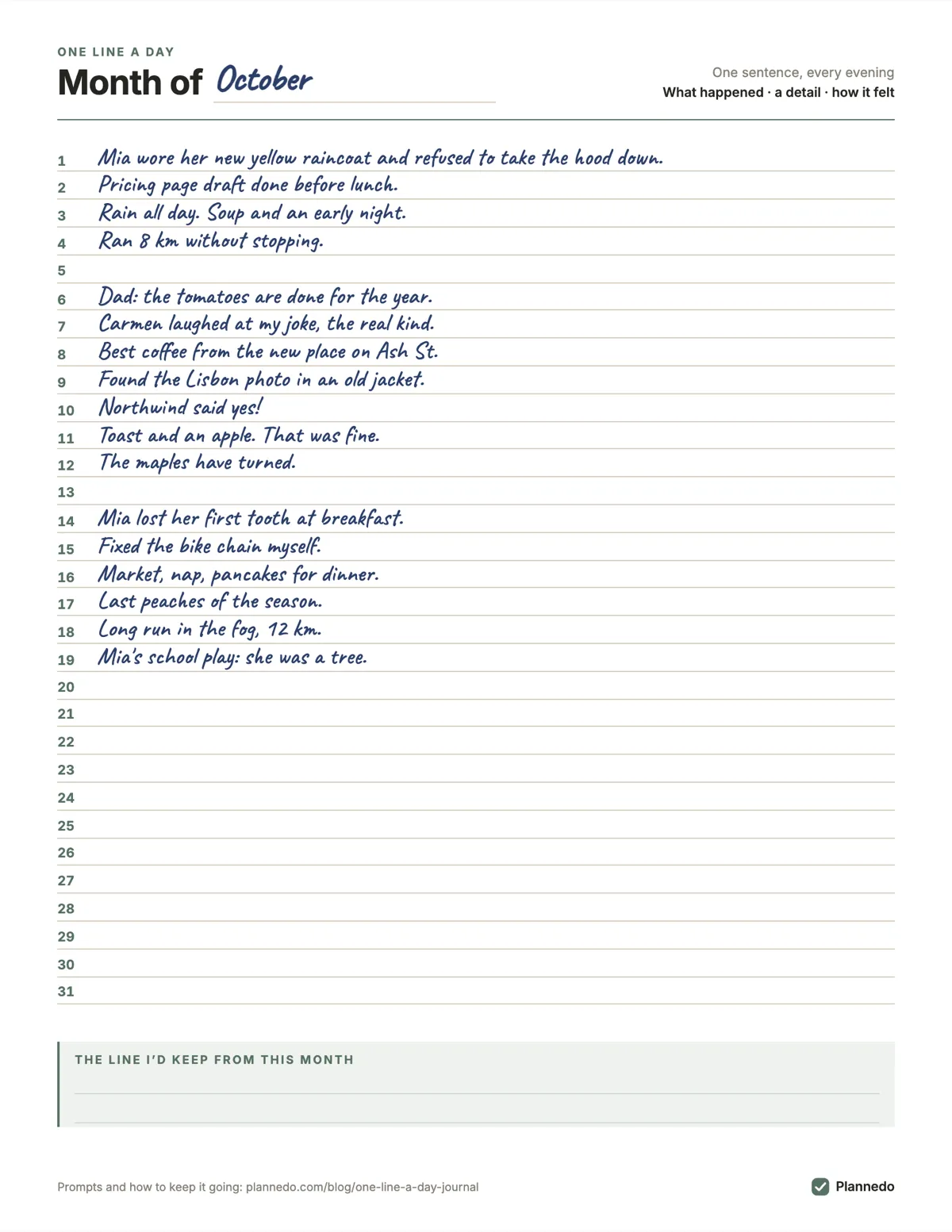
60 one line a day journal prompts
Use these on the evenings when nothing comes. Pick one, answer it in a sentence, done.
Everyday moments
- What did I eat today that I’d eat again?
- What’s one thing I saw that I’d normally walk past?
- What was the weather like, and what did it make me do?
- What did I hear today that stuck in my head?
- Where was I at noon?
- What did I buy today?
- What took longer than I expected?
- What made me laugh?
- What did I read or watch?
- What was the best five minutes of the day?
People
- Who did I talk to today, and what did they say?
- What did someone do that I want to remember?
- Who made my day easier?
- What did a child, a parent or a friend say that was funny?
- Who did I think about today?
- What did I learn about someone?
- Who did I help, even a little?
- What did someone teach me?
- Who would I like to see this week?
- What did we talk about at dinner?
Small wins and progress
- What did I finish today?
- What did I start?
- What did I do that I’d been putting off?
- What moved one of my goals forward?
- What did I do better than last week?
- What problem did I solve?
- What did I say no to?
- What did I learn how to do?
- What would I tell someone about today’s work?
- What am I proud of, however small?
Feelings and mood
- How did I feel this morning, and how do I feel now?
- What drained me today?
- What gave me energy?
- What worried me, and did it happen?
- When did I feel calm?
- What do I wish I’d done differently?
- What am I looking forward to?
- What was hard today?
- In one word, how was today? Why that word?
- What did I need today that I didn’t get?
Gratitude
- What’s one thing I’m grateful for today?
- What small thing went right?
- What do I have now that I once wished for?
- What made today better than it could have been?
- Who am I grateful for, and why today?
- What did I enjoy that cost nothing?
- What comfort did I have today?
- What part of my routine do I like?
- What would I miss about today if it hadn’t happened?
- What surprised me in a good way?
Firsts, lasts and seasons
- What did I do for the first time?
- What did I do for the last time this year?
- What’s in season, in the shops or outside?
- What’s changed since last month?
- What’s on my mind that wasn’t a year ago?
- What song is stuck on repeat this week?
- What did the light look like this evening?
- What am I reading, watching or playing these days?
- What would I want to remember about this age, for the kids or for me?
- If this day were a photo, what would be in it?
Gratitude prompts have research of their own. In a 2003 set of studies, Robert Emmons and Michael McCullough asked people to keep weekly or daily lists: some listed what they were grateful for, others hassles or other everyday topics. The gratitude groups came out ahead on several measures of well-being, with the clearest effect on positive mood. You don’t need a separate gratitude journal; on some days, your one line can be that.
5-year book, notebook or app?
| Five-year book | Notebook or printable | App | |
|---|---|---|---|
| Reading back | Built in: last years’ lines are on the same page | You flip back | Depends on the app |
| Effort | Open the book, write one line | Same | Often already open in the evening |
| Where it lives | One place at home | One place at home | Phone and computer |
| Cost | You buy the book | Free | Free or paid |
| Best for | Seeing years side by side | Starting today, for free | Pairing the line with your day and goals |
The five-year book is unbeatable for one thing: rereading the same date across years. If that’s what you want most, buy the book. If you want to start tonight, print the monthly page above or use any notebook. If you already plan your day in an app, put the line where you close the day.
One line a day in Plannedo
I build Plannedo, a daily planner, and its journal was designed around exactly this: a line or two about how the day went. In the evening, Log the day on Today asks for a short reflection and one tap per goal, whether today moved it. If you only want the line, you can switch the goal part off.
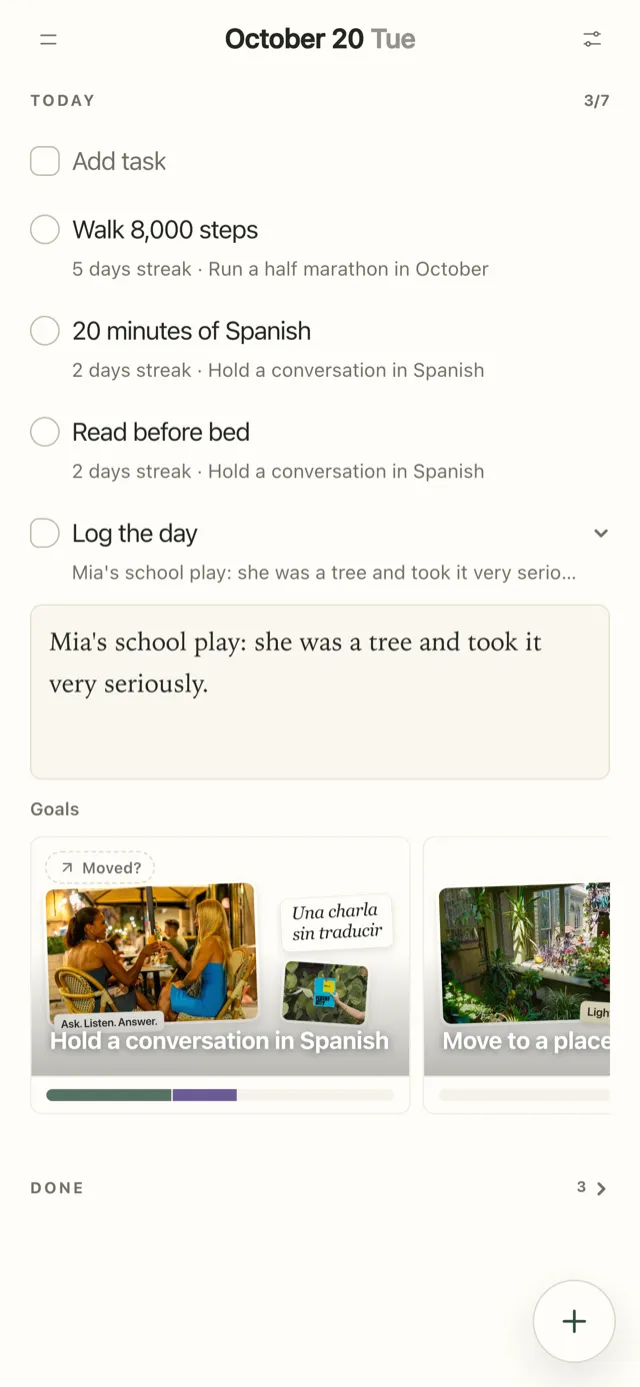
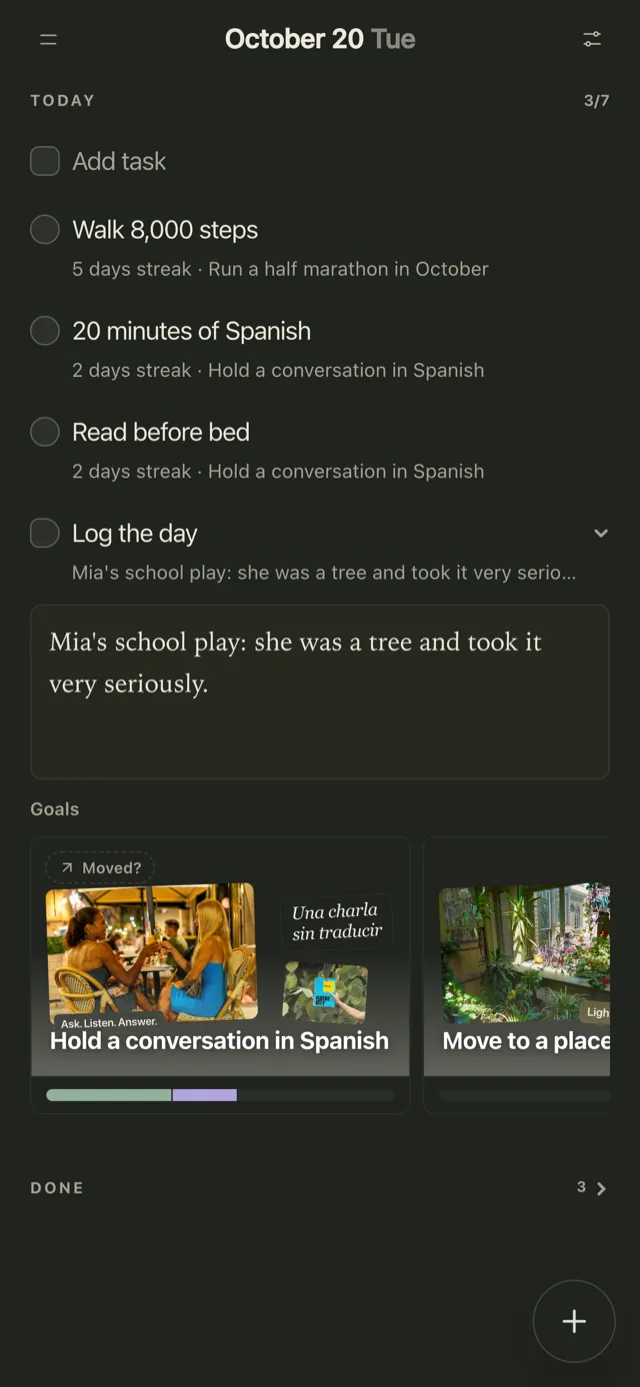
The Journal page shows a strip of recent days with a dot on every day that has an entry, the entry itself, and what the day held: its tasks, habits and goals. That last part is useful a year later: the line says how it felt, and the tasks say what you were actually doing.
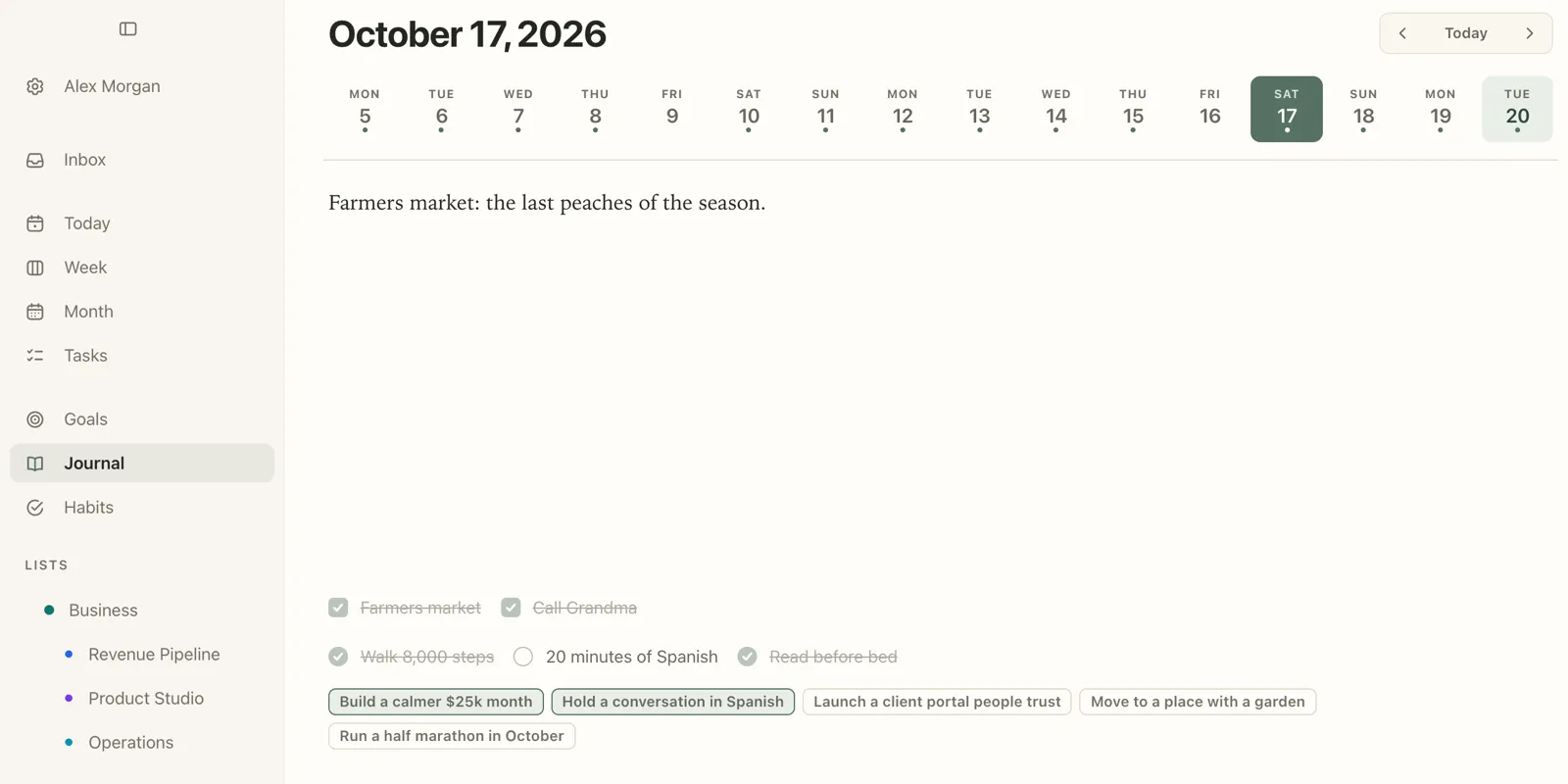
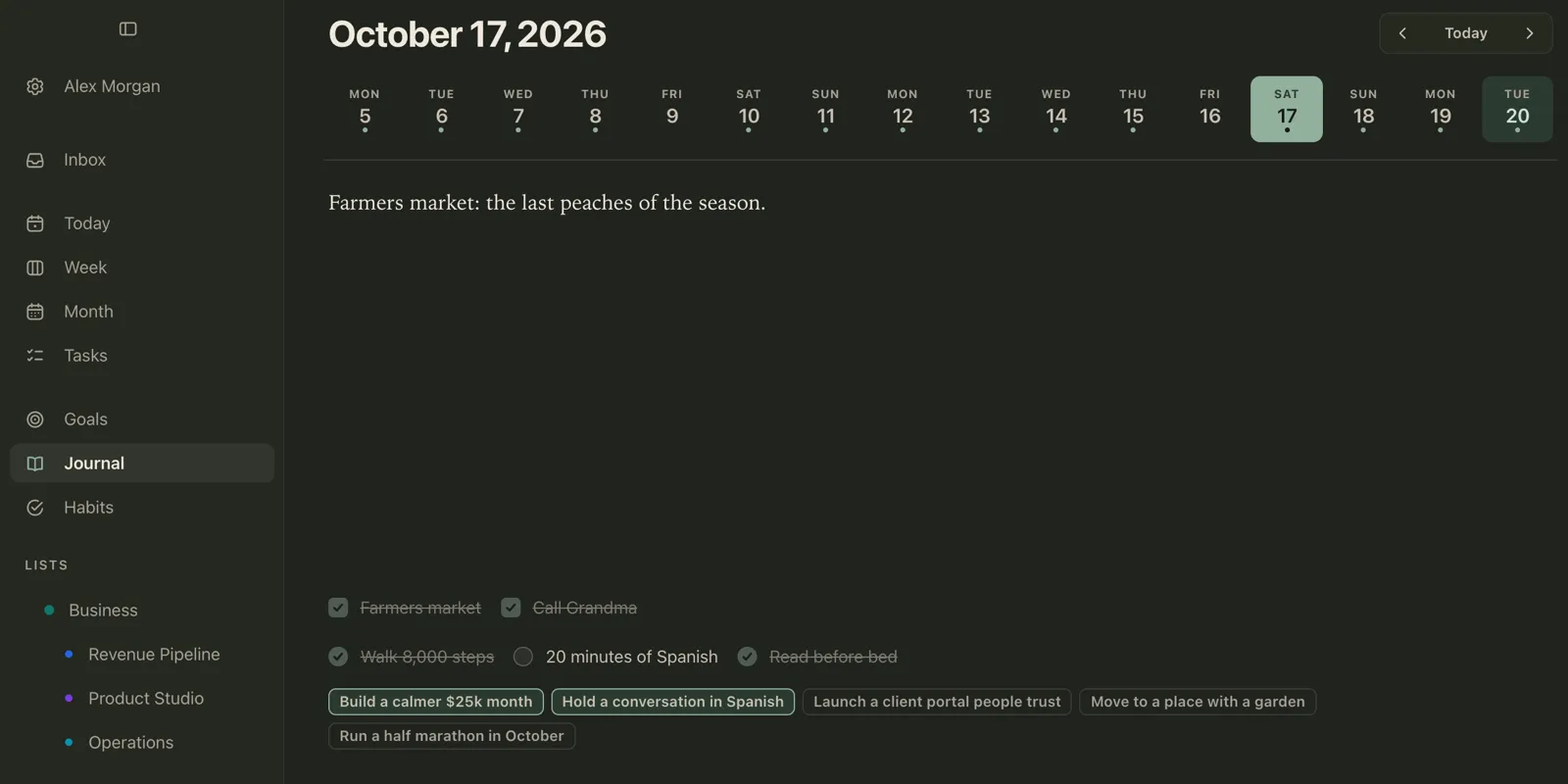
Details on the journal are in the help centre under The journal, and on the evening check-in under Evening check-in.
FAQ
What do you write in a one line a day journal?
One specific thing about the day: a detail, something someone said, a small win, something you noticed or how it felt. “Last peaches of the season” is better than “good day”. If nothing comes, answer a prompt, such as “What made me laugh today?”
How do you start a one line a day journal?
Pick a moment you already have every evening, like brushing your teeth, and a place, like a notebook on the nightstand or an app. Write one specific line tonight. Skip days you miss instead of catching up, and read back once a month.
Is a one line a day journal worth it?
Yes, if you like the idea of remembering ordinary days. A 2014 set of studies from Harvard Business School found that people underestimate how interesting it will be to rediscover everyday moments later, most of all the mundane ones, and so skip recording things they’d later be glad to have.
What is the One Line a Day five-year journal?
A book from Chronicle Books with a page for each date of the year and space for five short entries on it, one per year. Over five years you see the same day side by side.
Can I keep a one line a day journal on my phone?
Yes. Any notes app works, and planners with a journal, like Plannedo, let you write the line where you close the day, next to that day’s tasks and habits. If seeing the same date across five years is what you want most, a five-year book does that best.
What if I miss a day?
Leave it empty and write tonight’s line. Catching up from memory makes the habit feel like homework, and a few empty lines are part of the record.
Studies mentioned
- Zhang, T., Kim, T., Brooks, A. W., Gino, F., & Norton, M. I. (2014). A “present” for the future: The unexpected value of rediscovery. Psychological Science, 25(10), 1851-1860.
- Emmons, R. A., & McCullough, M. E. (2003). Counting blessings versus burdens: An experimental investigation of gratitude and subjective well-being in daily life. Journal of Personality and Social Psychology, 84(2), 377-389.
- Frattaroli, J. (2006). Experimental disclosure and its moderators: A meta-analysis. Psychological Bulletin, 132(6), 823-865.