52-Week Savings Challenge 2027: Free Printable Tracker
The 52-week savings challenge saves $1,378 in a year. A free fillable tracker (PDF), five versions including reverse and payday, the month-by-month math for 2027, and what to do when you miss a week.
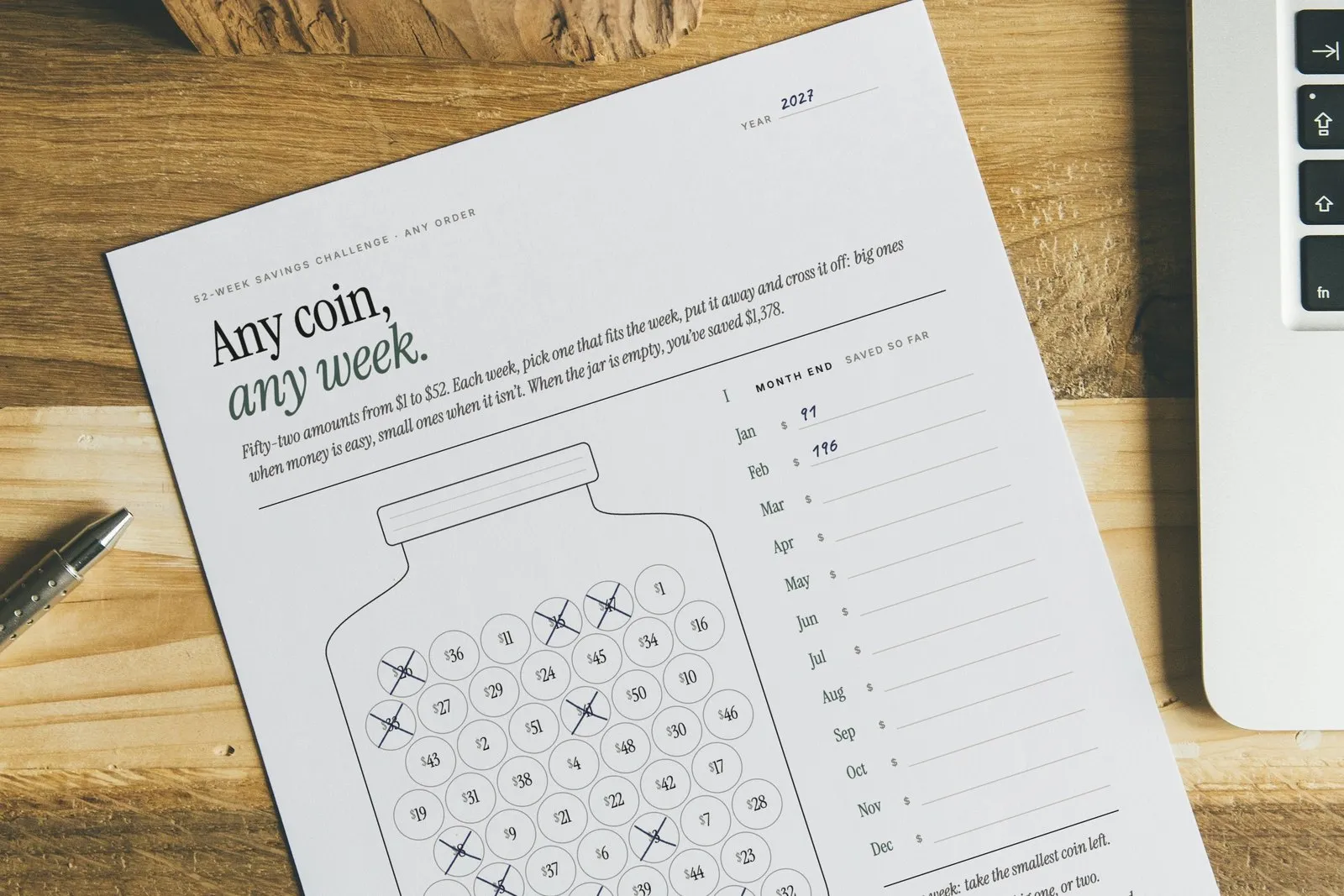
The 52-week savings challenge is a year of small, growing deposits: $1 in the first week, $2 in the second, a dollar more every week, and $52 in the last. Add it up and you have $1,378 at the end of the year. Below is a free printable tracker you can fill in on paper or on a screen, five versions of the challenge, the month-by-month math for 2027, and what to do when you miss a week.
2027 makes it easy to start: January 1 is a Friday, so “every Friday” lines up with the calendar from the first day of the year to Christmas Eve, week 52.
What is the 52-week savings challenge?
It’s a savings plan dressed up as a game. Every week has its own amount, and every week you tick off makes the next one feel like a streak worth keeping. The chart has no known author. It went viral on Facebook in January 2013, when Kassondra Perry-Moreland, a 911 dispatcher from Oakland, posted it and started a group that passed 1,000 members in three days. By late January, 3,000 people had joined, according to CBS Miami.
The idea behind it is much older. In 1909, Merkel Landis, treasurer of the Carlisle Trust Company in Pennsylvania, started what’s usually called the first Christmas savings club: members put money in through the year and got it back in time for the holidays. The 52-week challenge is the same deal you make with yourself, without the bank holding the money.
How much do you save, and when?
The classic version saves $1,378: the numbers from 1 to 52 add up to 52 × 53 ÷ 2. That’s $114.83 a month on average. But the money isn’t spread evenly, and that’s the part most charts don’t show.
| By the end of | Saved so far |
|---|---|
| Week 13 (March 26, 2027) | $91 |
| Week 26 (June 25) | $351 |
| Week 37 (September 10) | $703, past halfway |
| Week 39 (September 24) | $780 |
| Week 52 (December 24) | $1,378 |
The first half of the year brings in a quarter of the money. The last 13 weeks bring in $598, or 43%, and December alone asks for $202 (four Fridays at $49, $50, $51 and $52), in the month of gifts, travel and heating bills. January, by contrast, is $15. That’s why so many people start strong and stall in the autumn: the challenge gets harder exactly as the year gets more expensive.
It’s not a reason to skip the challenge. It’s a reason to choose your version on purpose.
Five versions of the challenge
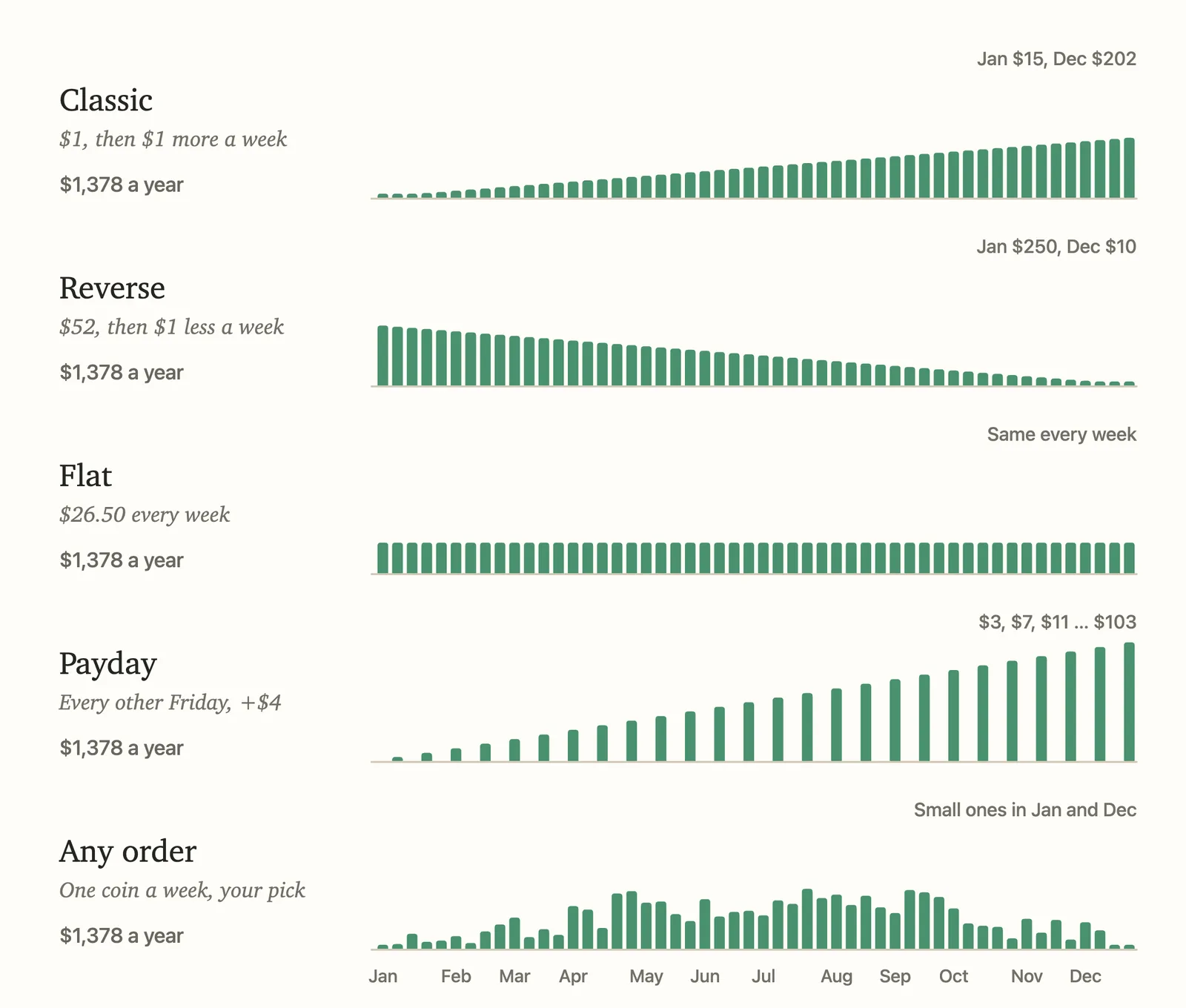
All five of these end at the same $1,378. They just put the weight in different places.
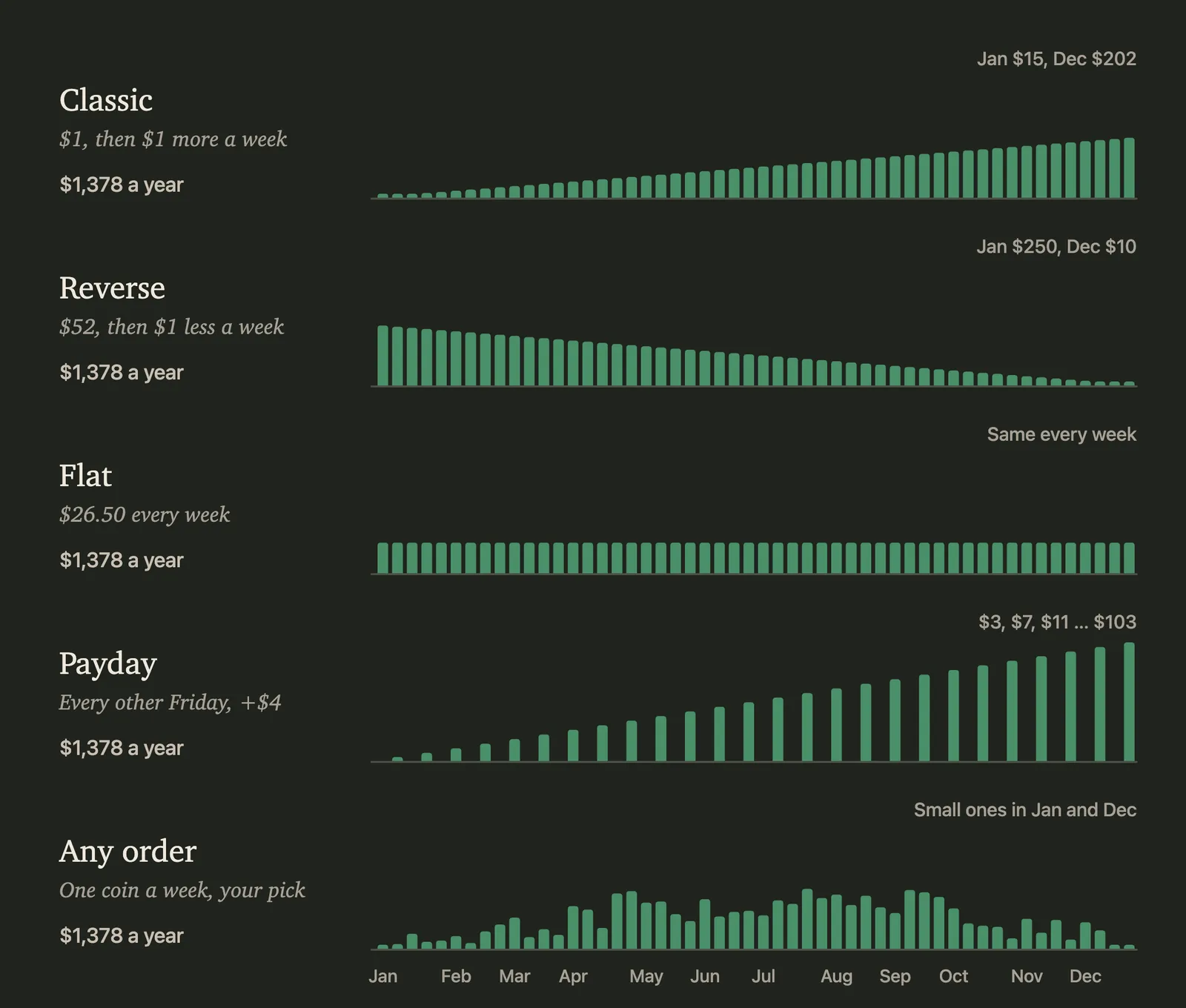
| Version | How it works |
|---|---|
| Classic | $1 in week 1, then $1 more each week. Week 52 is $52. |
| Reverse | $52 in week 1, then $1 less each week. The big deposits land in January, when motivation is highest, and December costs $10. |
| Flat | $26.50 every week. The easiest to automate, because the amount never changes. |
| Payday | Every two weeks: $3, then $4 more each time, up to $103. Each deposit is two classic weeks put together, so it matches a biweekly paycheck. |
| Any order | 52 amounts from $1 to $52, crossed off one a week in whatever order fits. Small ones in lean weeks, big ones when money is easy. |
If $1,378 is too small or too big, scale it. Doubling every amount ($2, $4, $6…) gives $2,756. Steps of $5 ($5, $10, $15…) give $6,890. For a round goal, divide it by 52 and save a flat amount: $5,000 is $96.15 a week, $10,000 is $192.31.
How to choose
Pick the version whose biggest deposit you could still make in your worst month. If December is tight, that rules out the classic (and the payday version, whose last deposit is $103). If your income is irregular, any order lets a bad week be a $3 week instead of a missed one. If you want to set it up once and forget about it, choose flat and make it an automatic transfer.
There’s one more reason to think twice about the classic. The best-known study of rising savings rates, Thaler and Benartzi’s Save More Tomorrow, worked because each step up was timed to a pay rise: participants’ savings rates went from 3.5% to 13.6% over 40 months. The classic challenge raises the amount every week whether your income rises or not. That works for some budgets, but it’s worth knowing that the escalation is the hard part, not the clever part.
Does the 52-week challenge work?
No one has studied the 52-week challenge itself. There’s no completion rate, and the “challenge finishers save three times more” claims you may see online have no source. What does exist is good research on the pieces the challenge is made of, and it says which pieces to keep.
A commitment you can’t quietly undo. In the Philippines, Ashraf, Karlan and Yin offered bank clients a savings account that locked the money until a date or an amount they chose. Only 28% of those offered opened one, yet a year later savings in the whole offered group had grown by about 80% more than in the control group. Writing the plan down, with an end date and a total, is the paper version of that commitment.
A pot with a name. Soman and Cheema paid construction workers in rural India with part of their wages set aside for savings in envelopes. Workers whose savings were split into two envelopes saved about 70% more over 14 weeks than those with one (414 rupees against 241), and envelopes printed with photos of their children helped a little more, at least when the money was split. Money that’s earmarked for something specific is harder to spend on something else.
A reminder on the day. In a study across Bolivia, Peru and the Philippines, Karlan and colleagues sent savers reminders by text message or letter. Savings rose by about 6%, and reminders that mentioned both the saver’s goal and the reward for reaching it worked best. That’s a small effect from a very cheap nudge.
Someone who sees it. In Chile, Kast, Meier and Pomeranz found that microcredit clients in peer savings groups made deposits 3.7 times as often as the control group and ended with almost twice the balance. In a later round, weekly text messages giving people feedback on their own progress had effects of a similar size. A friend doing the challenge with you counts, and so does a tracker you look at every week.
Small steps, framed as small. In a field experiment with the Acorns app, Hershfield, Shu and Benartzi offered the same deposits framed as $5 a day, $35 a week or $150 a month. The daily framing got roughly four times as many people to sign up as the monthly one. A dollar a week is about as small as a first step gets.
Automation, where you can. When one large US employer switched its retirement plan to automatic enrollment, participation among new employees rose from 37% to 86% (Madrian and Shea). The challenge’s changing amounts are hard to automate, which is one more point for the flat version, or for an automatic transfer of the classic amounts set up a month at a time.
A fresh start. People are more likely to start a goal after a landmark date: a new year, a new month, a Monday, a birthday (Dai, Milkman and Riis). In a study of retirement savings, offering to raise contributions after a fresh-start date, such as a birthday or the first day of spring, led to about 25% more saved over the following eight months than other mailings (Beshears and colleagues). January 1, 2027 is as fresh a start as it gets, but a Friday in June is one too.
For context, the latest Federal Reserve survey of household finances found that 63% of US adults would cover an unexpected $400 expense with cash or its equivalent, and 55% had three months of expenses set aside. $1,378 won’t fix everything, but it’s more than three of those $400 surprises.
How to do the challenge in 6 steps
1. Give the money a name
Not “savings”, but what it’s for: “Emergency fund: the next car repair, without the credit card”, or “Lisbon in May”. If you’re saving for two things, keep two pots. Write the name at the top of the tracker, and if you can, put a picture of it somewhere you’ll see.
2. Pick your version and your day
Choose from the table above with your worst month in mind, then pick a day. Payday is the natural one, because the money is there and it hasn’t been spent yet. If you’re paid every two weeks, the payday version matches your paycheck.
3. Open a separate account
Keep the challenge money out of your everyday account, ideally at a different bank and without a debit card attached, so moving it back takes effort. An insured savings account earns some interest, too: at 4% a year, the classic version earns roughly $18 by the end, the flat version about $27, and the reverse version about $36, because its money sits there longer.
4. Set a reminder for the day and time
“Friday, 8:00, after payday” beats “sometime this week”. Put it in your phone or your planner as a weekly repeat.
5. Tick the week only when the money has moved
Not when you meant to move it. A tracker full of honest ticks is the feedback that makes the next week easier, and the month-end total on the tracker tells you where you stand without opening your banking app.
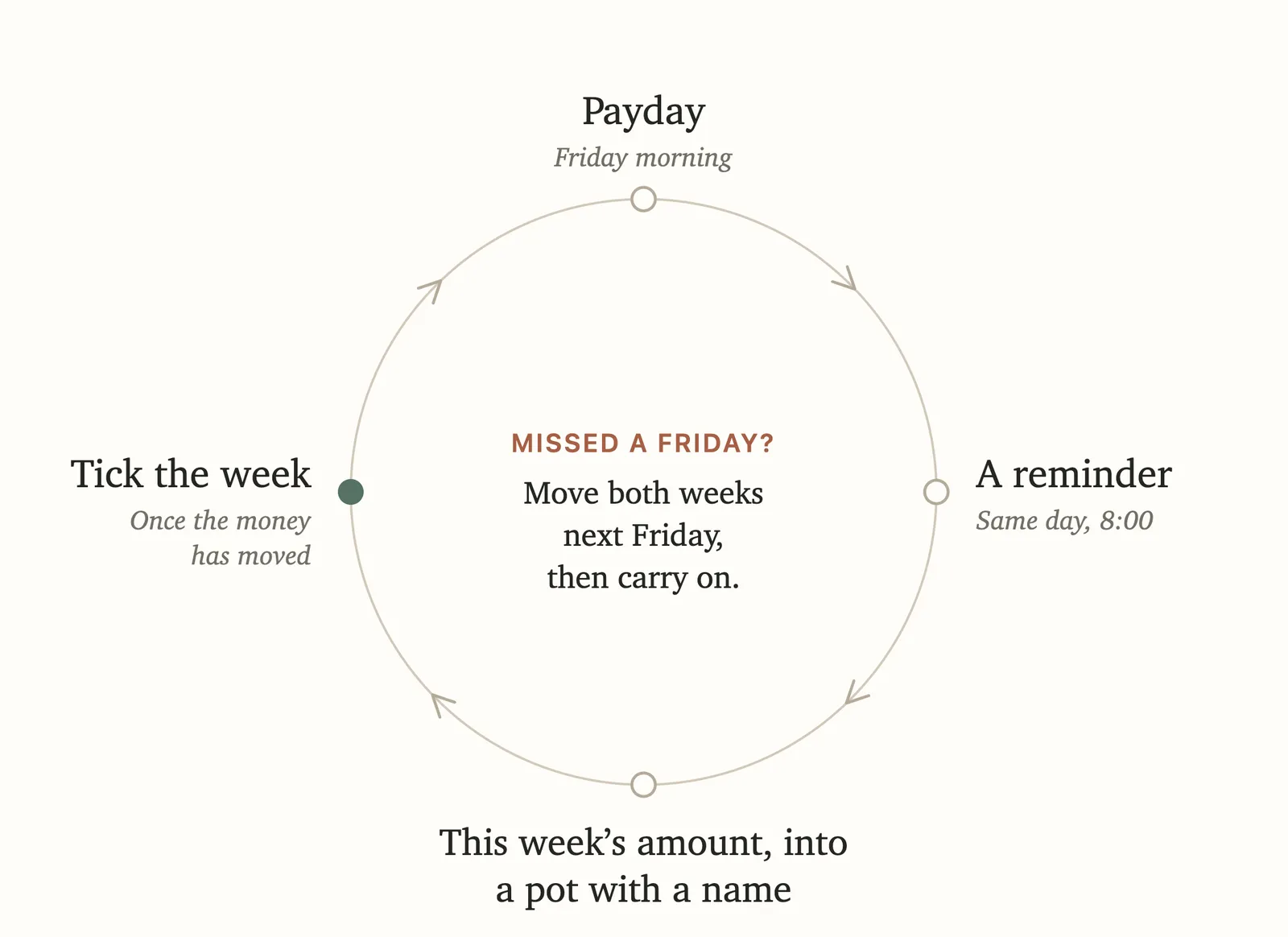
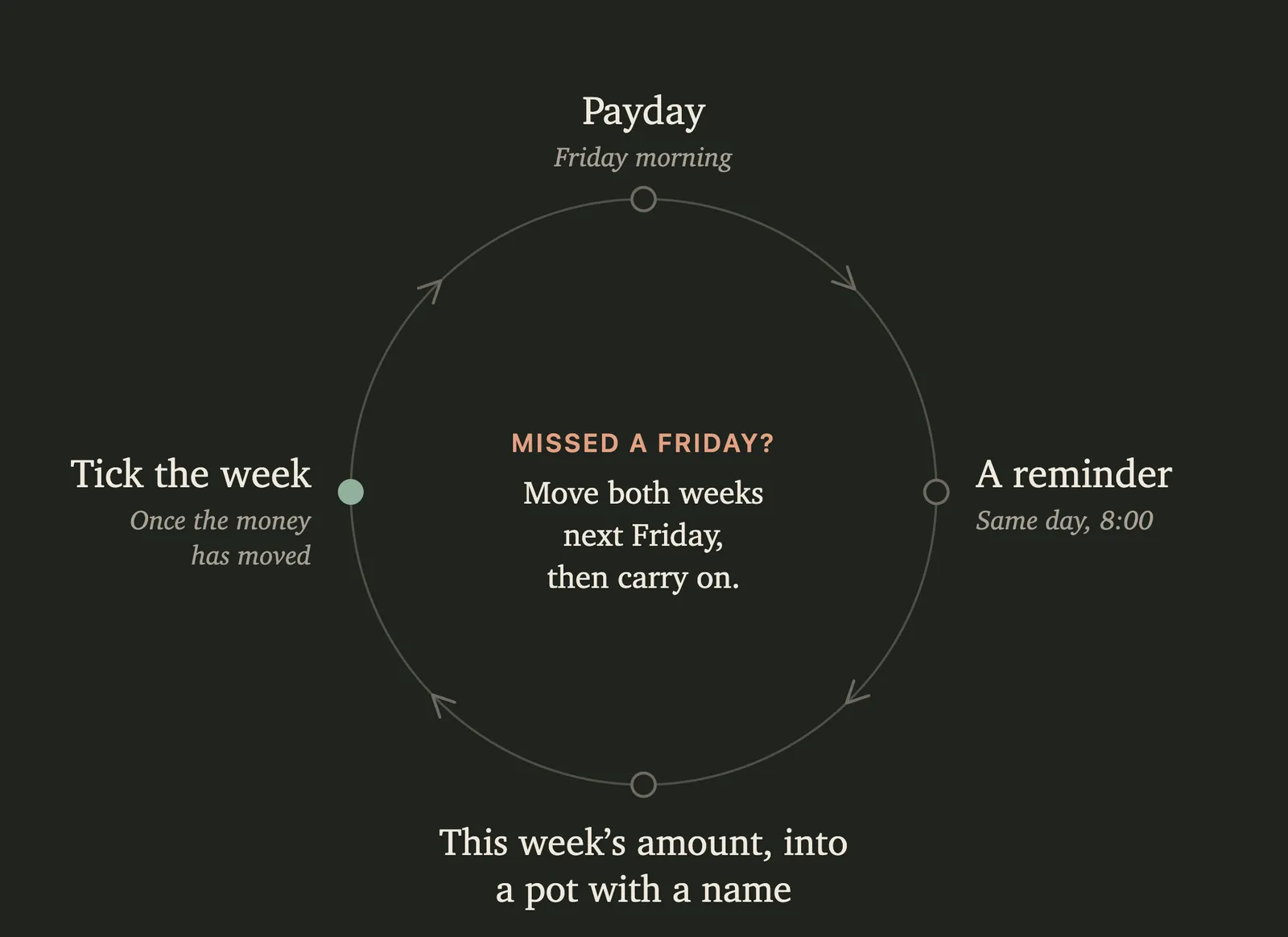
6. Decide now what happens when you miss a week
Because you will. Write your rule on the tracker before you need it. Most people pick one of these:
- Catch up next week. Move both amounts the next Friday: miss week 30 ($30) and week 31 becomes $61.
- Take a small one. In the any-order version, a lean week is a $3 week, not a missed one.
- Switch to flat. Take what’s left and divide it by the weeks left. After week 30 of the classic, $913 remains over 22 weeks: about $41.50 a week.
- Run late. Push the finish back a week for every week you miss. Nothing is lost but time.
The one rule that doesn’t work is starting over. A gap in the tracker is a week; restarting is a year.
What to do with $1,378
Decide before you start, because the name is part of what makes the money stay put. The most common order personal finance writers suggest is an emergency fund first, then high-interest debt, then the next goal you’d otherwise put on a card: a trip, a car repair, the holidays. If you finish the year and the fund is in place, the next challenge can be a bigger version, or the same one with a different name.
The 52-week challenge in Plannedo
Plannedo is a planner, not a bank, so it doesn’t move money. What it does is the loop around the money: the name, the day and the ticks.
The pot is a goal. In the example below it’s Emergency fund: $1,378, with a deadline of December 25 and a board that shows what the money is for: a photo of the car it will fix, a line in handwriting and a note with the day. A second pot, a trip, is a second goal with its own board. The Free plan includes one goal with a full board; Pro has no limit.
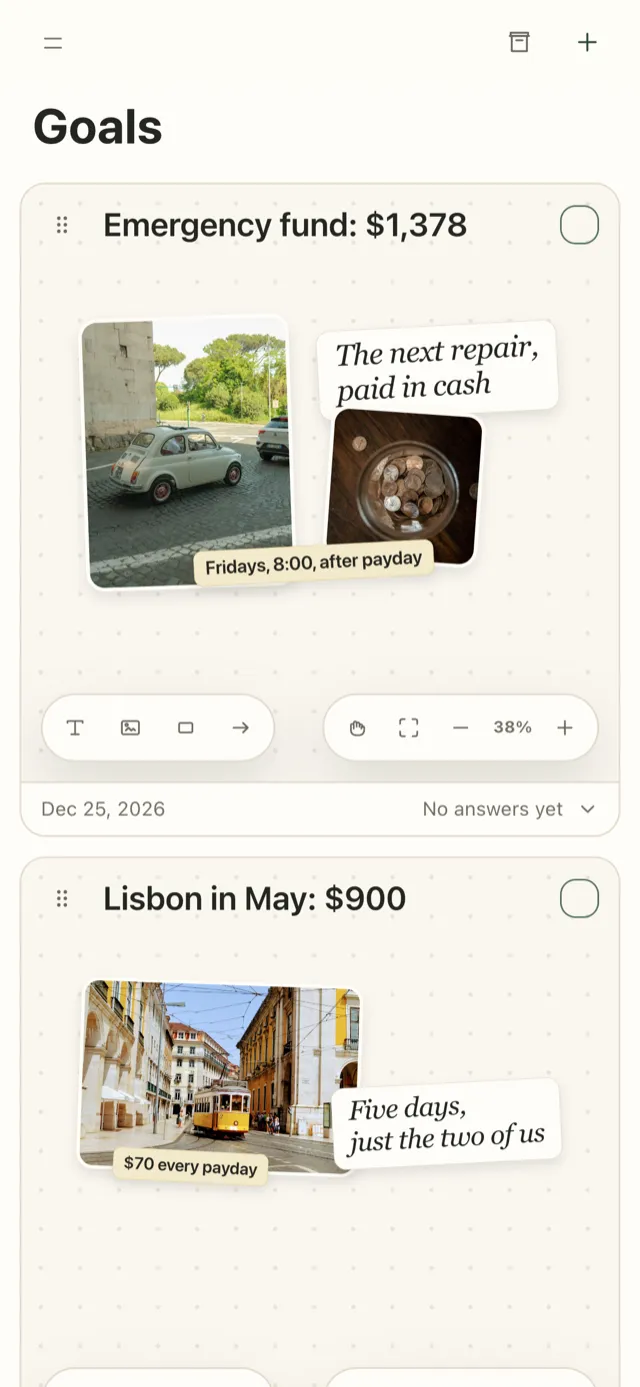

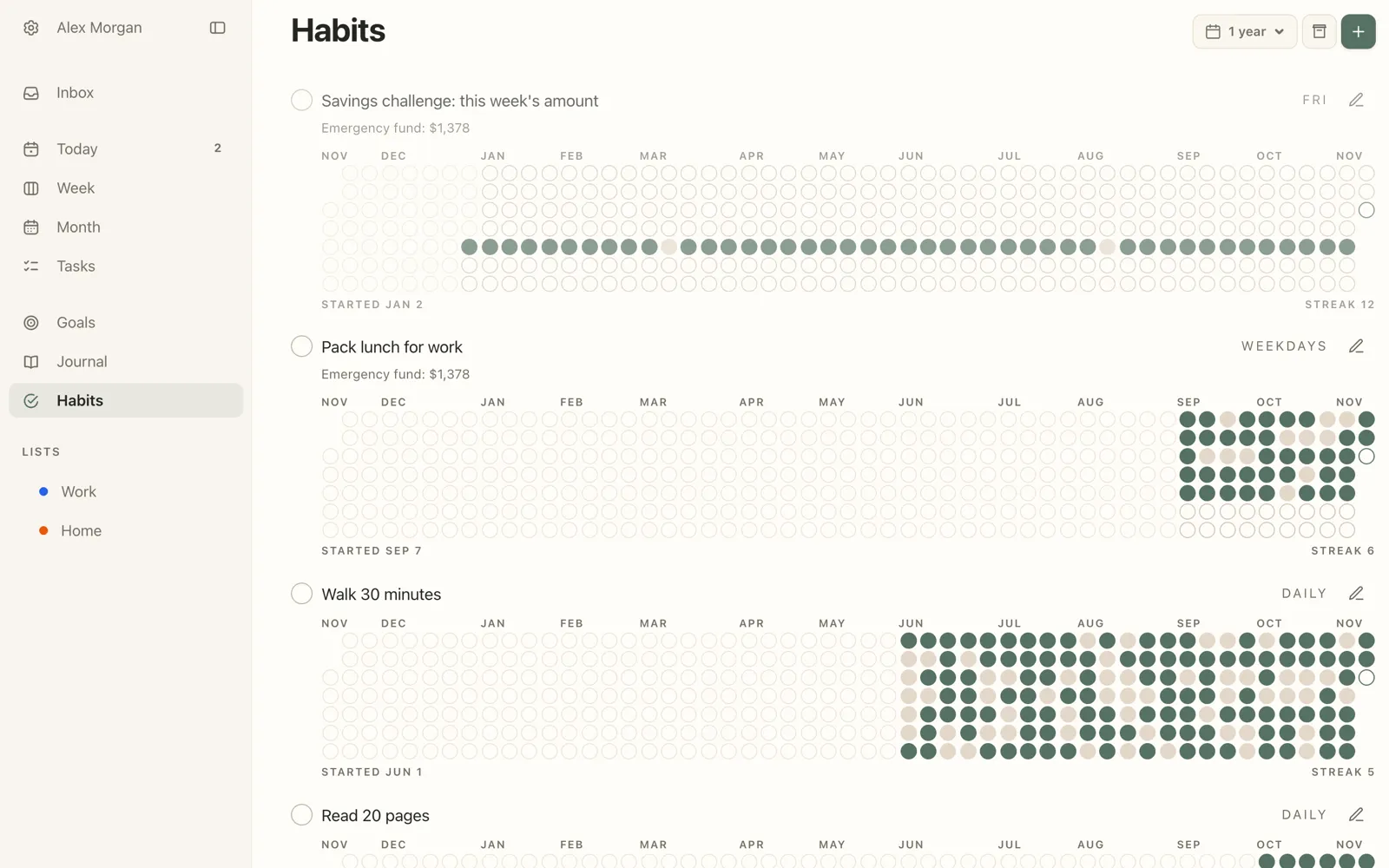
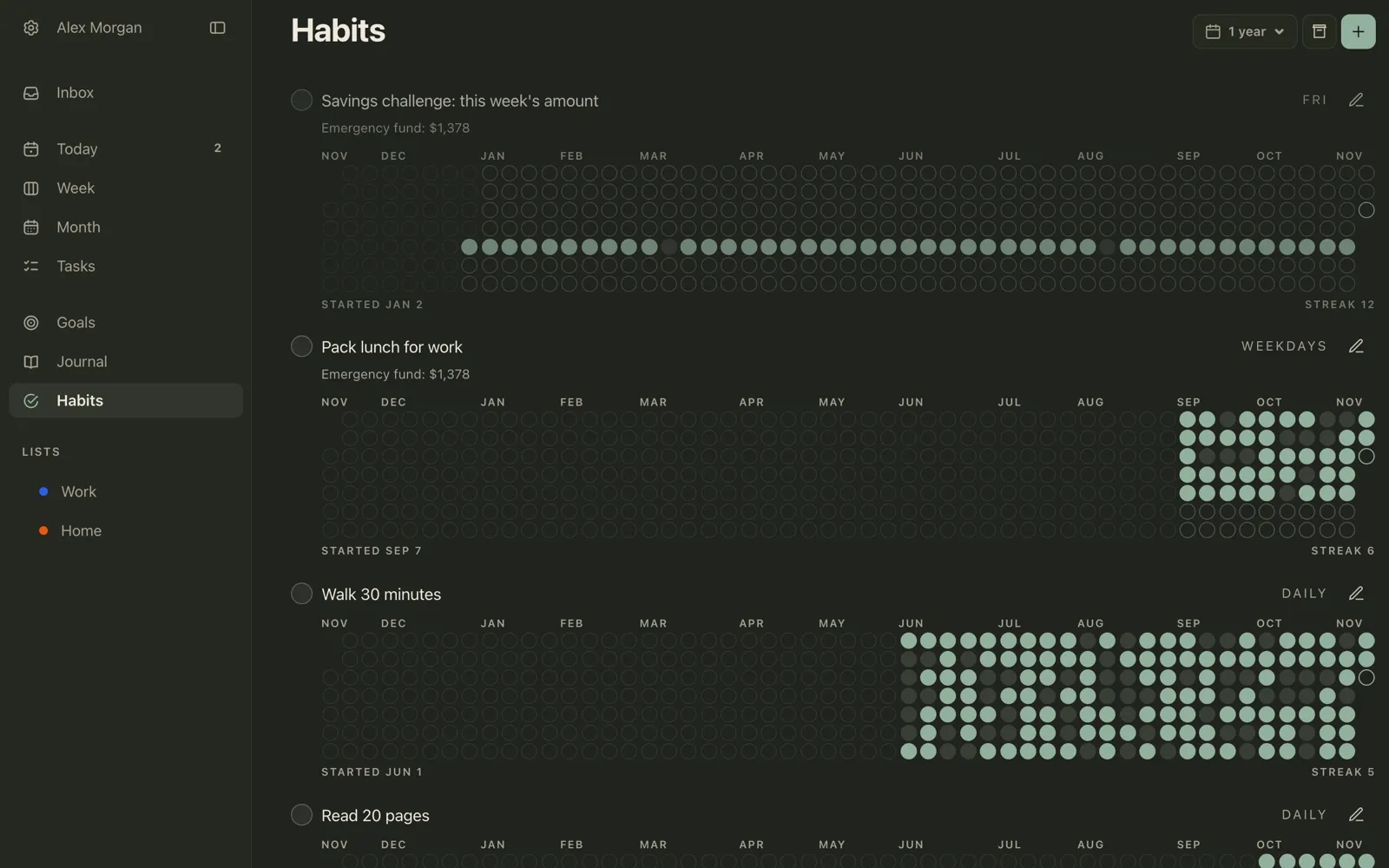
The deposit is a habit under that goal, on a Custom schedule with only Fri selected. Ticking it on Friday marks the goal as moved for the day, and the habit’s history with the range set to 1 year turns into the tracker: one dot for every Friday, with the missed ones easy to spot.
If you want a nudge at a set time, add a task with a date and a time, set Repeat to Weekly (it repeats on the weekday of its start date, so start it on a Friday) and choose a reminder, a Pro feature, At time or up to a day before. More in the help centre: goal boards, habits, repeating tasks and reminders.
Saving money is also one of the most common New Year’s resolutions, and the same rules apply to all of them: see how to stick to New Year’s resolutions, and if the challenge is one of several, the resolution bingo card. To turn the goal itself into a sentence you can check, use the SMART goals template, whose worked example is, as it happens, a savings goal.
Free 52-week savings challenge printable (PDF)
The tracker has four pages:
- Page 1, the classic chart: each week’s deposit and running total are printed, so all you fill in is the date and the tick. Above it, the plan: what you’re saving for, where the money goes, the day and time, and your rule for a missed week.
- Page 2, your own amounts: the same 52 rows with blank amounts and totals, for the reverse, flat, payday, double or $5-step versions, with all of them listed at the top.
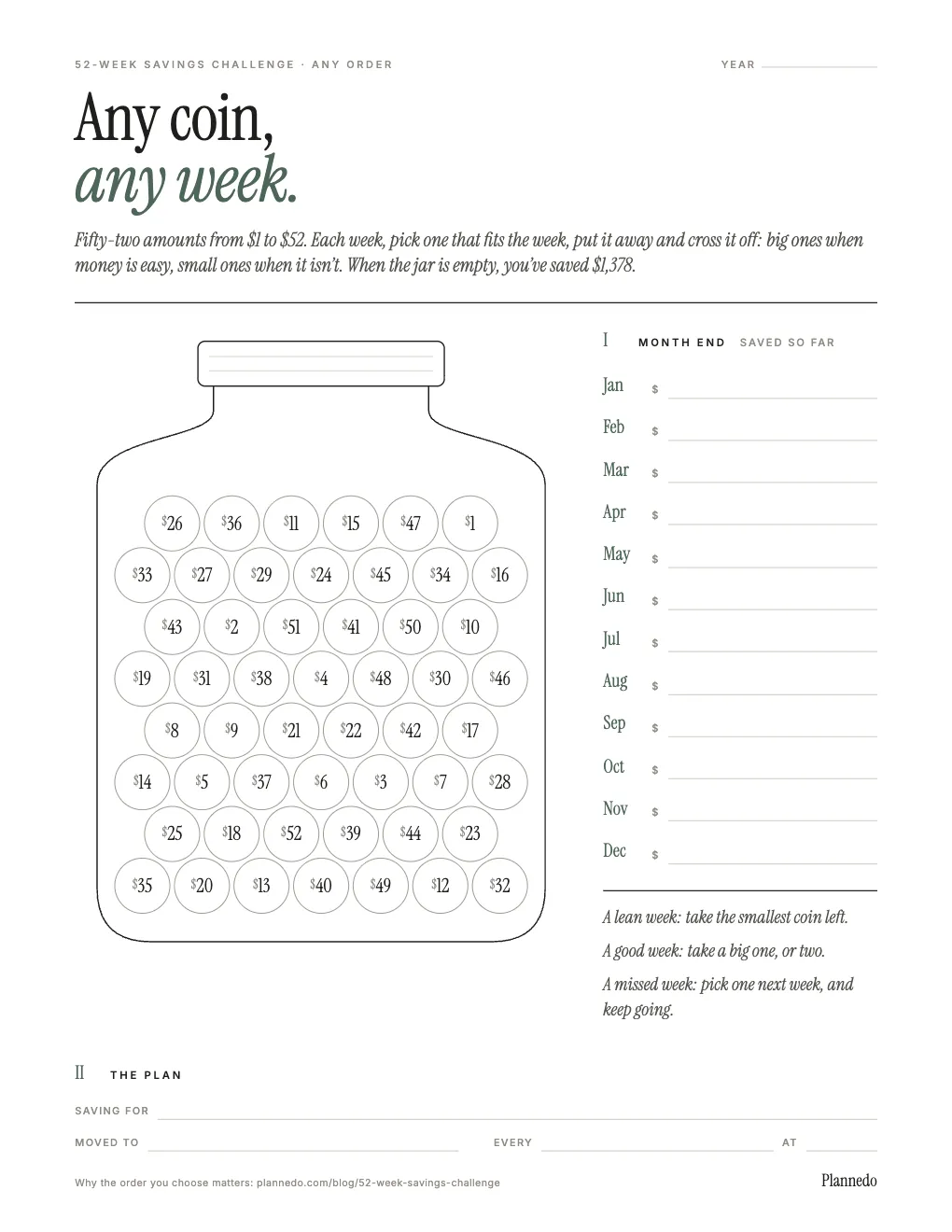
- Page 3, any order: a jar of 52 coins from $1 to $52 to cross off one at a time, with a month-end total for each month.
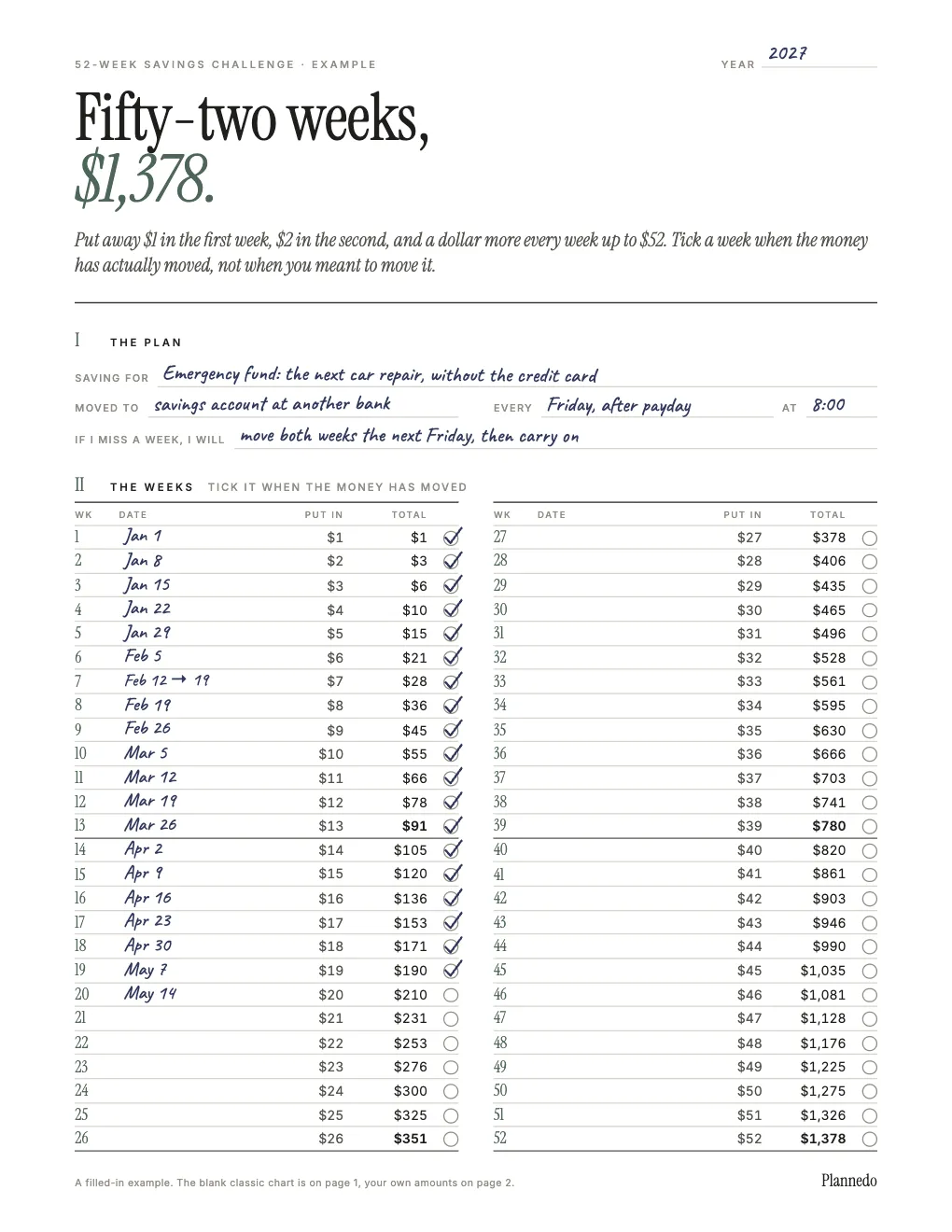
- Page 4, a filled-in example: the classic chart 20 weeks into 2027, with one week moved a Friday late.
Every line is a form field, so you can fill it in on an iPad or a computer, or print it on US Letter or A4.
FAQ
How much do you save with the 52-week savings challenge?
$1,378 in the classic version: $1 in week 1, rising by $1 a week to $52 in week 52. The reverse, flat ($26.50 a week) and payday versions save the same amount. Doubling every deposit gives $2,756, and steps of $5 give $6,890.
How much is the 52-week challenge per month?
$114.83 on average, but the classic version is uneven: in 2027, January needs $15 and December $202. The flat version is $26.50 a week, or $106 to $132.50 a month depending on whether the month has four or five Fridays.
Can I start the 52-week challenge in the middle of the year?
Yes. The challenge is 52 weeks from whichever week you start, not January to December. If you’d rather finish by December 31, either catch up by putting in the weeks you’ve missed, or switch to a flat amount: the total you want divided by the weeks left.
What happens if I miss a week?
Decide in advance and write it down. The simplest rule is to move both amounts the next week. In the any-order version, a tight week can be a small coin instead of a missed one. What doesn’t help is starting over: a missed week costs a week, a restart costs the year.
Is the reverse 52-week challenge better?
For many people, yes. It puts the biggest deposits in January, when motivation is highest and the year is fresh, and leaves December, the most expensive month, at $10. It also earns about twice the interest of the classic version, because the money arrives earlier. The trade-off is a harder start: $250 in January 2027.
How do I do the challenge if I’m paid every two weeks?
Use the payday version: $3 on the first payday, then $4 more each time, up to $103 on the 26th. Each deposit is two classic weeks added together, so the total is still $1,378. If one of your paydays falls on January 1, 2027, the year has 27 of them, so you can finish a payday early.
How do I save $5,000 or $10,000 in 52 weeks?
Divide the goal by 52 and save that every week: $96.15 a week for $5,000, $192.31 for $10,000. You can also scale the classic chart: multiply every amount by 3.63 for about $5,000, but the last weeks then cost over $180 each.
Where should I keep the money?
In a separate savings account, not your everyday one, so it’s harder to spend by accident. An account at a different bank adds a little friction, which helps. In the US, deposits at an FDIC-insured bank are covered up to $250,000 per depositor, per bank, for each account ownership category.
Studies and sources
- Ashraf, N., Karlan, D., & Yin, W. (2006). Tying Odysseus to the mast: Evidence from a commitment savings product in the Philippines. The Quarterly Journal of Economics, 121(2), 635-672.
- Soman, D., & Cheema, A. (2011). Earmarking and partitioning: Increasing saving by low-income households. Journal of Marketing Research, 48(SPL), S14-S22.
- Karlan, D., McConnell, M., Mullainathan, S., & Zinman, J. (2016). Getting to the top of mind: How reminders increase saving. Management Science, 62(12), 3393-3411.
- Kast, F., Meier, S., & Pomeranz, D. (2018). Saving more in groups: Field experimental evidence from Chile. Journal of Development Economics, 133, 275-294.
- Hershfield, H. E., Shu, S., & Benartzi, S. (2020). Temporal reframing and participation in a savings program: A field experiment. Marketing Science, 39(6), 1039-1051.
- Thaler, R. H., & Benartzi, S. (2004). Save More Tomorrow: Using behavioral economics to increase employee saving. Journal of Political Economy, 112(S1), S164-S187.
- Madrian, B. C., & Shea, D. F. (2001). The power of suggestion: Inertia in 401(k) participation and savings behavior. The Quarterly Journal of Economics, 116(4), 1149-1187.
- Dai, H., Milkman, K. L., & Riis, J. (2014). The fresh start effect: Temporal landmarks motivate aspirational behavior. Management Science, 60(10), 2563-2582.
- Beshears, J., Dai, H., Milkman, K. L., & Benartzi, S. (2021). Using fresh starts to nudge increased retirement savings. Organizational Behavior and Human Decision Processes, 167, 72-87.
- Board of Governors of the Federal Reserve System (2026). Economic Well-Being of U.S. Households in 2025, May 2026.
- FDIC. Understanding deposit insurance.
- Black Enterprise (2013). Meet the woman behind the 52 week savings challenge. CBS Miami (2013). The 52-week savings goal catching on.
- Heisey, D. J. (2004). The topless bathing suit revisited. Cumberland County History, 21(2), on Merkel Landis and the first Christmas club.
Photo credits
The cover photo is by Markus Spiske on Unsplash. The photos on the goal boards are by Alexis Presa (the car), Matthew Lancaster (the jar) and Aayush Gupta (the tram), also on Unsplash.