Morning Routine Checklist: Free Printable for Adults and Kids
A morning routine checklist that sticks: example routines for adults and kids, 40 ideas, how to build it around one anchor, and a free two-page printable.
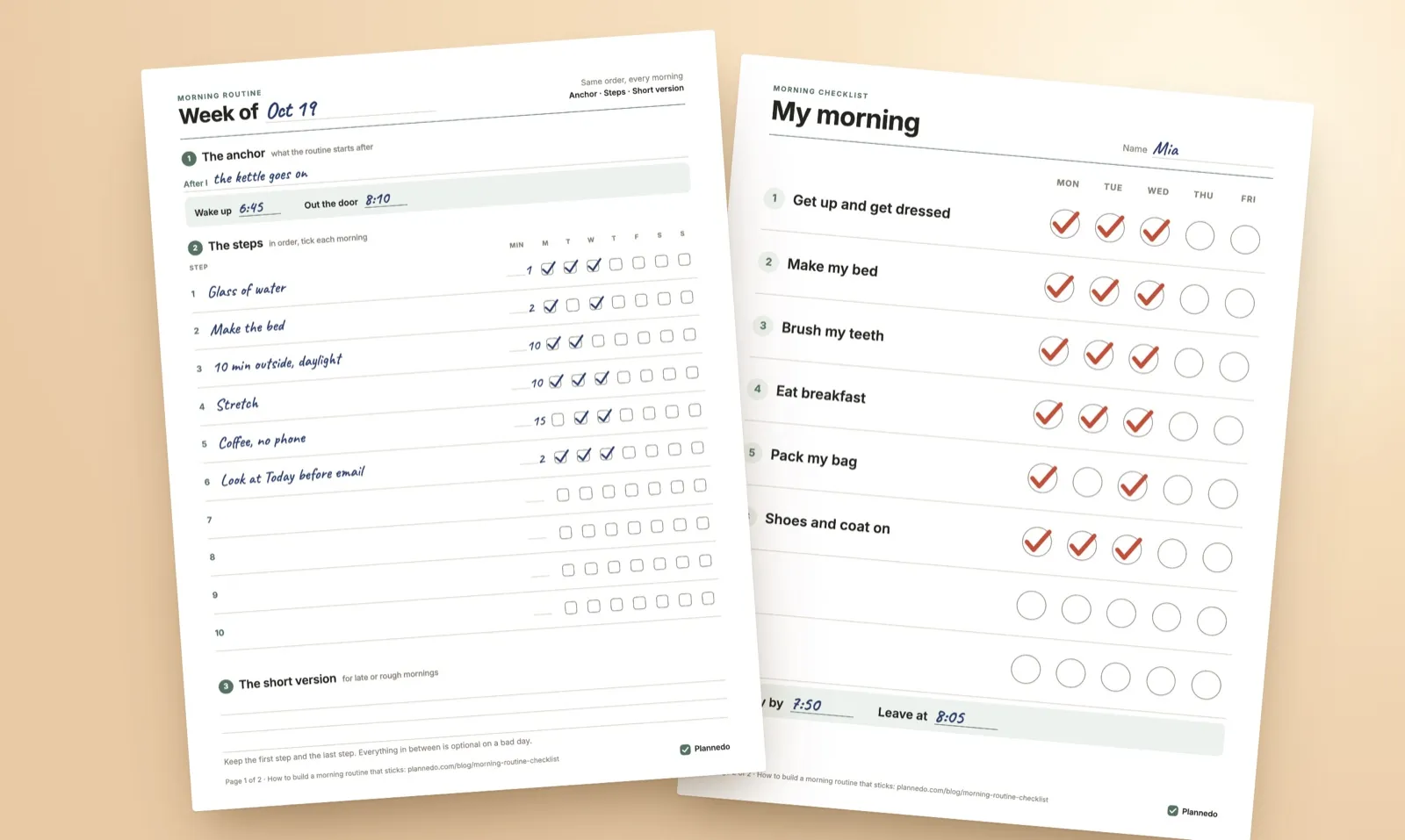
A good morning routine checklist has four to seven small steps in a fixed order, starting right after something you already do every morning. For example: after the kettle goes on, drink a glass of water, make the bed, spend ten minutes outside in daylight, stretch, and look at today’s plan before opening email. Do it in the same order every day, and keep a two-step version for mornings when everything goes wrong.
Below are example routines for adults and kids, forty ideas to build your own, how to make it stick, and a free two-page printable: a weekly checklist for adults and a school-morning checklist for kids.
Morning routine checklist for adults
A 30-minute example, from waking up to starting work:
| Step | Minutes |
|---|---|
| Glass of water after waking | 1 |
| Make the bed | 2 |
| Ten minutes outside in daylight, or by a bright window | 10 |
| Stretch | 10 |
| Coffee and breakfast, no phone | 15 |
| Look at today’s plan before email | 2 |
And the short version, for mornings that start late or badly: glass of water, look at today’s plan. Keep the first and the last step; everything in between is optional on a bad day. A routine with a short version survives the mornings that kill a routine without one.
Why a morning routine works
Mornings are already full of habits
In diary studies by Wendy Wood and colleagues, people reported what they were doing every hour of the day. About 43% of what they did was something they did almost every day, in the same context, and while doing those things their thoughts were usually elsewhere. They also felt less stressed during habitual actions than during ones they had to think through. The morning is the most repetitive part of most days, which makes it the easiest place to put a new habit: you’re adding a step to a sequence you already run on autopilot.
Morning habits may form faster
In a 2017 study by Marion Fournier and colleagues, 48 students tried to adopt a daily stretch for 90 days, half of them right after waking up and half before going to bed. Modeling their learning curves, the researchers estimated that the stretch became automatic after about 106 days in the morning group and about 154 days in the evening group. Their explanation is cortisol, a hormone that peaks in the morning and is involved in habit learning. It’s one small study, but it points the same way as everyday experience: mornings are when a routine is easiest to keep.
Morning daylight helps set your clock
In a study by Kenneth Wright and colleagues, people spent a summer week camping with only natural light. Their internal clocks shifted earlier, so that their biological night began around sunset and ended near sunrise. Indoor life, with little daylight in the day and lots of light at night, pushes the clock later. A few minutes outside in the morning is the easy part of that lesson, which is why it’s on the example list.
How to build a morning routine that sticks
- Pick the anchor. The routine starts after something you already do without thinking: the alarm, the kettle, the first coffee, getting out of the shower. Write it down: “After the kettle goes on.” A fixed cue is what turns a sequence into a habit; reminders only nag you through it.
- Start with three steps. The ones that matter most, in the order you’ll do them. Add a fourth after a couple of weeks, when the first three run by themselves.
- Fix the order. Same steps, same order, every day. The order is the routine; each step becomes the cue for the next.
- Time it backwards. Write down when you have to be out the door and how long each step takes, then set the wake-up time from that. Most rushed mornings are a math problem.
- Keep the phone for last. Messages and news fill whatever time you give them. Put “look at today’s plan” at the end of the routine, and email after that.
- Prepare the night before. Clothes out, bag packed, the first task of the day decided. The evening routine in how to plan your day the night before does most of the work a morning routine gets credit for.
- Track it for a month. Tick each step every morning. After four weeks you’ll see which steps stuck and which only looked good on paper. New habits take about two months to feel automatic; the research is in How Long Does It Take to Form a Habit?.
40 morning routine ideas
Pick three to start. You won’t need more than seven.
Body
- Drink a glass of water
- Ten minutes outside in daylight
- Stretch for ten minutes
- Walk around the block
- Push-ups or squats, two sets
- A cold splash of water on the face
- A 20-minute run, three mornings a week
- Breakfast sitting down
- Take your vitamins or medication
- Skincare
Mind
- No phone until after breakfast
- Three deep breaths before getting up
- Five minutes of quiet with coffee
- Read ten pages
- Write one line in a journal
- Write down one thing you’re looking forward to
- Listen to a podcast or music instead of news
- Ten minutes of a language app
- Pray or meditate
- Look out of the window for a minute
Home
- Make the bed
- Open the curtains and a window
- Unload the dishwasher
- Wipe the kitchen counter
- Start a load of laundry
- Water the plants
- Feed and walk the dog
- Take out the trash on its day
Plan
- Look at today’s plan before email
- Pick the one thing that has to happen today
- Check the calendar for fixed appointments
- Move one task you won’t get to
- Fill your water bottle for the day
- Pack lunch
- Check the weather and dress for it
People
- Breakfast together, phones away
- Say good morning properly
- Send one kind message
- Walk the kids to school
- Hug before anyone leaves
Morning routine checklist for kids
A before-school checklist works best with five or six steps, in the same order every day, on paper where the child can see it:
- Get up and get dressed
- Make the bed
- Brush teeth
- Eat breakfast
- Pack the bag
- Shoes and coat on
A few things help:
- Let them tick it. A child who ticks their own box owns the routine. Page two of the printable has big circles for exactly that.
- Prepare the evening before. Clothes laid out, bag by the door. Mornings go wrong over socks and lost homework.
- Use the same order every day. Arguments are about decisions; a fixed order removes the decisions.
- Pictures for young children. For kids who can’t read yet, draw a small picture next to each step.
- Give a “ready by” time, not a list of reminders. “Ready by 7:50” lets them pace it themselves.
Morning routine for adults with ADHD
These are practical adjustments many people with ADHD find helpful; if you work with a clinician or coach, follow their advice first.
- Make it visible. A printed checklist by the bathroom mirror or the kettle, or a widget on the phone’s home screen.
- Fewer, smaller steps. Three steps that happen beat seven that don’t.
- Prepare the night before. Every decision made in the evening is one less to make while half asleep.
- Put the phone at the end. If the phone comes first, the routine usually doesn’t come at all.
- Time it. Estimate each step’s minutes once, then check against reality for a week.
Common morning routine mistakes
- Copying someone else’s routine. A 5 am routine from a podcast won’t fit a life with a toddler.
- Too many steps. Ten habits at once is a wish list.
- No short version. Without one, a single late start breaks the whole routine.
- Phone first. The first five minutes of messages turn into thirty.
- Judging it after three days. It takes weeks before a new step runs by itself.
A morning routine in Plannedo
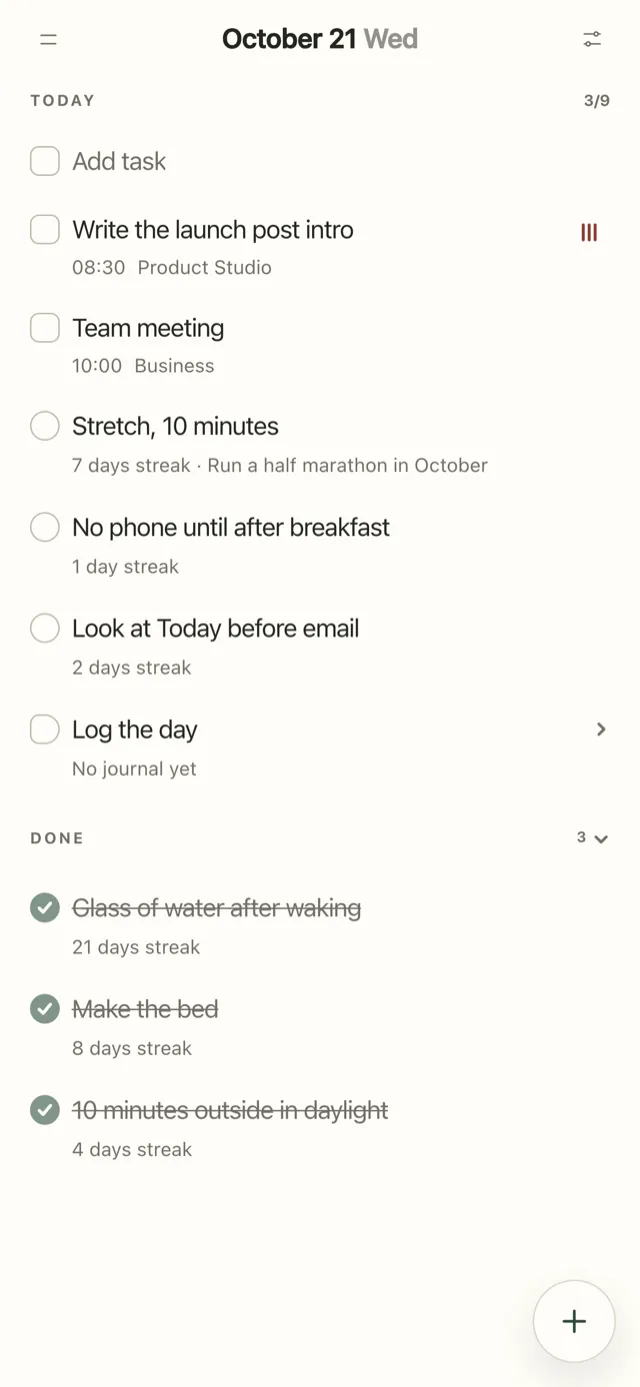
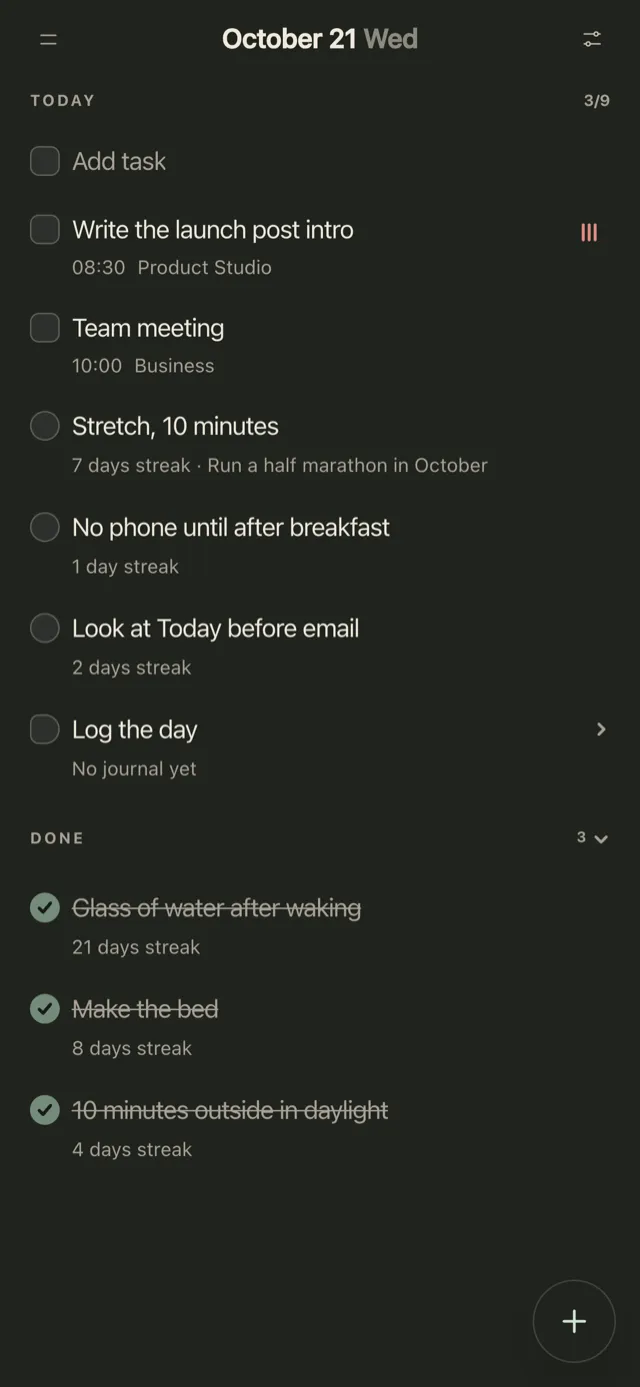
I build Plannedo, a daily planner with habits, so this is how I set mine up. Each step is a habit with its own schedule: Daily, Weekdays, Weekends or any days you pick. The Today page lists the day’s habits under its tasks, and ticked ones move to Done, so by eight o’clock the morning is either finished or plainly not.
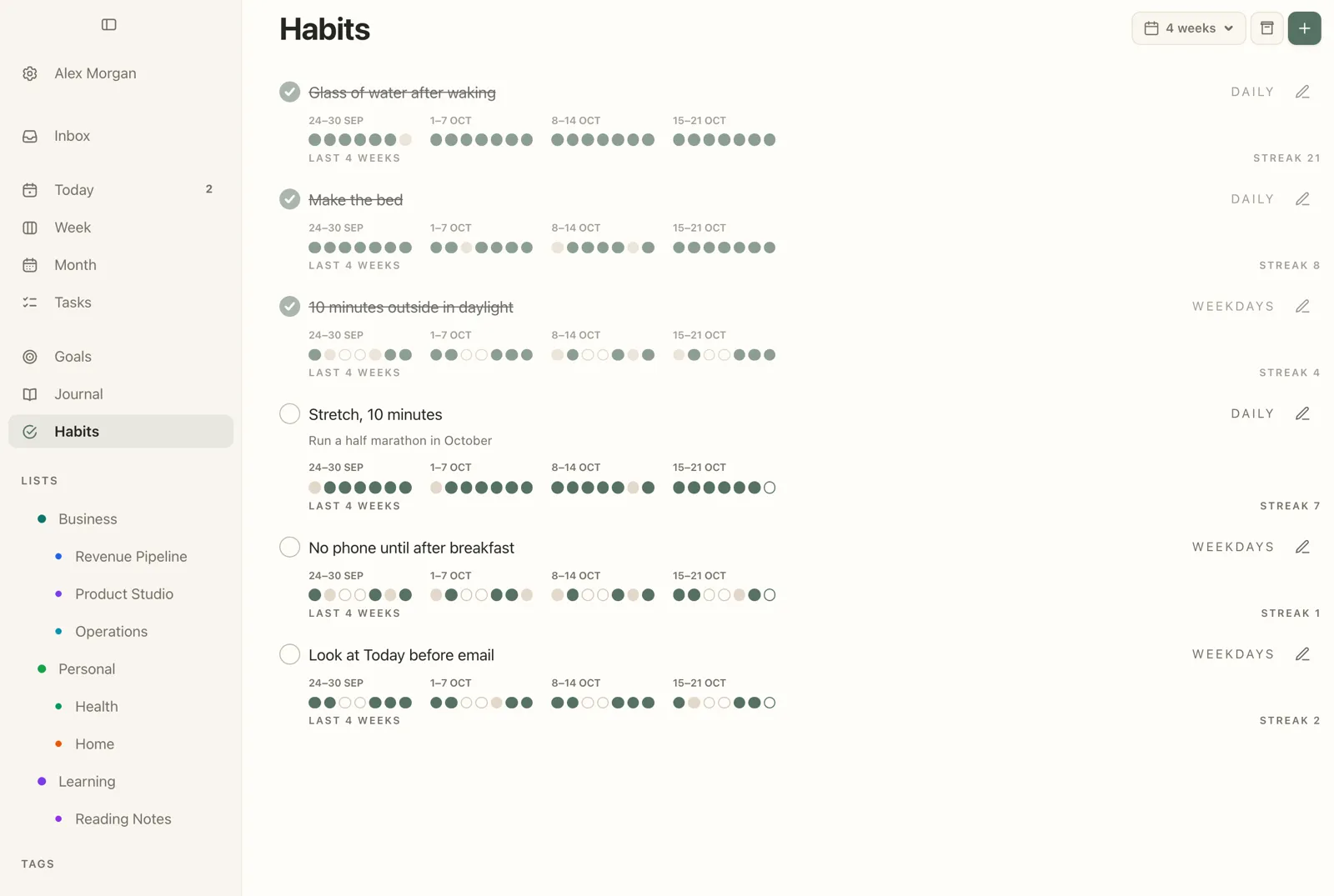
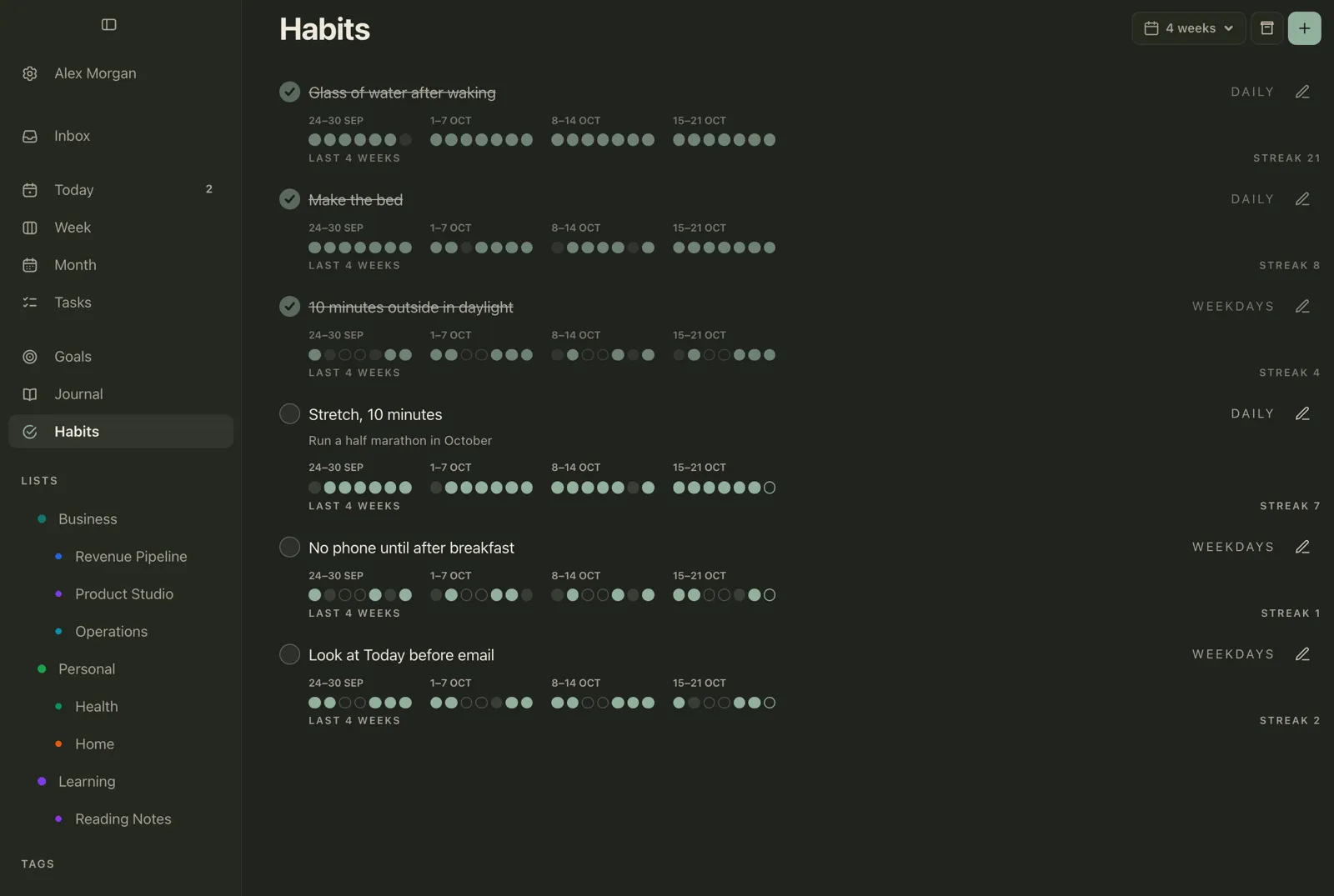
The Habits screen shows each step’s last four weeks, so you can see which ones stuck. In the example, the glass of water and the bed are nearly solid; “No phone until after breakfast” is the one that needs work.
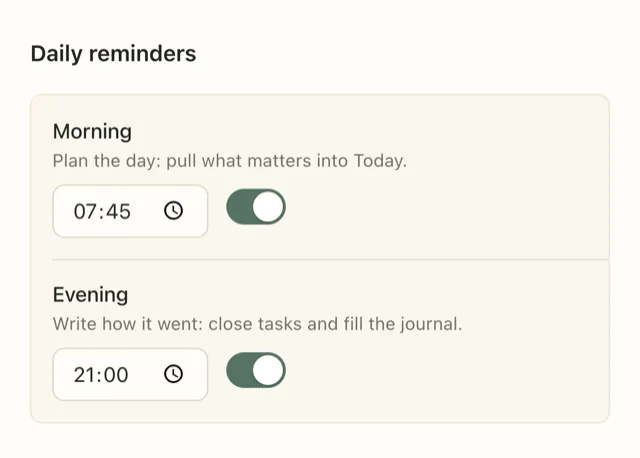
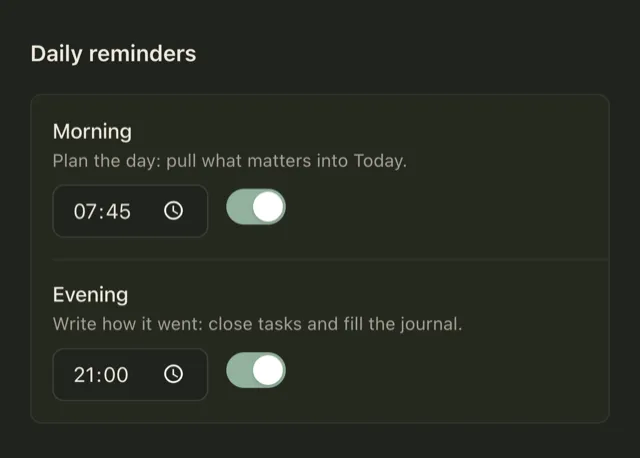
You can tick habits from the iPhone and Mac widgets without opening the app (Widgets). With Pro, a morning reminder at the time you choose opens Today, ready for the last step of the routine (Daily reminders).
If you’d rather track the routine on paper, the free habit tracker printable makes a monthly sheet for any set of habits, and there are more ideas in Habit Tracker Ideas.
FAQ
What should be on a morning routine checklist?
Four to seven small steps in a fixed order, starting after something you already do every morning. A common set: a glass of water, make the bed, ten minutes outside in daylight, stretch, breakfast without the phone, and a look at today’s plan before email.
How long should a morning routine take?
Twenty to sixty minutes for most adults, depending on when you need to leave. Work backwards from your out-the-door time, and keep a two-step version for late mornings.
What is a good morning routine for kids before school?
Five or six steps in the same order every day: get up and get dressed, make the bed, brush teeth, eat breakfast, pack the bag, shoes and coat on. Put it on paper where they can tick it, and lay out clothes and the bag the evening before.
How do I stick to a morning routine?
Start with three steps, attach the first to something you already do, keep the same order every day, prepare the night before, and tick each step for a month. Add more only when the first steps run by themselves.
Is the morning the best time to build a habit?
It’s a good one. In a 2017 study, a stretching habit done right after waking became automatic after about 106 days, against about 154 days for the same stretch done before bed.
Should I check my phone first thing in the morning?
Leave it for the end of the routine. Messages and news fill whatever time you give them, and the steps after them tend not to happen.
Studies mentioned
- Wood, W., Quinn, J. M., & Kashy, D. A. (2002). Habits in everyday life: Thought, emotion, and action. Journal of Personality and Social Psychology, 83(6), 1281-1297.
- Fournier, M., d’Arripe-Longueville, F., Rovere, C., Easthope, C. S., Schwabe, L., El Methni, J., & Radel, R. (2017). Effects of circadian cortisol on the development of a health habit. Health Psychology, 36(11), 1059-1064.
- Wright, K. P., McHill, A. W., Birks, B. R., Griffin, B. R., Rusterholz, T., & Chinoy, E. D. (2013). Entrainment of the human circadian clock to the natural light-dark cycle. Current Biology, 23(16), 1554-1558.