Habit Tracker Ideas: 100 Habits to Track (+ Free Printable)
100 habit tracker ideas by category: health, sleep, money, work, students and habits to break, plus how many to track at once and a free printable tracker.
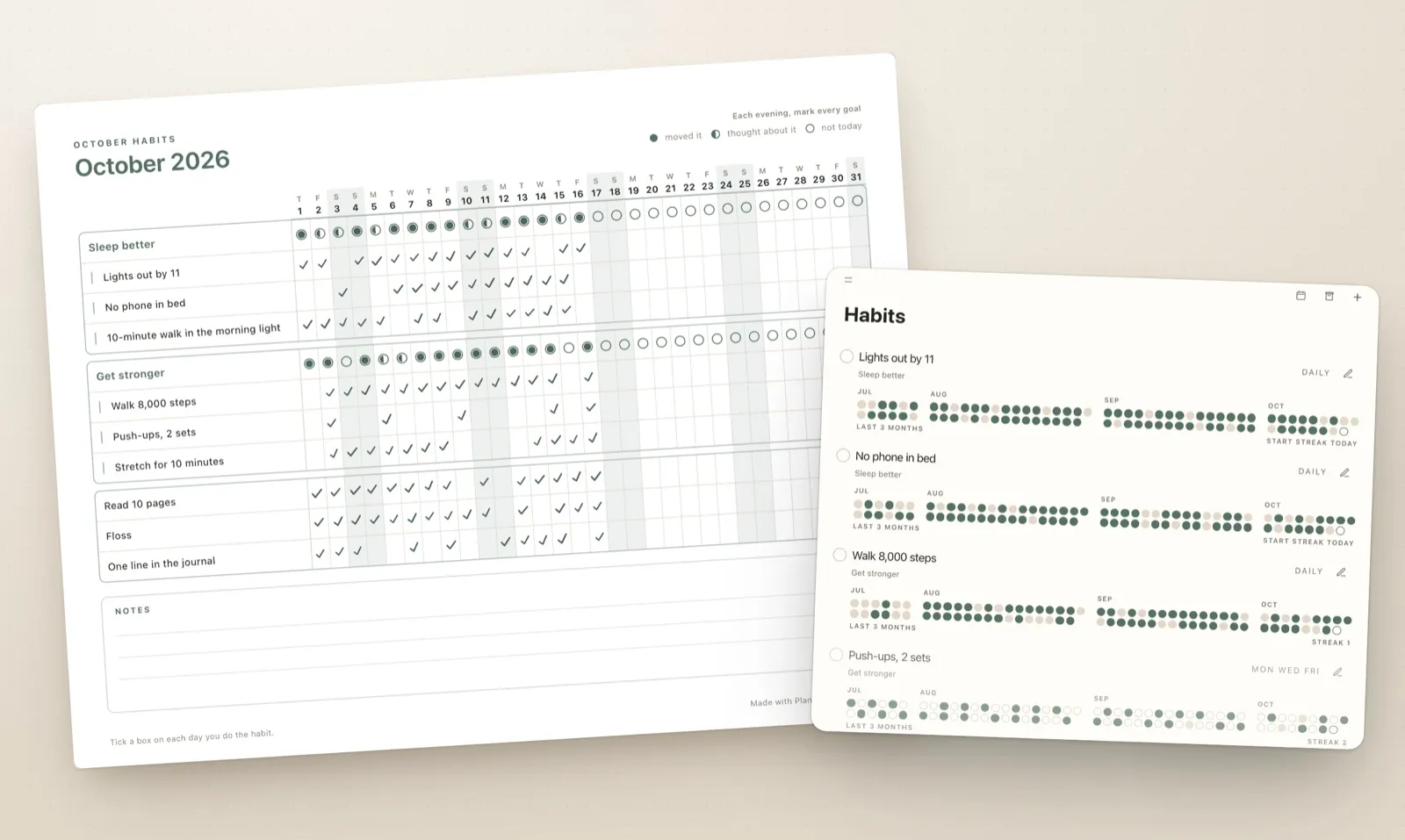
Good habit tracker ideas are small, daily actions you can tick off: walk 8,000 steps, lights out by 11, read 10 pages, no phone in bed, floss, drink water with every meal. Track three to five at a time, write each one as an action rather than a result, and tie it to something you already do, like “after coffee”.
Below are 100 ideas grouped by area of life, with short lists for students and busy adults, habits to break, and layouts for a bullet journal. If you want to print a tracker straight away, the free habit tracker printable makes one for any month.
How to choose habits worth tracking
A habit tracker works when every row is something you can answer with yes or no at the end of the day. Three rules get you there.
1. Track the action, not the result. “Lose 5 kg” can’t be ticked today; “Walk 8,000 steps” can. The result comes from the action, and the action is what you control.
2. Make it small enough for a bad day. “Read 10 pages”, not “Read more”. “Push-ups, 2 sets”, not “Get fit”. A habit you can do on a tired Tuesday survives; one that needs a perfect day doesn’t. Simple habits also tend to become automatic sooner than demanding ones, as the studies in How Long Does It Take to Form a Habit? show.
3. Tie it to something you already do. In a 2015 study, Katarzyna Stawarz, Anna Cox and Ann Blandford compared ways of supporting a new daily habit over four weeks. Reminders helped people repeat the behaviour, but they got in the way of it becoming automatic. Linking the habit to an existing event in the day, “after breakfast”, “when I sit down at my desk”, made it more automatic. So write the cue into the habit: “After coffee: read 10 pages.”
| Hard to track | Easy to track |
|---|---|
| Get fit | Walk 8,000 steps |
| Sleep better | Lights out by 11 |
| Read more | After coffee: read 10 pages |
| Eat healthier | A vegetable with lunch and dinner |
| Be less on my phone | Phone stays out of the bedroom |
| Save money | Log every expense |
How many habits should you track at once?
Start with three to five. A tracker with fifteen rows turns into a daily report card, and a run of empty boxes makes it easy to give up on all of them. Add a new habit when the old ones feel automatic, which typically takes about two months, not three weeks.
Tracking itself helps. A 2016 meta-analysis of 138 experiments found that getting people to monitor their progress made them more likely to reach their goals, especially when the progress was written down. A tracker on the fridge or in an app you open every day does exactly that.
100 habit tracker ideas
Health and movement
- Walk 8,000 steps
- Take the stairs
- Stretch for 10 minutes
- Push-ups, 2 sets
- 20-minute run or brisk walk
- Yoga, even 10 minutes
- Stand up once an hour at work
- Strength training (on its days)
- Cycle to work
- Floss
- Take your medication on time
- Wear sunscreen
On steps: a 2022 analysis of 15 studies with 47,471 adults found the risk of death kept falling with more daily steps until about 6,000 to 8,000 for people over 60 and 8,000 to 10,000 for younger adults. That’s a more useful target than the famous 10,000, which, as the authors note, has little evidence behind it.
Sleep
- Lights out by 11
- No phone in bed
- Same wake-up time, weekends too
- No caffeine after 2 pm
- Screens off an hour before bed
- Ten minutes of morning light outside
- Seven hours in bed
- Start winding down at 10:30
Seven hours isn’t arbitrary: the American Academy of Sleep Medicine and the Sleep Research Society recommend that adults sleep seven or more hours a night on a regular basis.
Food and drink
- Water with every meal
- A vegetable with lunch and dinner
- Cook dinner at home
- No snacks after dinner
- Bring lunch to work
- Fruit instead of dessert
- No alcohol on weeknights
- Breakfast sitting down
- Prep tomorrow’s lunch
Mind and mood
- One line in a journal
- Three things that went well
- Meditate for 5 minutes
- Rate your mood from 1 to 5
- Ten minutes outside without your phone
- A three-minute breathing exercise
- Lunch break away from the desk
- Write down one worry and one next step
Learning and reading
- Read 10 pages
- 20 minutes of a language
- One lesson of a course
- Learn one new word
- Practise an instrument for 15 minutes
- Write 200 words
- Review flashcards
- Check the news once a day, not all day
Work and focus
- Plan tomorrow before you finish (how to plan your day the night before)
- First hour without email
- One 90-minute focus block
- Clear the inbox once a day
- Close all tabs at the end of the day
- Take a real lunch break
- Stop work by 6
- Update the to-do list
- Do one task you’ve been avoiding
Money
- Log every expense
- No-spend day
- Check your bank balance
- Move $5 into savings
- Wait 24 hours before buying anything over $50
- Make coffee instead of buying it
- Review subscriptions (monthly)
Home and chores
- Make the bed
- Ten-minute tidy
- Dishes done before bed
- One load of laundry
- Water the plants
- Clear the desk
- Take out the recycling (on its day)
- Open the mail
Relationships
- Message a friend
- Call your parents
- Phone-free dinner
- Ten minutes of undivided time with your partner or kids
- Say thank you to someone
- Ask someone a real question
- Plan one thing with friends (weekly)
Phone and screen time
- Phone stays out of the bedroom
- Under an hour of social media
- No phone for the first 30 minutes after waking
- Notifications off after 8 pm
- Phone in another room while you work
- No screens at meals
Creativity and self-care
- Draw for 10 minutes
- Take one photo you like
- Write a page of a story
- Play music
- Cook something new (weekly)
- Skincare, morning and evening
- A walk at lunch
- Half an hour for a hobby
- A bedtime stretch
- Get dressed before you start work at home
Habits to break
For a habit you want to stop, tick the days you didn’t do it, or better, track what you do instead.
- No smoking
- No sugar in coffee
- No nail biting
- No impulse buys
- No snooze button
- No scrolling after 10 pm
- No takeaway on weekdays
- No energy drinks
Habit tracker ideas for students
- Study for 25 minutes before touching the phone
- Review today’s notes
- Read the assigned chapter
- Pack the bag the night before
- Asleep by midnight
- Plan tomorrow’s assignments
- Practise a language for 15 minutes
- Exercise for 20 minutes
- Phone away in lectures
- Drink water between classes
Habit tracker ideas for busy adults
When the day is full, pick habits that take minutes and fit an existing routine, such as a morning routine:
- Walk 8,000 steps (take calls on foot)
- Lights out by 11
- Cook dinner at home
- Log every expense
- Message a friend
- First hour without email
- Floss after brushing
- One line in the journal
Weekly and monthly habits to track
Not everything belongs on a daily grid. A few things work better once a week or once a month:
- Weekly: a weekly review, a long run, a call with your parents, a meal plan, cleaning the fridge.
- Monthly: checking the budget, reviewing subscriptions, a deep clean, a day trip.
On paper, give weekly habits their own short list rather than a row with 30 boxes, most of them empty by design. In an app, give them a schedule so the days off don’t count as misses.
Bullet journal habit tracker ideas
A few layouts that work in a bullet journal:
- The monthly grid. Habits down the side, days across the top, a box to tick each day. The classic, and the easiest to keep up.
- Grouped by goal. Put the habits that serve one goal together, under the goal’s name, so you see at a glance whether “Sleep better” is getting your attention or just its first row.
- The weekly strip. Seven wide columns with room for a note. Good for the first weeks of a new habit.
- A year at a glance. One small square per day for a single habit you want to keep for the whole year.
Leave white space, and keep the tracker on a page you open every day. A tracker in the back of the notebook gets forgotten by the second week.
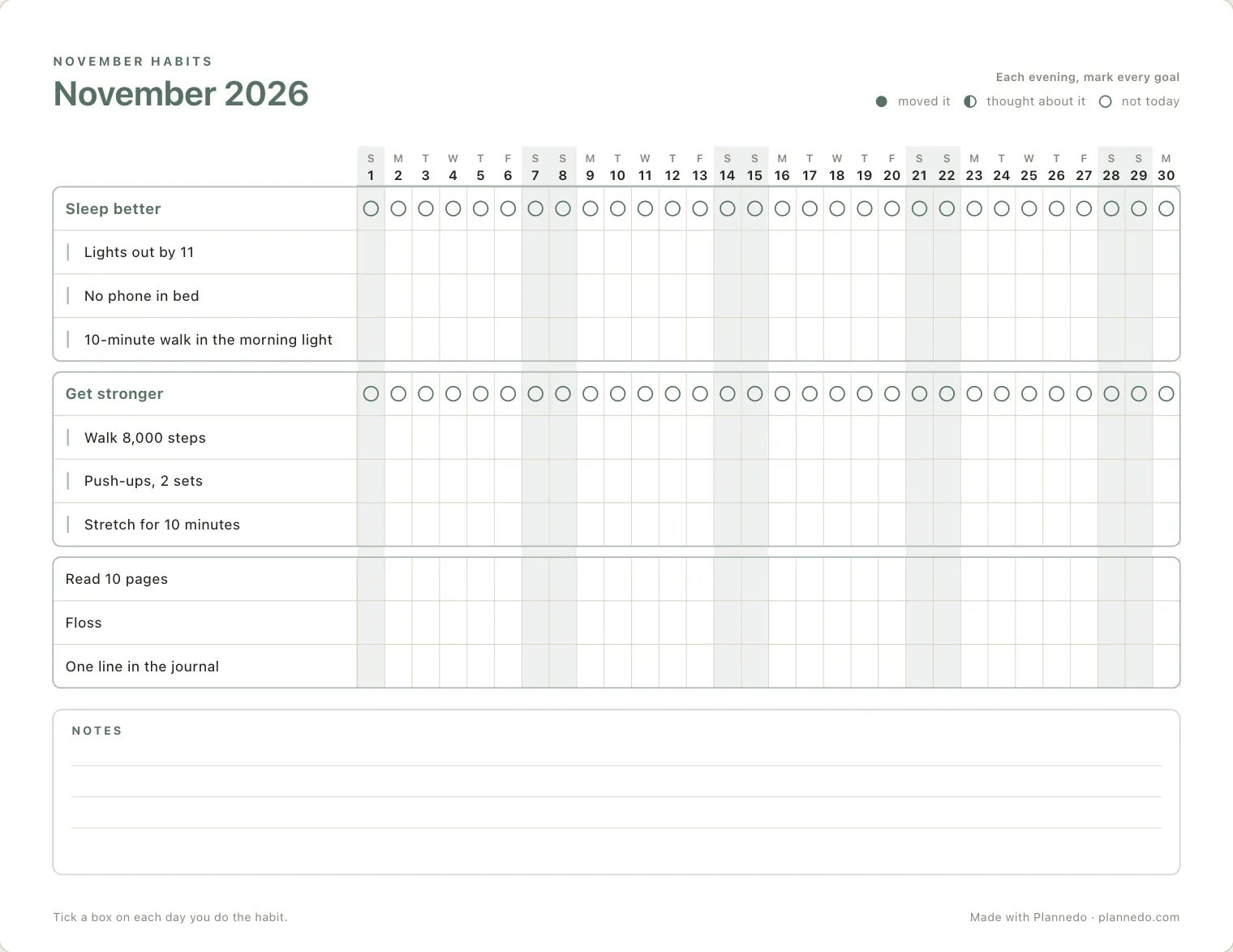
If you’d rather not draw the grid, the free habit tracker printable does it for you: type your habits, group them under a goal if you like, pick a month, a week or a whole year, and print it or download a PDF for A4 or US Letter. The PNG works in GoodNotes and Notability.
Tracking habits in an app
Paper is great until you forget it at home or fill up the page. An app keeps the history and shows the pattern over months. We compared ten of them, with prices and free plans, in the best habit tracker apps.
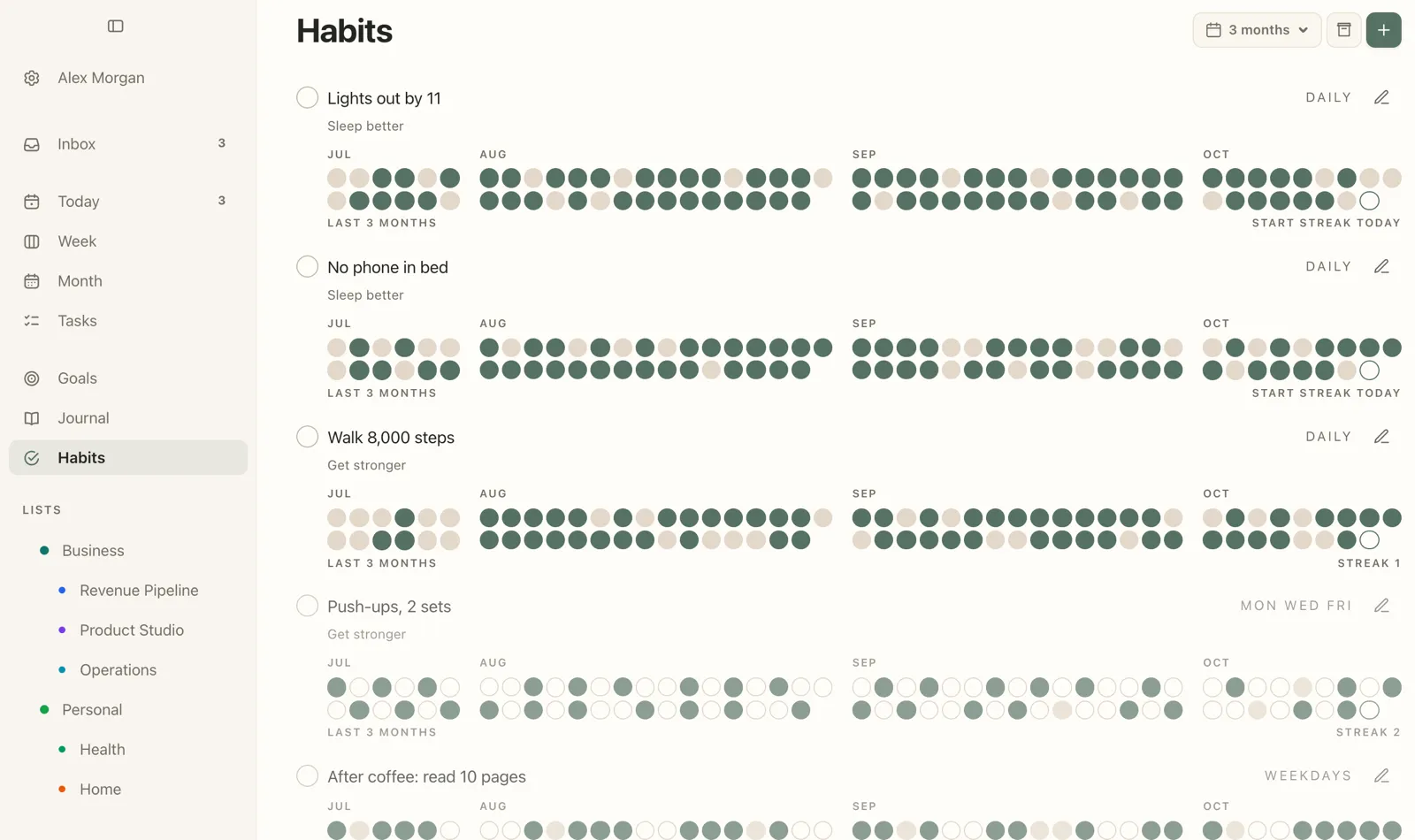
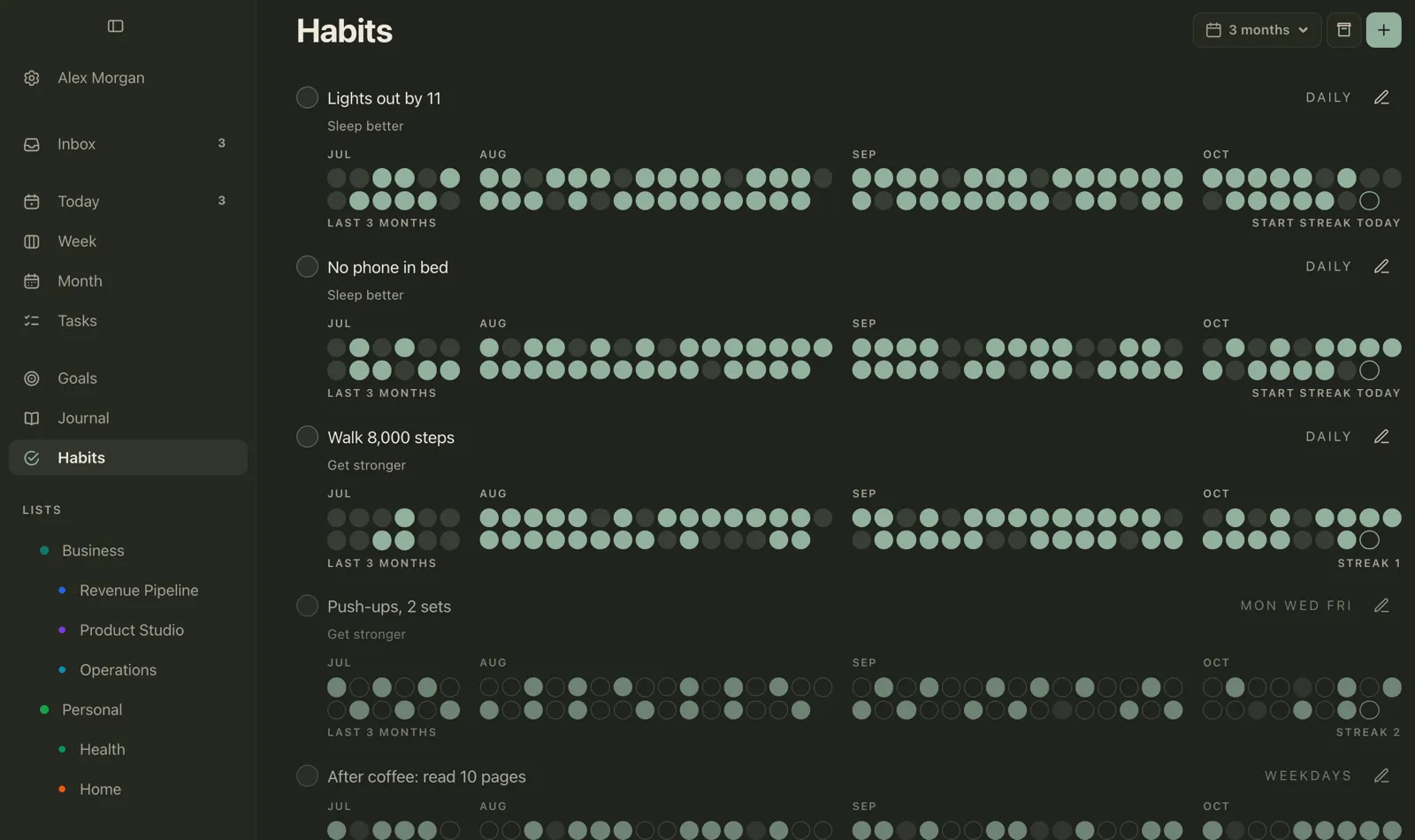
In Plannedo, a habit has a schedule (Daily, Weekdays, Weekends or any days you pick), a streak, and a history you can view by 4 weeks, 3 months or a year. A habit can belong to a goal, and ticking it marks the goal as moved for the day. You tick habits on the Today page, on Week and Month, or straight from the iPhone and Mac widgets. The free plan includes three habits, which is a good number to start with (Habits and streaks).
FAQ
What should I put in my habit tracker?
Small, daily actions you can answer with yes or no: walk 8,000 steps, lights out by 11, read 10 pages, no phone in bed, floss. Write each habit as an action rather than a result, and start with three to five.
What are good daily habits to track?
Ones that support what you care about most right now. Common picks: steps, a bedtime, reading, water with meals, a short workout, a line in a journal, no phone in bed, and logging expenses.
How many habits should you track at once?
Three to five. More than that turns the tracker into a report card, and a page of empty boxes makes it easy to give up. Add a new habit when the current ones feel automatic, which usually takes about two months.
What are good habit tracker ideas for students?
Study for 25 minutes before checking the phone, review the day’s notes, read the assigned chapter, pack the bag the night before, sleep by midnight, and exercise for 20 minutes.
Should I track habits daily or weekly?
Track daily habits daily, on one grid. Give weekly habits like a long run or a call with your parents their own short list, or a schedule in an app, so the days off don’t look like misses.
Is it better to track habits on paper or in an app?
Both work if you look at them every day. Paper is visible and satisfying to tick; an app keeps the history, follows you everywhere and can show habits next to your tasks. Some people do both: a printed sheet on the fridge for the family and an app for themselves.
Studies mentioned
- Stawarz, K., Cox, A. L., & Blandford, A. (2015). Beyond self-tracking and reminders: Designing smartphone apps that support habit formation. Proceedings of the 33rd Annual ACM Conference on Human Factors in Computing Systems (CHI ‘15), 2653-2662.
- Lally, P., van Jaarsveld, C. H. M., Potts, H. W. W., & Wardle, J. (2010). How are habits formed: Modelling habit formation in the real world. European Journal of Social Psychology, 40(6), 998-1009.
- Harkin, B., Webb, T. L., Chang, B. P. I., Prestwich, A., Conner, M., Kellar, I., Benn, Y., & Sheeran, P. (2016). Does monitoring goal progress promote goal attainment? A meta-analysis of the experimental evidence. Psychological Bulletin, 142(2), 198-229.
- Paluch, A. E., et al. (2022). Daily steps and all-cause mortality: A meta-analysis of 15 international cohorts. The Lancet Public Health, 7(3), e219-e228.
- Watson, N. F., et al. (2015). Recommended amount of sleep for a healthy adult: A joint consensus statement of the American Academy of Sleep Medicine and Sleep Research Society. Sleep, 38(6), 843-844.