75 Hard Challenge: Rules, Free Tracker (PDF) and What to Know
The 75 Hard rules as the official FAQ explains them, a free fillable 75-day tracker (PDF), how to fit two workouts into a workday, what the research says, and 75 Hard vs Medium vs Soft.
The 75 Hard challenge is 75 days in a row of five daily tasks: follow a diet with no cheat meals and no alcohol, do two 45-minute workouts (one of them outdoors), drink a gallon of water, read 10 pages of a nonfiction book, and take a progress photo. Miss any of them, on any day, and you start again at day 1. Below are the rules as the official FAQ explains them, a free 75 Hard tracker you can print or fill in on a screen, a plan for fitting it around a workday, and what the research says about the parts that work and the parts that don’t.
This post and the tracker are unofficial: Plannedo isn’t affiliated with Andy Frisella or 44Seven Media, which owns the 75 HARD trademark. The full official rules are free on his site.
What is 75 Hard?
75 Hard was created by Andy Frisella, an entrepreneur and podcast host, who introduced it on his podcast in March 2019 and calls it “a transformative mental toughness program”. That framing matters. It isn’t designed as a training plan or a diet, and it doesn’t tell you which workouts to do or what to eat. It asks you to keep five promises to yourself every day for 75 days, with no exceptions and no substitutions, and to start over when you don’t.
Officially, 75 Hard is also the first step of a longer program, LIVEHARD, which adds three more 30-day phases over the rest of the year. This post is about the 75 days.
The 75 Hard rules
Every day, for 75 days in a row:
- Follow a diet. Any diet that fits your goal, chosen by you. No cheat meals and no alcohol.
- Do two workouts of 45 minutes each. One of them has to be outdoors.
- Drink a gallon of water. That’s about 3.8 liters.
- Read 10 pages of a book. Nonfiction, for self-improvement or learning.
- Take a progress picture.
If you miss any task on any day, you start over at day 1. Not day 2 of a new week: day 1 of 75.
The official FAQ answers most of the questions that come up in the first week. In short:
| Question | What the official FAQ says |
|---|---|
| Can a 45-minute workout be split into two shorter ones? | No. Each workout is 45 minutes in one go. |
| How far apart should the two workouts be? | At least three hours apart. |
| Does the outdoor workout count under a roof or a cover? | No. It has to be outside. |
| What counts as water? | A gallon of plain water, nothing added. |
| Do audiobooks count? | No. Ten pages, read. |
| What counts as a day? | From when you wake up to when you go to bed. |
| Can you start a new book before finishing the last? | No. Finish each book before the next. |
Everything else is up to you: the diet, the kind of workout, the book. That freedom is the point, and also the risk, which comes up below.
75 days, added up
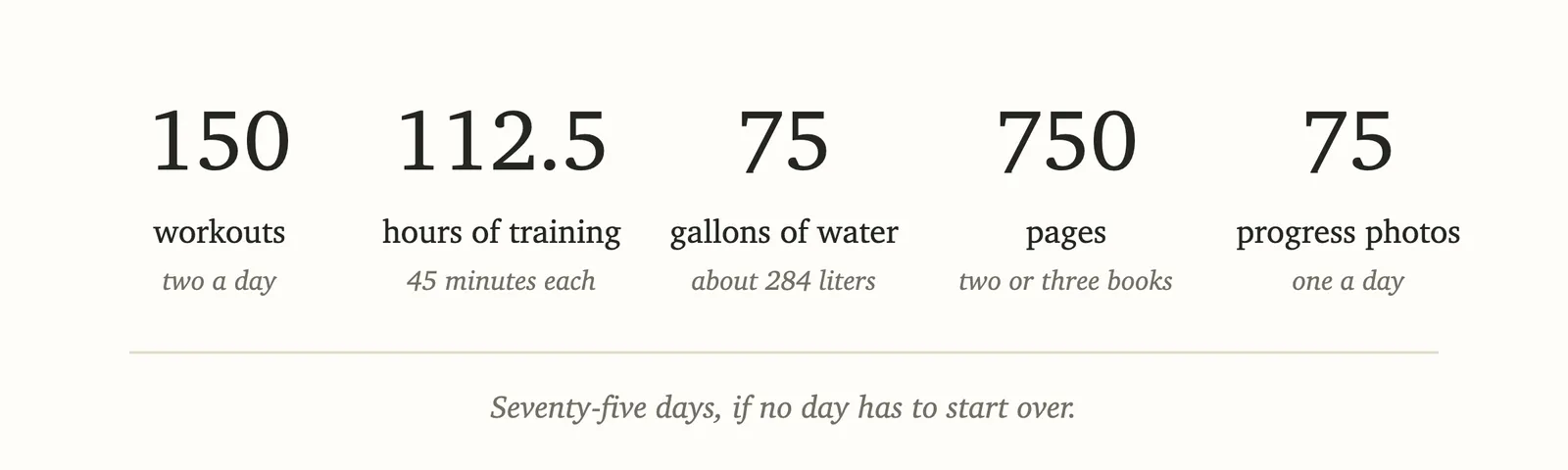
Done in one go, 75 Hard is 150 workouts, 112.5 hours of training, 75 gallons of water and 750 pages. Ten pages a day sounds small, and it is: at an average reading speed for nonfiction, it takes 10 to 15 minutes. The workouts are what take the day: an hour and a half of training, plus changing, showering and getting there, every day for 11 weeks.
Is 75 Hard good for you? What the research says
There are no published studies of 75 Hard itself: no completion rates and no measured results. Even Frisella’s own page on the science behind it says the evidence doesn’t come from a trial of the program. What does exist is solid research on each of its parts, and it splits the challenge in two.
What the research supports. Daily self-monitoring works. A meta-analysis of 138 studies by Harkin and colleagues found that monitoring your progress toward a goal reliably helps you reach it, and that the effect is larger when the progress is physically recorded or made public. A tick on a tracker and a photo every morning are exactly that. Seventy-five days is also a sensible length for new habits: in Lally and colleagues’ study of how habits form, a daily behavior took 66 days on average to become automatic, with a range from 18 to 254.
What it doesn’t. The restart rule. In the same habit study, missing a single day didn’t materially affect how the habit formed. Habits are built by repetition over weeks, not by an unbroken chain. And all-or-nothing rules have a known failure mode: once a rule is broken, people tend to abandon it entirely rather than return to it, which psychologists call the “what-the-hell effect”. Research on relapse finds the same pattern: a lapse is most likely to turn into giving up when people read it as proof they have no willpower, rather than as one bad day. The day-1 reset is a deliberate test of discipline, which is what Frisella intends. It isn’t how habits work, and for many people one bad day becomes the reason they stop altogether.
The training load. Two 45-minute workouts a day add up to 630 minutes a week. The WHO’s guidelines for adults are 150 to 300 minutes of moderate activity a week, or 75 to 150 minutes of vigorous activity, plus muscle-strengthening on two or more days. More activity brings further benefits, but 75 Hard has no rest days. If you’re starting from little or no exercise, make most of the workouts easy, such as a brisk walk, and build up. The US guidelines put it as “start low and go slow”: sudden jumps in hard training are how overuse injuries happen, and, rarely, exertional rhabdomyolysis, a breakdown of muscle that shows up as very sore muscles and dark, tea-colored urine and needs a doctor.
The water. A gallon is 3.8 liters of plain water on top of what you get from food and other drinks. The US National Academies’ adequate intake for total water, from all sources, is about 3.7 liters a day for men and 2.7 liters for women, about 80% of it from drinks. For most healthy adults a gallon spread across the day is more than needed but harmless. Drinking a lot of it fast is not: healthy kidneys can only clear about 0.8 to 1 liter an hour, and too much water too quickly can dilute the blood’s sodium (hyponatremia). Spread it out, and don’t use the last hour before bed to catch up.
The diet and the photos. The rules don’t set a diet, which is sensible, but strict food rules and a daily photo of your body aren’t a good mix for everyone. If you have a history of disordered eating, or notice the challenge making food or your body feel like the enemy, choose a gentler version or skip the photo. The official guidance is also clear on one point: don’t start if your doctor advises against it. That’s worth a call if you’re pregnant, have a heart, kidney or blood pressure condition, or are recovering from an injury.
How to fit 75 Hard into a workday
The challenge rarely breaks on effort. It breaks on a late meeting, a rainy evening or a forgotten water bottle. Most of the planning is deciding, before day 1, where each task goes.
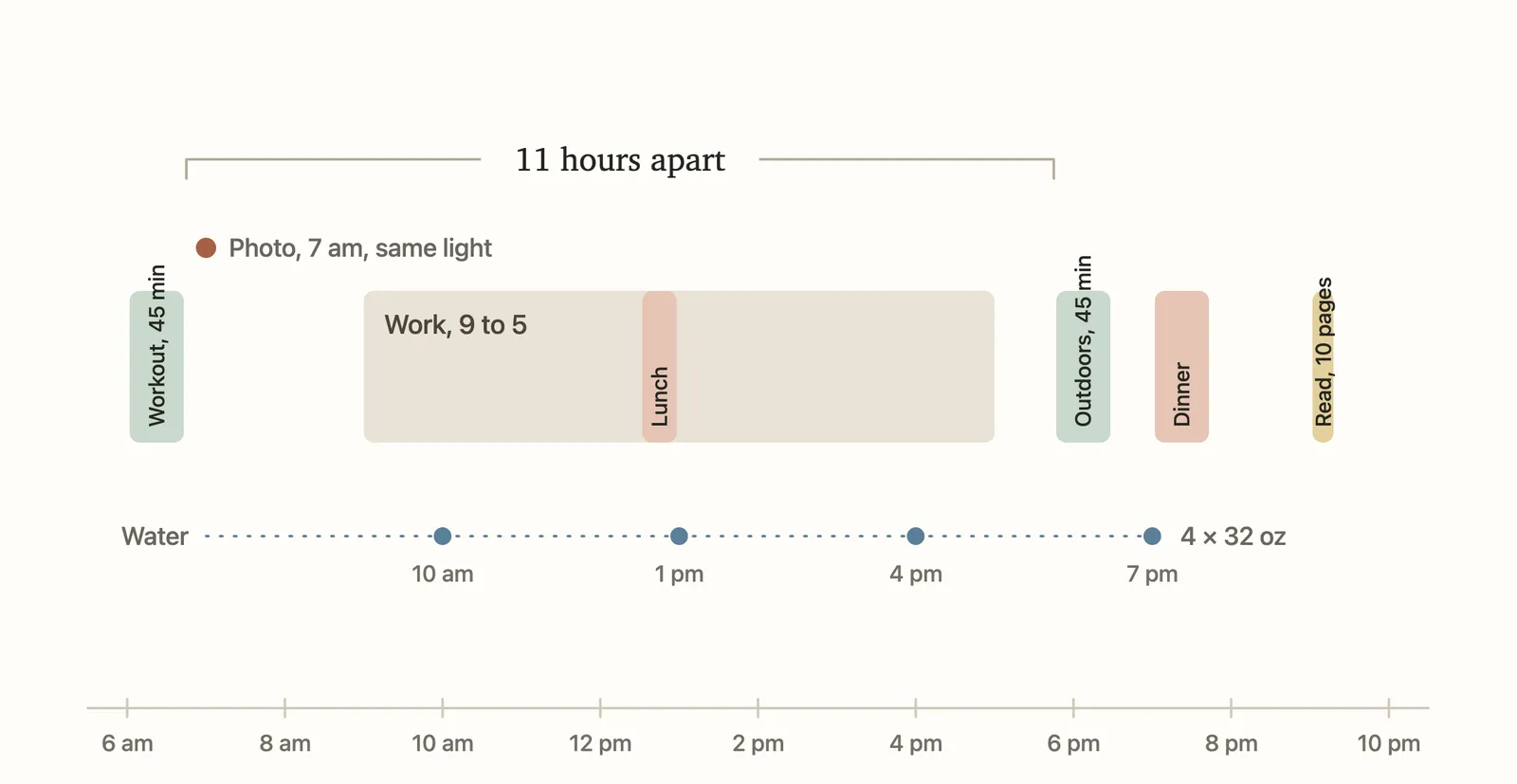
- Put the first workout before work. Mornings are the part of the day other people can’t book. If mornings are impossible, use lunch for a 45-minute walk, which counts as the outdoor workout.
- Make the outdoor one easy to start. A run, a walk or a bike ride from your front door needs no booking and no gym bag. Decide now what you’ll wear when it pours, because the outdoor workout still has to happen.
- Keep the workouts apart. The FAQ’s three-hour minimum is easy with one before work and one after.
- Give the water deadlines. A gallon is 128 ounces: four 32-ounce bottles, each finished by a set time (10 am, 1 pm, 4 pm, 7 pm), means you’re never trying to drink a liter at 10 pm.
- Read at the same time every day. Ten pages before bed, or on the train. Pick the book before day 1, and the next one before you finish it.
- Take the photo in the same place and light. Same time, same spot, same angle. It takes a minute, and it’s the task people most often forget.
- Plan tomorrow tonight. Two minutes in the evening to check tomorrow’s meetings and move the workouts around them. More in how to plan your day the night before.
75 Hard vs 75 Medium vs 75 Soft
75 Medium and 75 Soft are fan-made versions that spread on social media. 75 Soft is usually credited to the Irish fitness influencer Stephen Gallagher, who posted it on TikTok in 2021; 75 Medium has no known author. Neither has official rules, so the versions you find online vary. These are the most common ones.
| Version | The usual rules |
|---|---|
| 75 Hard | Two 45-minute workouts a day, one outdoors; a diet with no cheat meals and no alcohol; a gallon of water; 10 pages of nonfiction; a daily photo. Miss anything and start over. |
| 75 Medium | One 45- to 60-minute workout a day; follow your eating plan about 90% of the time; drink plenty of water; 10 to 20 minutes of personal development; progress photos optional. Usually no restart. |
| 75 Soft | One 45-minute workout a day with one day of active recovery a week; eat well and drink only on social occasions; 3 liters of water; 10 pages of any book. |
How to choose: if you exercise less than about 150 minutes a week now, start with 75 Soft. It’s already more than the WHO’s minimum. If you train regularly and want the challenge of the two workouts, try 75 Hard, but decide beforehand what you’ll do if you hit day 40 with a sore knee. Changing your own rules midway isn’t failure; ignoring an injury to keep a streak is.
What happens after day 75
Officially, the next step is LIVEHARD’s Phase 1, whenever you’re ready for it. For everyone else, the risk after day 75 is the rebound: a challenge built on rules ends, and the rules go with it.
Before day 75, write down what you’ll keep. Not all six tasks: two or three habits that changed how your days feel, at a size you could keep for a year. A 30-minute workout four days a week, the 10 pages, a water bottle on the desk. Then track those, the same way you tracked the challenge, for the next couple of months. How long it takes to form a habit explains why this part matters more than day 75 itself.
Tracking 75 Hard in Plannedo
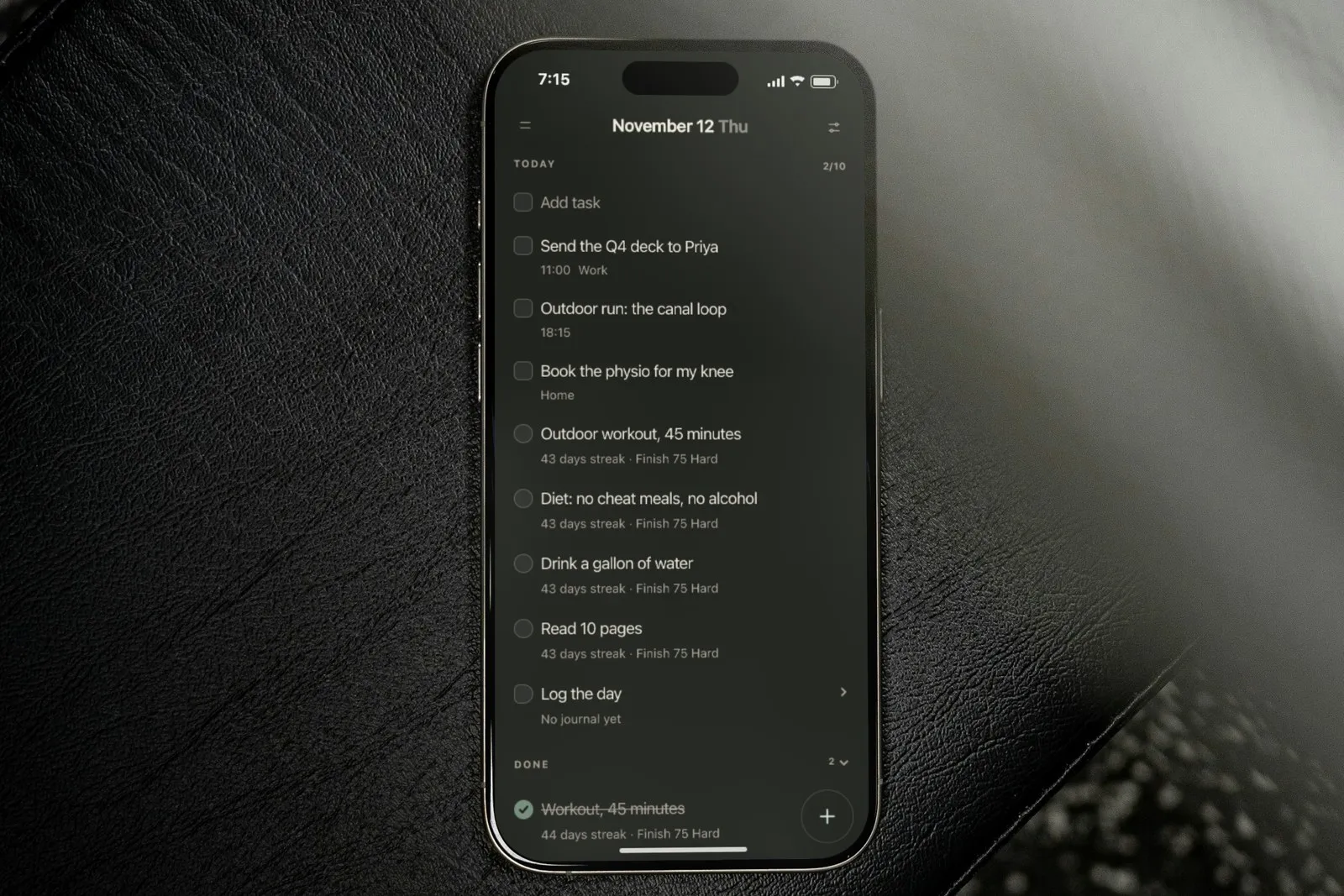
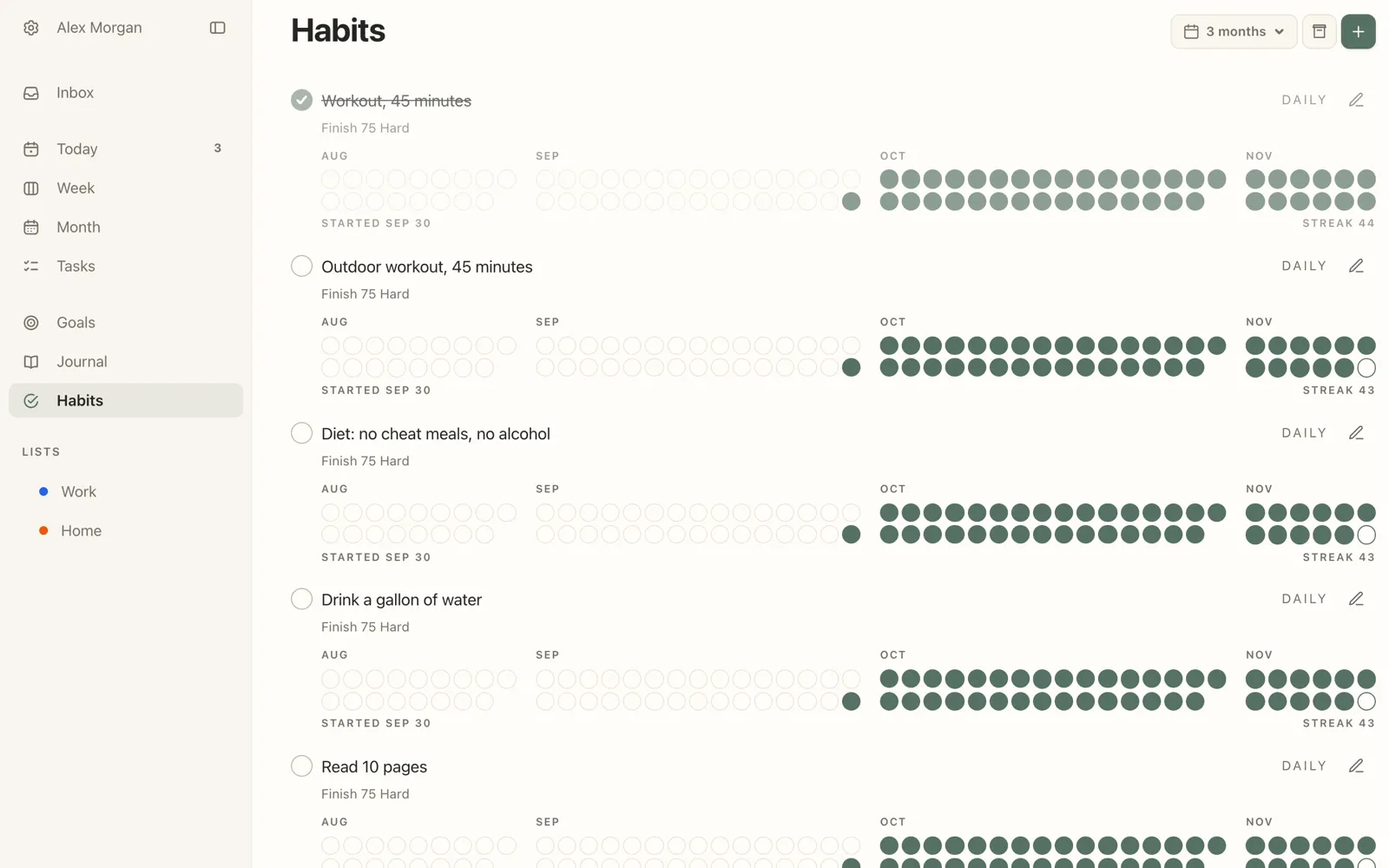
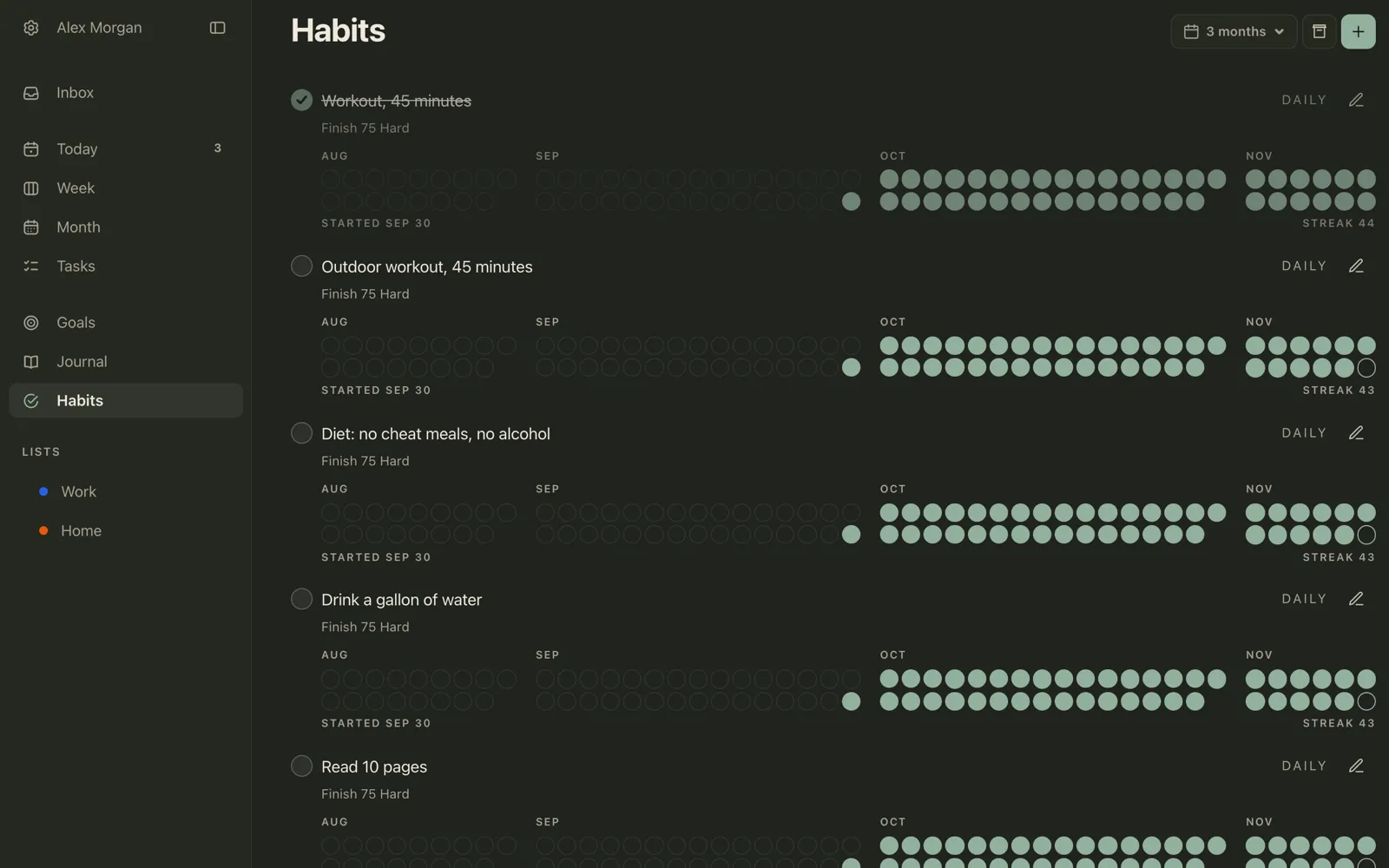
In Plannedo, the challenge is one goal with six daily habits under it: the two workouts, the diet, the water, the reading and the photo. Each habit has its own streak, and on Habits the 3 months range shows every day since you started, so a gap is easy to see. Six habits need Pro; the Free plan includes three active habits.
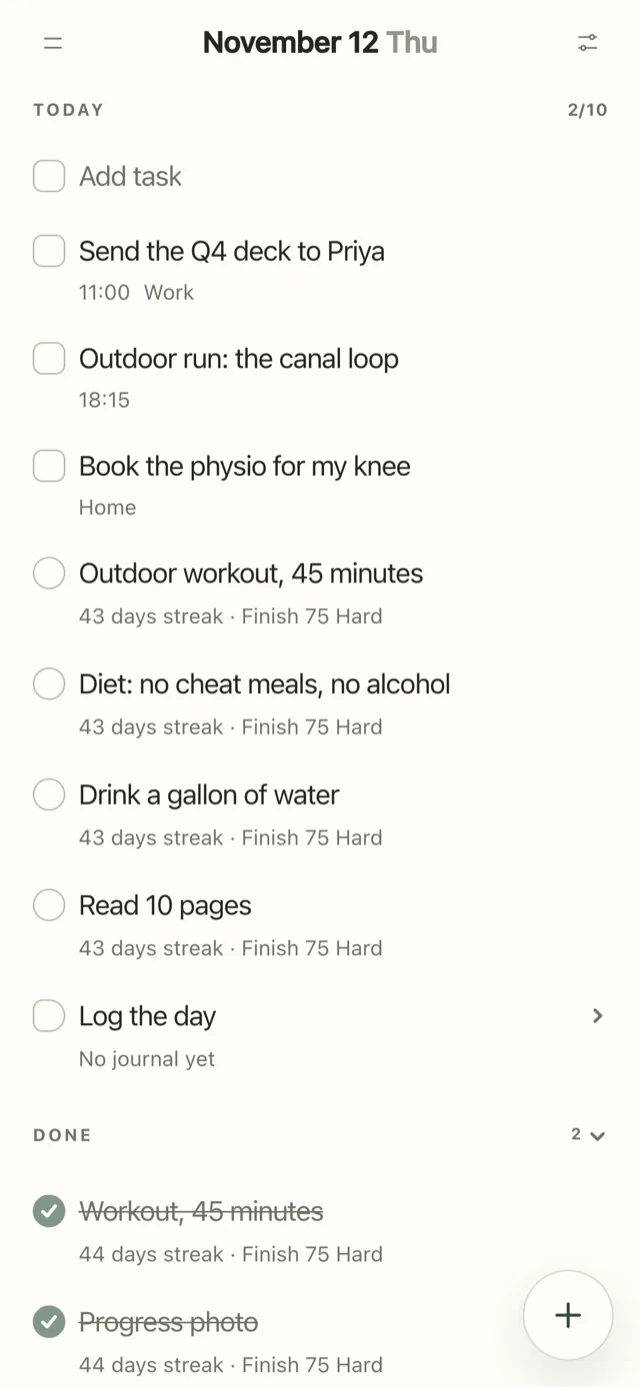
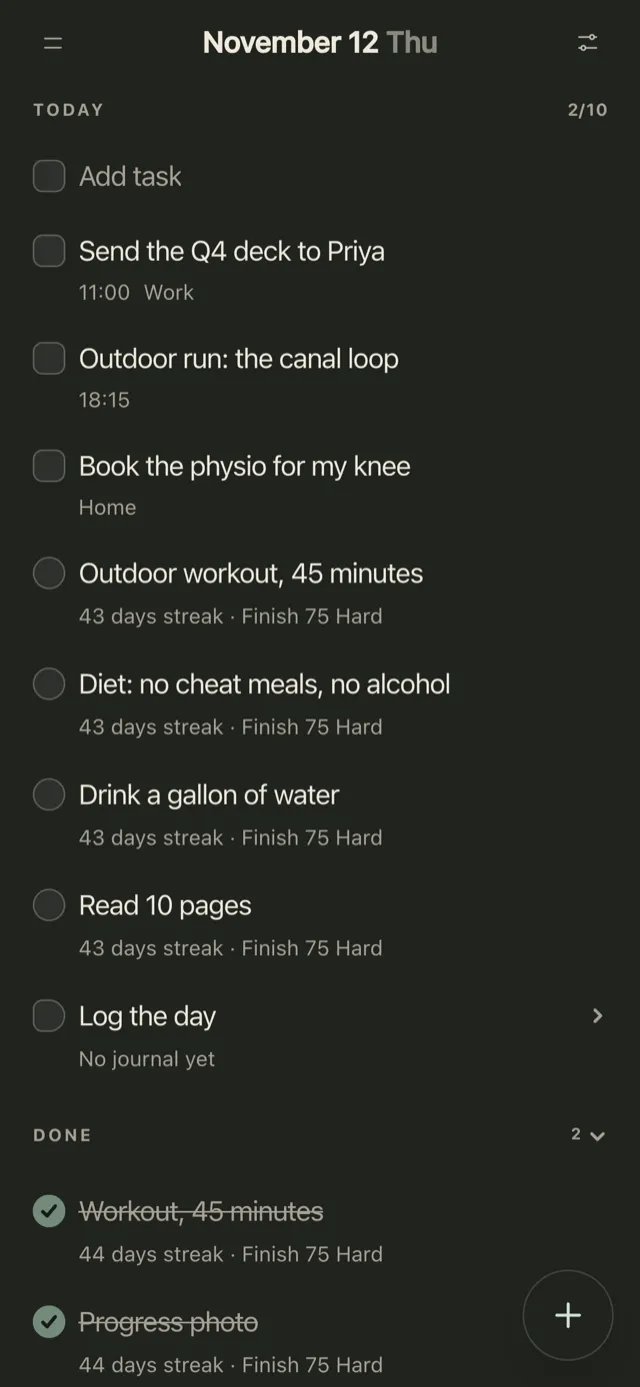
On Today, the habits sit under the day’s tasks, each with its streak. Give the workouts their own tasks with a start time and a reminder (Pro) so they’re booked like meetings: here, “Outdoor run: the canal loop” at 18:15, with a reminder 15 minutes before.
A missed day resets that habit’s streak on its own, and the dots show exactly which task broke. More in the help centre: habits and streaks, repeating tasks and reminders.
Free 75 Hard tracker (PDF)
The tracker is unofficial and has four pages:
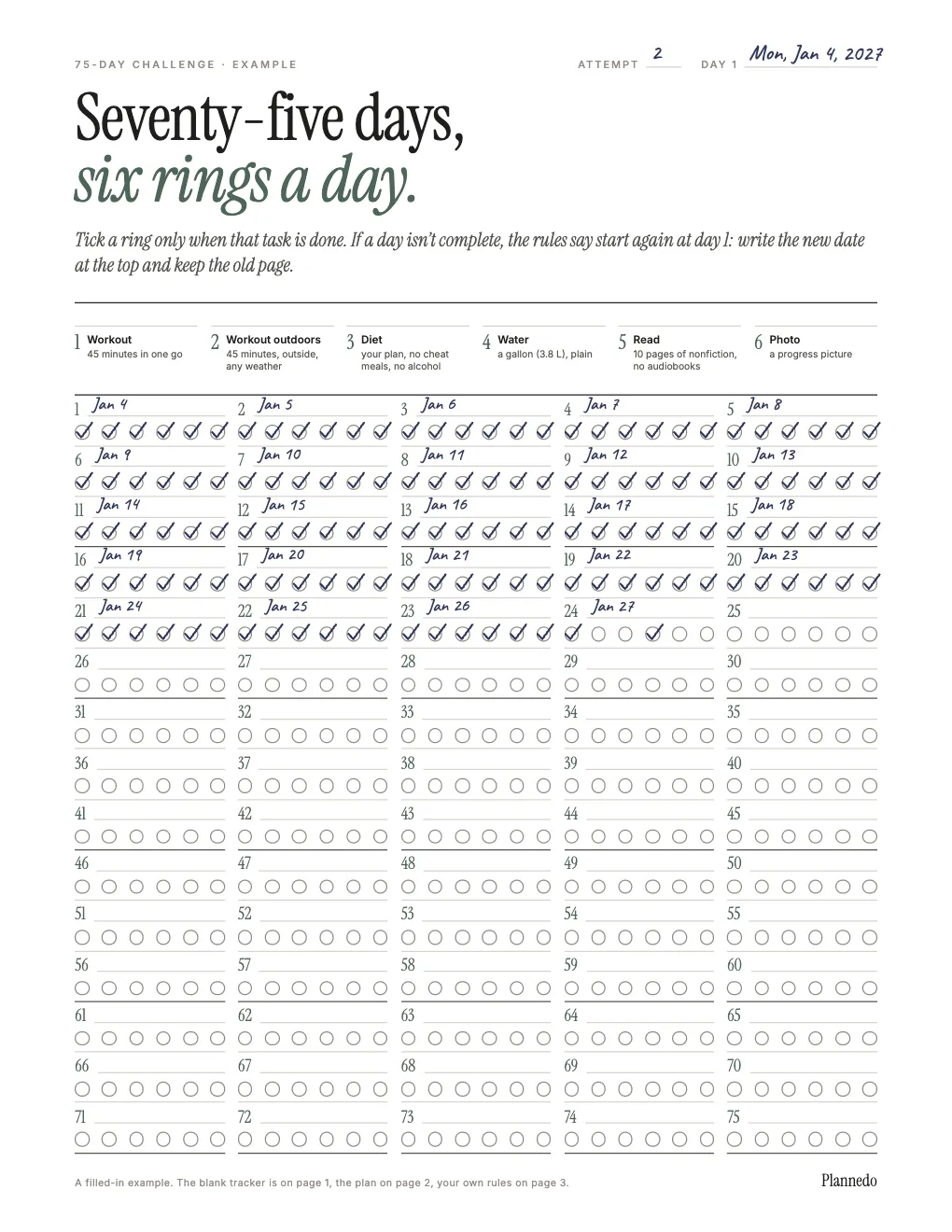
- Page 1, the 75 days: all 75 on one page, each with a date line and six rings in the order of the rules, a darker line every 15 days, and lines for the attempt number and the day-1 date.
- Page 2, the plan: when and where each task happens, what you’ll do if it pours, the water bottle and its refill times, a restart log with what broke each attempt, a reading list, and what you’ll keep and drop after day 75.
- Page 3, your own rules: the same 75 days with the six rules left blank, for 75 Medium, 75 Soft or a version of your own.
- Page 4, a filled-in example: a second attempt from January 4, 2027, 23 days in.
Every line is a form field, so you can fill it in on an iPad or a computer, or print it on US Letter or A4.
FAQ
What are the 75 Hard rules?
Every day for 75 days: follow a diet with no cheat meals and no alcohol, do two 45-minute workouts with one of them outdoors, drink a gallon of water, read 10 pages of a nonfiction book, and take a progress picture. If you miss any task, you start again at day 1.
What happens if you miss a day of 75 Hard?
Under the official rules you start over at day 1, even if you missed a single task on day 60. Many people choose a gentler version, such as 75 Medium or 75 Soft, where a missed day doesn’t reset the count. Habit research supports that: in Lally and colleagues’ study, missing one day didn’t materially affect how a habit formed.
Does walking count as a 75 Hard workout?
Yes. The official rules ask for two 45-minute workouts and don’t set a type or intensity, and a brisk 45-minute walk is the most common choice for the outdoor one. If you’re new to exercise, walking for most of the workouts is a sensible way to handle 630 minutes a week.
Can you split a 75 Hard workout into two shorter ones?
No. According to the official FAQ, each workout is 45 minutes in one go, and the two workouts should be at least three hours apart.
Do audiobooks count for the 75 Hard reading?
No. The official rule is 10 pages of a nonfiction book, read. That’s about 10 to 15 minutes a day at an average reading speed.
Is drinking a gallon of water a day safe?
For most healthy adults, a gallon spread across the day is more than they need but not dangerous. Drinking large amounts quickly can be: healthy kidneys clear only about 0.8 to 1 liter an hour, and overloading them can lower blood sodium. Spread the water across the day, and check with your doctor first if you have a heart or kidney condition.
What is 75 Soft?
A fan-made, gentler version of 75 Hard: usually one 45-minute workout a day with one day of active recovery a week, eating well with alcohol only on social occasions, 3 liters of water and 10 pages of any book. It has no official rules, so versions vary.
What happens after 75 Hard?
Officially, you can continue with LIVEHARD, a longer program that adds three more 30-day phases. Otherwise, the useful step is choosing two or three of the habits to keep at a size you can sustain, and tracking them for the next couple of months so the challenge doesn’t end in a rebound.
Studies and sources
- Andy Frisella. 75 HARD, the official program page; the official 75 HARD FAQ and LIVEHARD FAQ; and the podcast episode that introduced it, MFCEO 290 (March 7, 2019).
- Cleveland Clinic (2025). 75 Hard Challenge rules and healthy alternatives. Cleveland Clinic (2023). 75 Soft Challenge. Cleveland Clinic (2026). 75 Medium Challenge.
- Lally, P., van Jaarsveld, C. H. M., Potts, H. W. W., & Wardle, J. (2010). How are habits formed: Modelling habit formation in the real world. European Journal of Social Psychology, 40(6), 998-1009.
- Harkin, B., Webb, T. L., Chang, B. P. I., Prestwich, A., Conner, M., Kellar, I., Benn, Y., & Sheeran, P. (2016). Does monitoring goal progress promote goal attainment? A meta-analysis of the experimental evidence. Psychological Bulletin, 142(2), 198-229.
- Gardner, B., Lally, P., & Wardle, J. (2012). Making health habitual: The psychology of ‘habit-formation’ and general practice. British Journal of General Practice, 62(605), 664-666.
- Cochran, W., & Tesser, A. (1996). The “what the hell” effect: Some effects of goal proximity and goal framing on performance. In L. L. Martin & A. Tesser (Eds.), Striving and Feeling: Interactions Among Goals, Affect, and Self-Regulation. Lawrence Erlbaum.
- Larimer, M. E., Palmer, R. S., & Marlatt, G. A. (1999). Relapse prevention: An overview of Marlatt’s cognitive-behavioral model. Alcohol Research & Health, 23(2), 151-160.
- World Health Organization (2020). WHO guidelines on physical activity and sedentary behaviour. And US Department of Health and Human Services (2018), Physical Activity Guidelines for Americans, 2nd edition.
- Rawson, E. S., Clarkson, P. M., & Tarnopolsky, M. A. (2017). Perspectives on exertional rhabdomyolysis. Sports Medicine, 47(Suppl 1), 33-49.
- National Academies of Sciences, Engineering, and Medicine (2005). Dietary Reference Intakes for Water, Potassium, Sodium, Chloride, and Sulfate.
- Noakes, T. D., Wilson, G., Gray, D. A., Lambert, M. I., & Dennis, S. C. (2001). Peak rates of diuresis in healthy humans during oral fluid overload. South African Medical Journal, 91(10), 852-857. And MedlinePlus, Hyponatremia.
- Brysbaert, M. (2019). How many words do we read per minute? A review and meta-analysis of reading rate. Journal of Memory and Language, 109, 104047.
Photo credits
The cover photo is by Dalibor Janeček on Unsplash.