Life Goals Examples: 80 Ideas by Area and Age (+ Worksheet)
80 life goals examples by area of life and by age, what research says about choosing goals worth having, and a free life goals worksheet.
Life goals are the few big things you want your life to add up to: the work you want to have done, the people you want around you, the places you want to see and the person you want to be at 80. Below are 80 life goals examples, by area of life and by age, each with a first step you could take this year.
Five to start with: hike with your grandkids at 75; write and publish a book; make work optional by 60; live abroad for a year; keep three close friendships for life. Mark the ones that pull at you, then test them with the questions below. There’s a free life goals worksheet at the end to map yours.
What are life goals?
A life goal is a goal measured in decades rather than months. It describes where you want your life to go, not what you’ll do this quarter, and it usually takes many smaller goals to reach.
| Life goals | Personal goals | Short-term goals | |
|---|---|---|---|
| Horizon | 10 years to a lifetime | A season to a year | Days to a few months |
| Example | Sail across the Atlantic | Get a day skipper certificate this year | Book the course by Friday |
| What it does | Sets the direction | Turns the direction into a plan | Gets you moving this week |
You need all three, in that order. A life goal without the other two stays a daydream; short-term goals without a life goal fill the calendar without adding up to much. For goals on a one-year horizon, see our personal goals examples; for goals at work, work goals examples.
How to choose life goals worth having
Most lists of life goals skip the hard part: some goals make a life better when you reach them, and some don’t. Research on well-being and regret gives four useful tests.
Would you want it if nobody ever knew? Tim Kasser and Richard Ryan sorted people’s life aspirations into intrinsic ones (personal growth, relationships, community, health) and extrinsic ones (money, fame, image). In samples of adults and students, people who put money, image and fame ahead of the rest reported less vitality and more physical symptoms. A later study by Christopher Niemiec, Ryan and Edward Deci followed 147 graduates for a year: reaching goals about growth, relationships, community and health went with greater well-being, while reaching money, fame and image goals added nothing to well-being and was linked to somewhat more anxiety and physical symptoms. Money can still be a good life goal, as long as you know what it’s for: time, safety, choices.
What would you regret never trying? Thomas Gilovich and Victoria Husted Medvec found that over the past week, people’s biggest regrets are about as likely to be things they did as things they didn’t. Over a lifetime, it’s lopsided: in one of their surveys, 84% said what they didn’t do haunted them more. Later work by Shai Davidai and Gilovich added which inactions: asked for their single biggest regret, 76% of people described falling short of the person they wanted to become, not of their duties. That’s a good filter for a list like the one below. Strike out what you’d do for other people’s approval, and keep what you’d regret not trying.
Write your best possible life before you write the list. In a small experiment, Laura King had 81 students write about their “best possible self” for 20 minutes on four days in a row; it raised their well-being three weeks later, and that group (along with students who wrote about a trauma) had less illness in health-center records over five months. A 2019 meta-analysis by Carrillo and colleagues pooled 29 studies with 2,909 people and found the exercise gives small-to-moderate boosts to well-being and optimism and a larger lift in positive mood, though no reliable drop in negative mood or depression. The worksheet below starts with it, because goals are easier to name once you’ve described the life.
Hold them loosely, and look again every year. Jordi Quoidbach, Daniel Gilbert and Timothy Wilson asked more than 19,000 people aged 18 to 68 how much they had changed in the past ten years and how much they expected to change in the next ten. Every age group said they’d changed a lot and expected to change little, which the researchers called the “end of history illusion.” The goals you write today were written by someone who will change more than they think. That’s not a reason to skip them, but it is a reason to review them once a year.
Life goals examples for health
Health life goals are about the body you want at 70 and 80, not this summer. Work back from what you want to still be able to do.
| Life goal | A first step this year |
|---|---|
| Hike with my grandkids at 75 | Strength train twice a week from January |
| Run a marathon before I turn 50 | Run a 10K by June |
| Be able to sit on the floor and get up without using my hands at 80 | Ten minutes of mobility work three mornings a week |
| Never smoke again | Pick a quit date and tell two people |
| Sleep seven or more hours on most nights, for good | Set a fixed bedtime for weeknights |
| Stay at a weight my knees thank me for | Cook dinner at home five nights a week |
| Learn to swim well enough to swim in the sea | Book six lessons at the local pool |
Life goals examples for family, friends and love
These goals are about the people you want around you in 30 years, and the kind of person you want to be to them. They rarely happen by accident; most need a date on the calendar.
| Life goal | A first step this year |
|---|---|
| Raise kids who still want to come home | One evening a week with no screens at dinner |
| Have a marriage we’re both proud of at our 30th anniversary | A date night every month, on the calendar |
| Keep three close friendships for life | A standing monthly call with each |
| Host the family for the holidays every year | Ask everyone for this year’s dates by October |
| Know my parents’ stories before it’s too late | Record one hour of conversation with each |
| Be the kind of neighbor people can count on | Learn the names of everyone on the street |
| Build a family tradition the kids carry on | Start one: a yearly trip, a recipe, a hike |
Life goals examples for work and purpose
Work life goals are about the kind of work you want to have done, not the next promotion. The best ones describe the work itself.
| Life goal | A first step this year |
|---|---|
| Write and publish a novel | Write 300 words a day |
| Start a business that pays me a full salary | Sell the first version to ten customers |
| Become the person people call for one hard problem in my field | Write one article a quarter about it |
| Change careers into something I’d do for free | Take one course and talk to five people in the field |
| Work four days a week by 50 | Ask for one Friday a month off |
| Mentor ten people who go further than I did | Take on the first one |
| Leave a company, team or product better than I found it | Name one thing you want to fix, and start |
Life goals examples for money
Money life goals are means, not ends. Name what the money is for: time, safety, choices.
| Life goal | A first step this year |
|---|---|
| Make work optional by 60 | Save 15% of every paycheck, automatically |
| Own my home outright | Overpay the mortgage by a fixed amount each month |
| Never have consumer debt again | Pay off the smallest card first |
| Keep a year of expenses in savings | Reach one month by June |
| Pay for my kids’ education without loans | Open an education savings account |
| Give 10% of my income away | Start with 1% and raise it each year |
| Take a year off in my 40s | Open a separate account for it and name it |
Life goals examples for learning
| Life goal | A first step this year |
|---|---|
| Speak Spanish fluently | Twenty minutes a day and one conversation class a week |
| Play the piano well enough to play for friends | Lessons every other week |
| Read 1,000 books in my lifetime | Read 25 this year and keep a list |
| Earn a degree I always wanted | Take one course to check I still want it |
| Understand how my body, money and mind work | Read one good book on each this year |
| Learn to sail | Take a beginner’s course in spring |
| Get really good at one craft | Choose it and practice twice a week |
Life goals examples for creativity
| Life goal | A first step this year |
|---|---|
| Paint a series good enough to exhibit | Paint every Sunday morning |
| Record an album of my own songs | Finish one song by March |
| Build a piece of furniture I’ll keep forever | Take a weekend woodworking class |
| Write a memoir for my family | Write one story a month |
| Make a garden people stop to look at | Plan one bed and plant it this spring |
| Make a short film | Shoot one minute on your phone this month |
| Keep a journal for the rest of my life | One line every evening |
Life goals examples for adventure
These are the bucket-list goals. Pick the ones you’d regret not doing, not the ones that would look good in photos.
| Life goal | A first step this year |
|---|---|
| Sail across the Atlantic before I turn 50 | Take a day skipper course |
| See the northern lights | Choose a week and a place, and book it |
| Live abroad for a year | Ask your employer about remote work |
| Walk the Camino de Santiago | Walk 15 km in one day |
| Visit every continent | Plan the next one and pick the year |
| Climb Kilimanjaro | Hike a mountain near home this summer |
| Spend a month on a road trip with no plan | Save for it and pick the season |
Life goals examples for giving back
| Life goal | A first step this year |
|---|---|
| Volunteer one day a month for life | Find one place and go once |
| Teach a child to do something I love | Offer to teach a niece, nephew or neighbor |
| Help start something in my town that outlasts me | Go to one local meeting |
| Be a mentor or coach | Sign up for one mentoring program |
| Leave a will and a letter for my family | Write the will this year |
| Give blood 50 times | Book the first appointment |
| Plant 100 trees | Plant the first ten |
Life goals examples by age
The same goal reads differently at 25 and at 55. These are goals that tend to fit each stage, with a first step for this year.
Life goals for students
| Life goal | A first step this year |
|---|---|
| Find work I’d want to do even on a bad day | Try two internships or part-time jobs in different fields |
| Finish my studies without debt I can’t carry | Apply for three scholarships |
| Speak a second language before I’m 25 | Twenty minutes a day with an app and a tutor |
| Keep the friends I make here for life | Start a weekly dinner with three of them |
Life goals in your 20s
| Life goal | A first step this year |
|---|---|
| Pay my own way and owe nobody | Keep a budget for three months in a row |
| Get good at one skill people pay for | Take on one paid project outside work |
| Start investing early and never stop | Set up an automatic monthly transfer to an index fund |
| Live in another country for a while | Pick the country and look at what it takes |
Life goals in your 30s
| Life goal | A first step this year |
|---|---|
| Build a home life I’m proud of | Agree with your partner on what that means, on paper |
| Become senior enough to choose my own projects | Ask your manager what that takes |
| Look after my health before it needs looking after | Get a full checkup |
| Raise kids, if that’s what we want | Have the honest conversation about when |
Life goals at 40 and 50
| Life goal | A first step this year |
|---|---|
| Change direction if the work no longer fits | Talk to five people doing what you’d like to do |
| Be fitter at 50 than at 40 | Strength train twice a week |
| Make work optional by 60 | Check your savings against the number you’d need |
| Mend one relationship that matters | Make the first call |
Life goals at 60 and beyond
| Life goal | A first step this year |
|---|---|
| Stay strong enough to travel on my own terms | Walk 8,000 steps a day |
| Pass on the family’s stories | Record an hour of them with your grandkids |
| Learn something I never had time for | Sign up for one class |
| Give my time where it counts | Volunteer one day a month |
Life goals for couples
| Life goal | A first step this year |
|---|---|
| Own a home together | Agree on a savings target and open a joint account |
| See a new country together every year | Pick next year’s country tonight |
| Keep a weekly date for life | Put it in both calendars |
| Build a family tradition that outlasts us | Choose one and do it once |
How to answer “What are your life goals?” in an interview
When an interviewer asks about your life goals, they want to know whether this job fits where you’re heading. Give one long-term goal that connects to the role, one personal one that shows who you are, and a step you’re already taking. For example: “Long term, I want to become the person teams call for hard data problems, and this role is full of them. Outside work, I want to run a marathon before I’m 40; I’m training for a half in the spring.” Keep money and job titles out of it.
From a life goal to this week
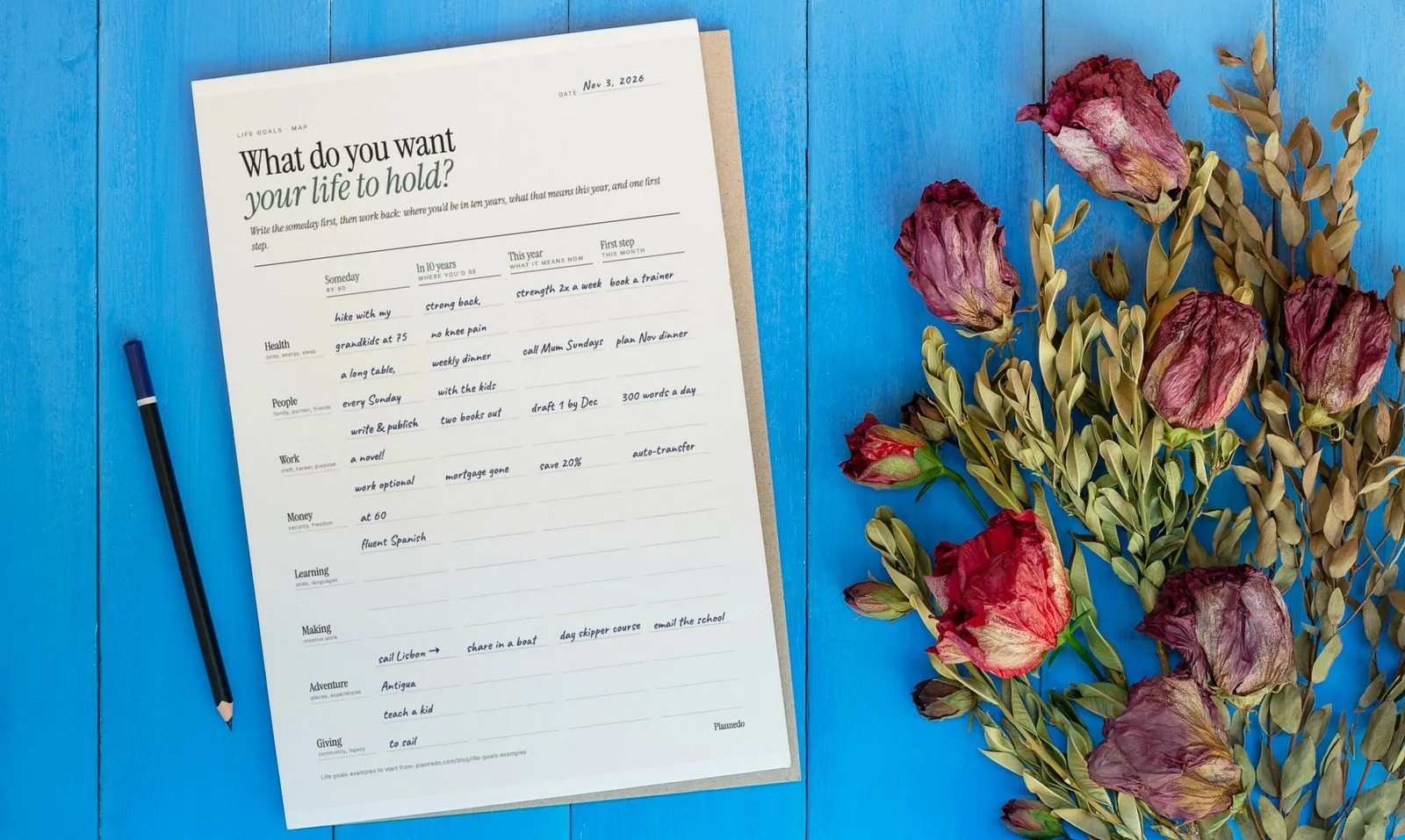
A life goal is too far away to act on. The way to make it move is to work back in steps, the way the worksheet’s columns do: someday, ten years, this year, a first step.
- Someday. One line: “Sail across the Atlantic before I turn 50.”
- Ten years. Where you’d need to be: “Own a share in a boat and have crossed the Bay of Biscay.”
- This year. What that means now: “Get a day skipper certificate and save $150 a month for the boat.”
- First step. Something you can do this month: “Email the sailing school about April dates.”
Near-term goals help with distant ones. In a business game described in Edwin Locke and Gary Latham’s review of goal-setting research, people who had near-term goals on top of a distant one felt more able to succeed and made higher profits than people with only the distant goal. A plan also quiets the goal in your head: E. J. Masicampo and Roy Baumeister found that unfinished goals keep intruding on people’s thoughts, but making a specific plan for them was enough to quiet those intrusions, even before the goal was done.
Then keep this year’s piece in view. Benjamin Harkin, Thomas Webb and colleagues pulled together 138 experiments with 19,951 participants and found that monitoring progress made people more likely to reach their goals, especially when progress was written down. The full method for a one-year goal is in how to set goals; if you like working in quarters, the 12 week year builds a system around them.
Free life goals worksheet
The worksheet follows this post. The front is a map: eight areas of life, each with a line for someday, ten years, this year and a first step. The back is the best possible life exercise, the three questions above and a ring to tick each time you look at the map again.
Life goals in Plannedo
A life goal written once and filed away doesn’t do much. In Plannedo it stays in view: each goal gets a board with photos of what it looks like and a few words about why it matters, and it doesn’t need a date. “Hike with my grandkids at 75” can sit there with no deadline at all, or with a year, a quarter or a month.
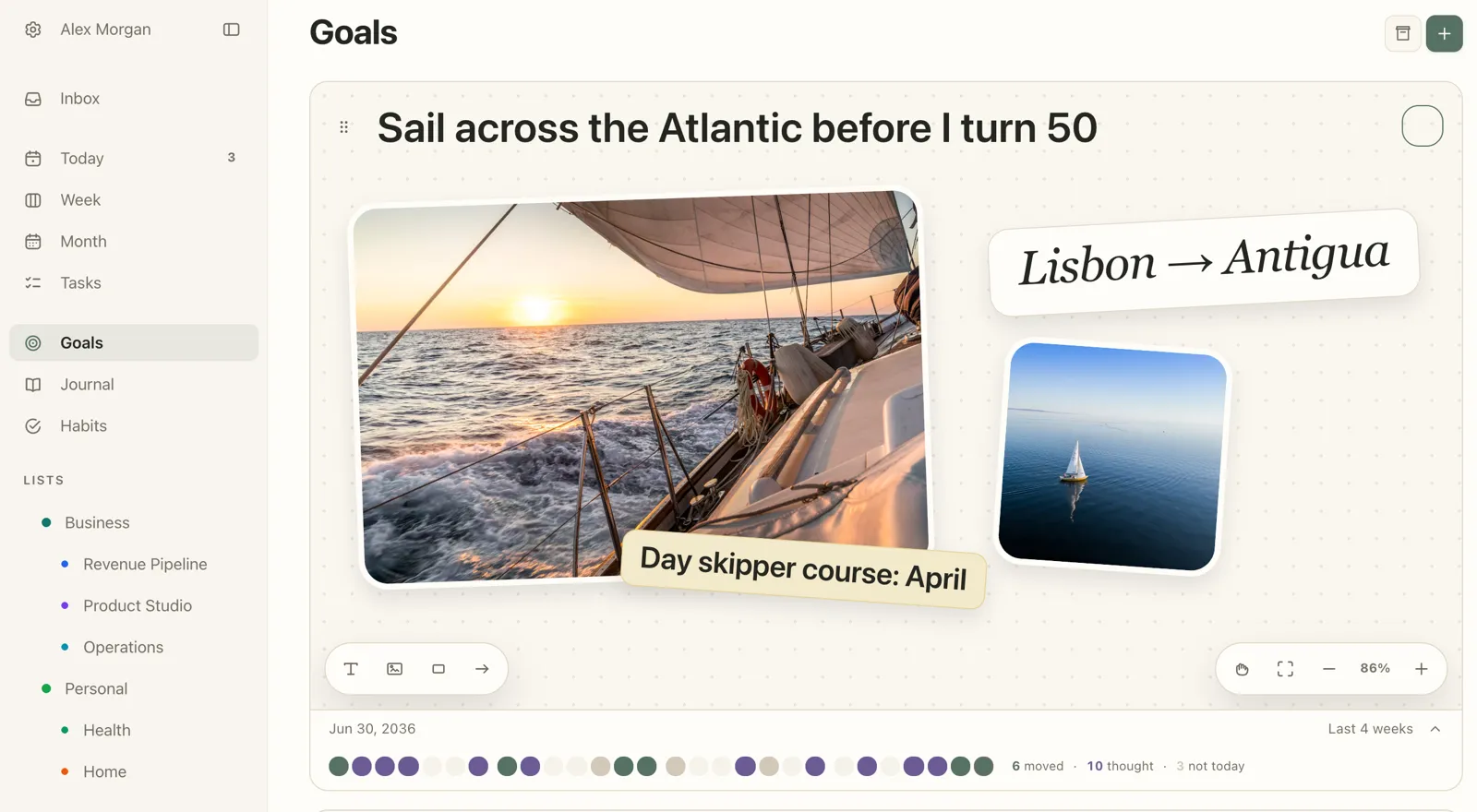
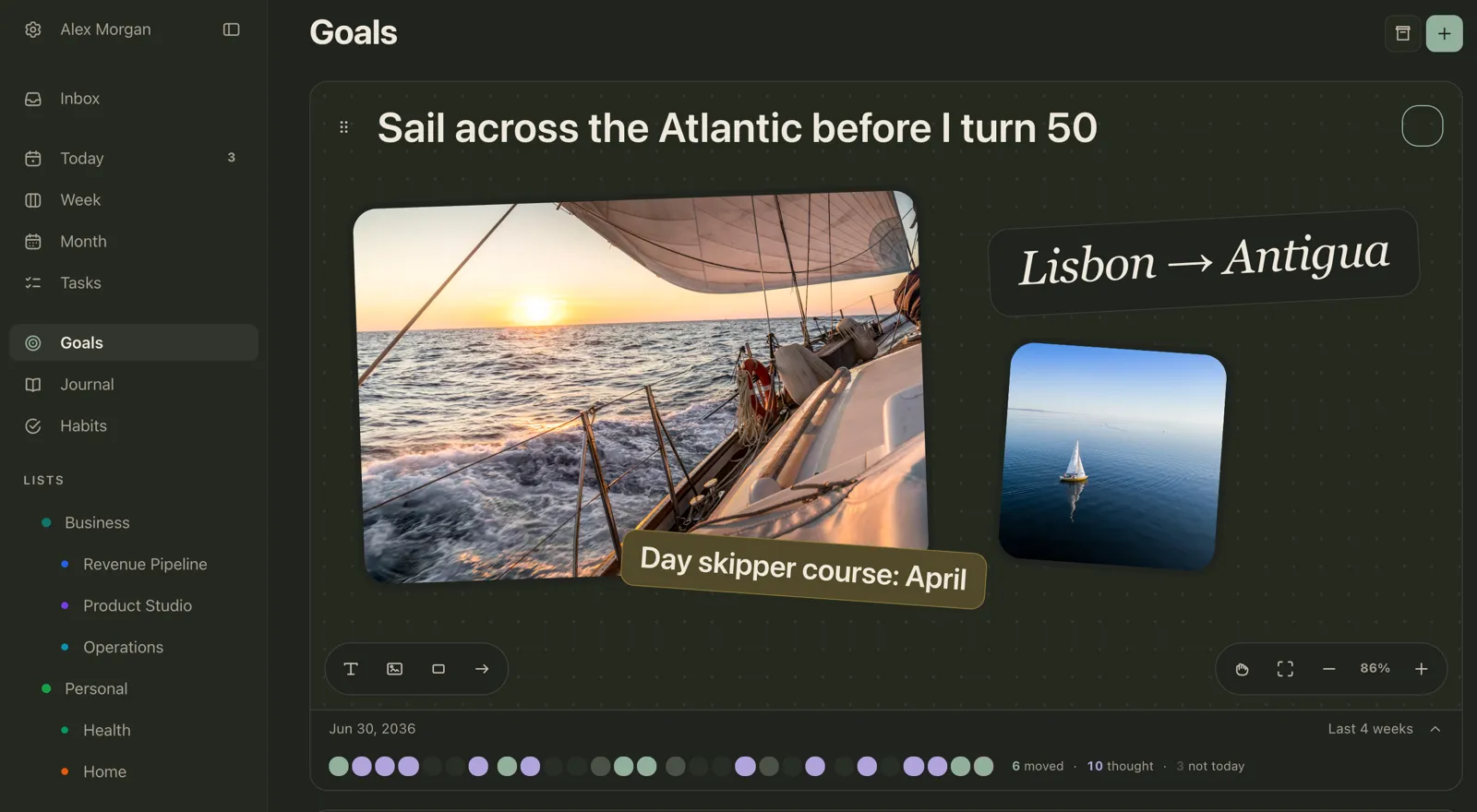
Tasks and habits link to a goal, so this year’s piece shows up on Today with the goal’s name under it: an email to the sailing school, 300 words before work, strength training twice a week. In the evening, Log the day asks about each goal, and a tap records whether today moved it: Moved, Thought or Not today. Over a few weeks, that shows which life goals get your time and which ones only get your attention.
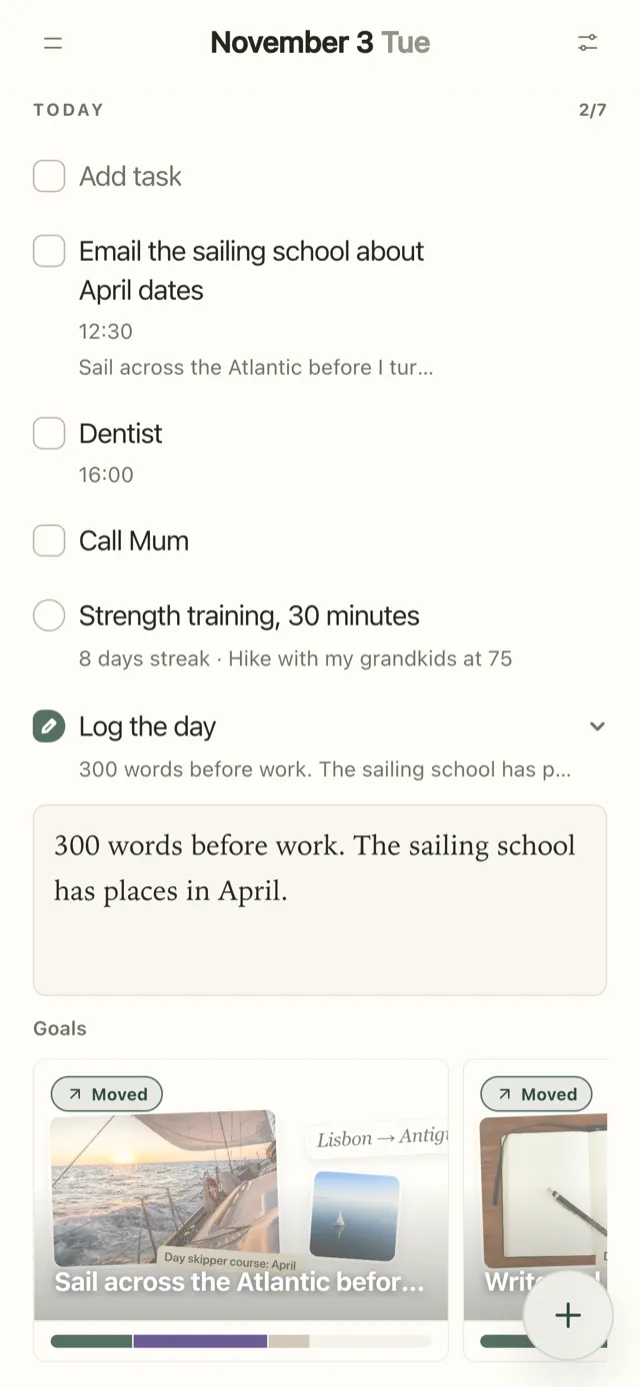
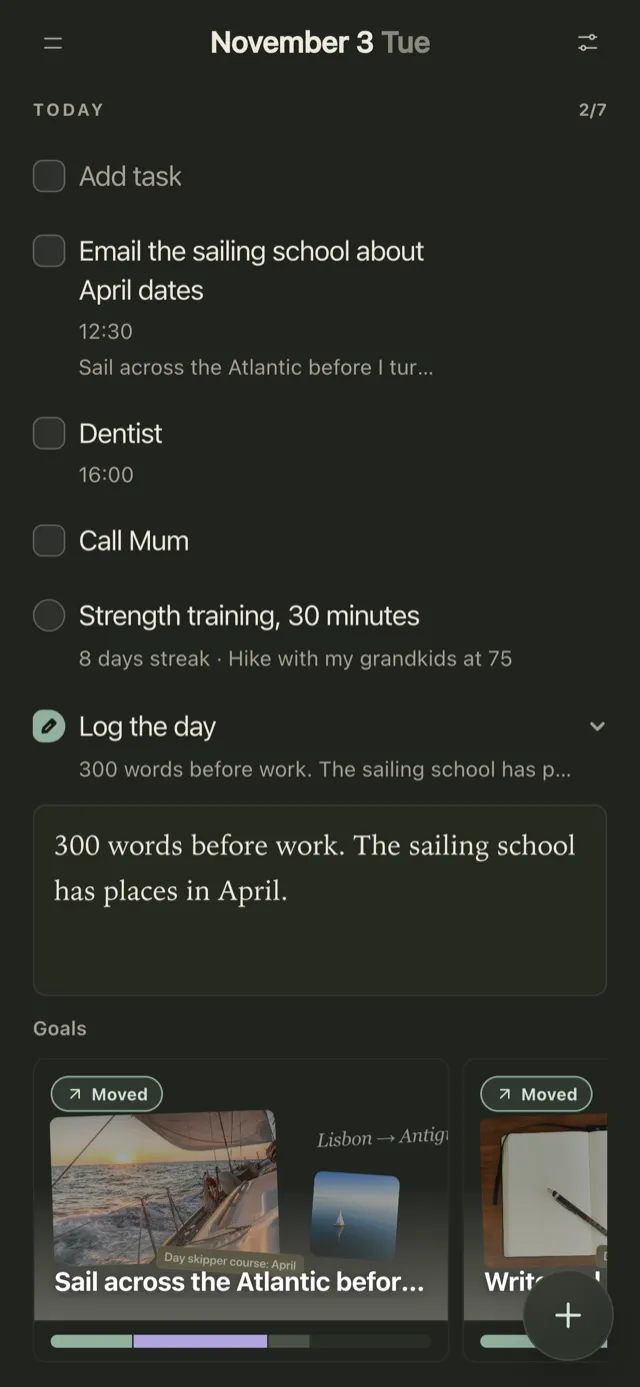
More in the help centre: goal boards, linking tasks and habits to goals and the evening check-in. If you think in pictures, 2027 vision board ideas has more boards to start from.
FAQ
What are some examples of life goals?
Hike with your grandkids at 75, write and publish a book, make work optional by 60, live abroad for a year, keep three close friendships for life, speak a second language fluently, volunteer one day a month for life. Good life goals are measured in decades and describe the life you want, not a single achievement.
What are the 5 main life goals?
There’s no official list, but most people’s life goals fall into a handful of areas: health, relationships, work and purpose, money, and personal growth. Research on well-being suggests weighting the ones you’d want for their own sake, like growth, relationships, community and health, over money, fame and image.
How many life goals should I have?
A few. Write as many as you like on a first pass, then keep three to five you’d regret not pursuing, and work on one or two of them this year. Too many life goals become a list you read once a year.
What’s the difference between life goals and personal goals?
Life goals set the direction over decades, like “sail across the Atlantic.” Personal goals turn that direction into this year’s plan, like “get a day skipper certificate by June.” Most life goals need several personal goals over the years.
What are good life goals for students?
Find work you’d want to do even on a bad day, finish your studies without debt you can’t carry, learn a second language, keep the friends you make, and build one skill people pay for. Each one works better with a step for this year, such as two internships in different fields.
How do you set long-term life goals?
Describe your best possible life ten years from now, list the goals it implies in each area of life, and keep the ones you’d want even if nobody knew and would regret not trying. Then work back: where you’d be in ten years, what that means this year, and one step for this month.
How often should you review your life goals?
Once a year is a good rhythm, for example in the last week of December or on your birthday. People change more over a decade than they expect, so a goal that fit at 30 may not at 40. Keep this year’s steps on a weekly review.
Is there an app for life goals?
Yes. Plannedo keeps life goals on photo boards with or without a deadline, links the year’s tasks and habits to them so they show up on the day, and records each evening whether a goal moved. It runs on iPhone, Mac and the web, and its free plan includes one goal with a full board and unlimited tasks.
Studies mentioned
- Carrillo, A., Rubio-Aparicio, M., Molinari, G., Enrique, Á., Sánchez-Meca, J., & Baños, R. M. (2019). Effects of the Best Possible Self intervention: A systematic review and meta-analysis. PLoS ONE, 14(9), e0222386.
- Davidai, S., & Gilovich, T. (2018). The ideal road not taken: The self-discrepancies involved in people’s most enduring regrets. Emotion, 18(3), 439-452.
- Gilovich, T., & Medvec, V. H. (1994). The temporal pattern to the experience of regret. Journal of Personality and Social Psychology, 67(3), 357-365.
- Harkin, B., Webb, T. L., Chang, B. P. I., Prestwich, A., Conner, M., Kellar, I., Benn, Y., & Sheeran, P. (2016). Does monitoring goal progress promote goal attainment? A meta-analysis of the experimental evidence. Psychological Bulletin, 142(2), 198-229.
- Kasser, T., & Ryan, R. M. (1996). Further examining the American dream: Differential correlates of intrinsic and extrinsic goals. Personality and Social Psychology Bulletin, 22(3), 280-287.
- King, L. A. (2001). The health benefits of writing about life goals. Personality and Social Psychology Bulletin, 27(7), 798-807.
- Locke, E. A., & Latham, G. P. (2002). Building a practically useful theory of goal setting and task motivation: A 35-year odyssey. American Psychologist, 57(9), 705-717.
- Masicampo, E. J., & Baumeister, R. F. (2011). Consider it done! Plan making can eliminate the cognitive effects of unfulfilled goals. Journal of Personality and Social Psychology, 101(4), 667-683.
- Niemiec, C. P., Ryan, R. M., & Deci, E. L. (2009). The path taken: Consequences of attaining intrinsic and extrinsic aspirations in post-college life. Journal of Research in Personality, 43(3), 291-306.
- Quoidbach, J., Gilbert, D. T., & Wilson, T. D. (2013). The end of history illusion. Science, 339(6115), 96-98.
Photo credits
The cover photo is by Elena Leya on Unsplash. Photos on the goal boards are by Marc Wieland, Daniel Stenholm and Mike Tinnion on Unsplash.