Work Goals Examples: 100 Goals for Your Performance Review
100 work goals examples for your performance review and self-evaluation, each with the evidence you would show, plus how to write them and a free worksheet.

Work goals are the results and skills you commit to at work for a set period, usually agreed with your manager and checked at your performance review. Below are 100 work goals examples in ten categories and four roles. Each is written the way a review form wants it, with a result and a date, and each comes with the evidence you’d show at the review.
Five good ones to start with: cut your average reply time to customer emails from two days to one by March 31; give a 10-minute talk at a team meeting by June; automate one manual report every quarter; earn the certification your role values most by October; take all your vacation days this year. Pick two or three, write them on the free work goals worksheet, and keep its wins log going until the review.
What are work goals?
A work goal is a specific result you aim for in your job by a date. There are two kinds, and most review forms ask for both:
- Performance goals are about the job you do now: faster, more accurate, more customers helped, a project shipped.
- Development goals, often called professional development goals, are about you: a skill, a certification, a kind of work you haven’t done yet.
The point of writing them down is to agree on what good looks like before the year starts, not after it ends. Many people never get that far. In Gallup’s latest US data, from the third quarter of 2026, only 46% of employees strongly agreed that they know what’s expected of them at work. Gallup has also found that only 30% of employees strongly agree their manager involves them in setting goals, and that those who are involved are 3.6 times more likely than other employees to be engaged. So don’t wait to be handed goals. Bring a draft to the conversation.
How to write a work goal
One sentence does most of the work:
By [date], I will [result], measured by [evidence], without [what must not get worse].
| Vague | Written as a work goal |
|---|---|
| Improve customer service | Raise my CSAT from 86% to 90% by June 30, without longer handle times |
| Be more organized | Clear my open requests from 60 to under 15 by March 31 and keep them there |
| Communicate better | Send my manager a five-line update every Friday this year |
| Learn new skills | Learn SQL well enough to build my own monthly report by May 31 |
| Grow in my career | Agree the criteria for a senior role with my manager by February and meet three of them by December |
Four things from the research are behind that sentence.
Specific and hard beats “do your best”. Across decades of studies, Edwin Locke and Gary Latham found that specific, difficult goals led to better performance than vague urging to do your best. A goal you can’t fail, like “improve communication”, is also a goal you can’t show at a review.
On complex work, set a learning goal first. Goals help less when the work is new or complicated. A 1987 meta-analysis of 125 goal-setting studies by Robert Wood, Anthony Mento and Edwin Locke found the effect on complex tasks, such as business games, science and engineering work and faculty research, was about half as big as on simple tasks. It was still a real effect. What helps is changing the kind of goal. When Dawn Winters and Gary Latham gave 114 business students a complex scheduling task, a learning goal beat both an outcome goal and “do your best”. In a complex business simulation, Gerard Seijts, Gary Latham and colleagues found the same: people with a specific learning goal outperformed people with a specific performance target and people with a vague goal. So if you don’t yet know how to hit a number, the goal is to find out: “try three ways to shorten onboarding by March 31 and pick one”, then the number.
Add a guardrail. In “Goals Gone Wild”, Lisa Ordóñez, Maurice Schweitzer, Adam Galinsky and Max Bazerman warned that goals used carelessly narrow people’s focus, encourage risky or unethical shortcuts and crowd out learning. Their best-known example is Sears in the early 1990s: a sales goal of $147 an hour for its auto repair staff led mechanics to sell repairs customers didn’t need. Locke and Latham replied that the critique leaned on anecdotes and that most of these pitfalls were already described in their own work. Either way, the fix is cheap. The “without” part of the sentence is it: faster replies, without lower satisfaction; fewer errors, without slower shipping.
Know why it matters. How a goal reaches you matters. When Latham and Miriam Erez, who had published conflicting results on this, designed experiments together with Locke as a mediator, most of the gap came down to delivery: a curt order versus a goal that came with its reasons. If your manager gives you a goal, ask what it’s for and write the answer down. If you write your own, say what it does for the team.
Three goals is plenty for most people: two performance goals and one development goal. The full method, from choosing goals to tracking them, is in how to set goals, and goals outside work are in personal goals examples.
Work goals examples for productivity and time management
Productivity goals work best as a number you already track, a before and an after. If you don’t track it yet, the first month of the goal is measuring it.
| Goal | What you’d show at the review |
|---|---|
| Cut my average email reply time from two days to one business day by March 31 | Inbox or help desk report, before and after |
| Clear my backlog of open requests from 60 to under 15 by the end of Q1 | Request count at the start and at the end |
| Block two 90-minute focus sessions a week for deep work through June | The calendar, and what got finished in those blocks |
| Deliver every project milestone on time this year, or flag a slip at least a week ahead | Project timeline with dates |
| Send the quarterly report two days before its deadline, four quarters running | The send dates |
| Cut the time I spend on weekly reporting from four hours to one by automating it by May | Time spent before and after |
| Run every meeting I organize with an agenda and finish on time, starting this month | Agendas; a two-question poll of attendees |
| Hit 90% of my sprint commitments for two quarters in a row | Sprint reports |
Work goals examples for quality and accuracy
Quality goals need an honest starting number. Count your errors, redo requests or review rounds for a month before you set the target.
| Goal | What you’d show at the review |
|---|---|
| Cut invoice errors from about five a month to one by June 30 with a two-step check | Error log by month |
| Get first-pass approval on 80% of my designs by Q3, up from about 60% | Review history |
| Keep data entry accuracy at 99.5% or better every month this year | Monthly audit samples |
| Halve the bugs reported in my releases compared with last year | Bug tracker counts |
| Write checklists for my three most common tasks by March and use them every time | The checklists; fewer redo requests |
| Miss no compliance deadlines this year | Compliance calendar |
| Get my reports through finance review in one round instead of three by Q2 | Review rounds per report |
| Lower returns on my product line from 4% to 3% by December, without slower shipping | Returns rate and shipping times |
Work goals examples for communication
“Improve communication” is the most common goal on review forms and the hardest to show. Turn it into a habit with a count, or a single event with a date.
| Goal | What you’d show at the review |
|---|---|
| Send my manager a five-line update every Friday this year | The updates |
| Give a 10-minute talk at the March all-hands | The talk; feedback from two colleagues |
| Present our team’s work at one meeting a month from February | Meeting agendas |
| Write a one-page summary for every project I close this year | The summaries |
| Answer every question in our team channel within four working hours | Response times |
| Finish a business writing course by April and rewrite our three most-used templates | Certificate; the new templates |
| Ask for feedback after every client presentation and act on one point each time | Feedback notes and what changed |
| Speak up at least once in every planning meeting this quarter | Meeting notes; my manager’s view |
Work goals examples for teamwork and collaboration
Teamwork goals are easy to fake and easy to dismiss at a review. Tie them to something other people can confirm.
| Goal | What you’d show at the review |
|---|---|
| Get our two new hires working on their own within 30 days of starting | Their first-month milestones |
| Review two teammates’ pieces of work a week and return comments within a day | Review log |
| Co-lead one project with another team this year | The project’s results |
| Document how the three key processes in my job work, so anyone can cover them by June | The documents; a colleague who covered a week |
| Leave a written handover note for every task before any leave longer than a week | The notes |
| Run a monthly 30-minute session where one person teaches the team something | List of sessions |
| Ask two teammates each quarter what would make their work easier, and do one thing | Notes and changes made |
| Pair with someone from another team once a month on a shared problem | Problems solved together |
Work goals examples for leadership and initiative
You don’t need a team to show leadership. These are goals for taking on something nobody asked you to own.
| Goal | What you’d show at the review |
|---|---|
| Mentor one junior colleague with a monthly one-on-one this year | Meeting log; their progress |
| Propose one improvement a quarter and get at least two adopted this year | Proposals and results |
| Volunteer to own one project nobody owns by March | The project’s outcome |
| Lead the planning for the Q3 offsite | The agenda; attendee feedback |
| Learn to cover my manager’s two key tasks by September | Tasks covered during their leave |
| Take over one vendor relationship and renegotiate its contract this year | The new terms; money saved |
| Build a dashboard the team uses to make decisions by Q2 | Usage; decisions made from it |
| Run the weekly team meeting for a month while my manager is away | Agendas and notes |
Work goals examples for customer service
Customer service has the best numbers to work with. Pair every speed goal with a satisfaction guardrail, or the speed comes out of the customer’s experience.
| Goal | What you’d show at the review |
|---|---|
| Raise my customer satisfaction score from 86% to 90% by June 30 | CSAT report |
| Resolve 80% of tickets on first contact by Q3, up from 70% | Help desk report |
| Cut average handle time by 15% without letting CSAT drop below 90% | Both numbers, by month |
| Reply to every complaint within one working day this year | Response times |
| Write help articles for the ten most common questions by April | The articles; fewer tickets on those topics |
| Keep escalations under 5% of my tickets every month | Escalation rate |
| Call five long-standing clients a month to ask what we could do better | Call notes and what changed |
| Know the spring release well enough to answer nine in ten questions alone by launch | Escalations after launch |
Work goals examples for process improvement
These goals pay off for the whole team, which makes them good review material. Measure the process before you change it.
| Goal | What you’d show at the review |
|---|---|
| Cut client onboarding from 21 days to 10 by June 30, keeping satisfaction above 90% | Days per client; CSAT |
| Map our month-end close and remove two steps by Q2 | Process maps, before and after |
| Automate one manual report every quarter | Hours saved per month |
| Find the top three causes of late orders and fix one by May | Late order rate |
| Cut supply spending by 5% by renegotiating two vendor contracts by September | Spend reports |
| Move the team’s files to one shared system and close the old drive by March | The old drive, closed |
| Run a 20-minute review after every project and keep a list of fixes | Review notes; fixes adopted |
| Shorten approval of purchase requests from a week to two days | Approval log |
Professional development goals examples
Professional development goals are about growing your skills and your options, not this year’s output. Name the skill, the proof and where you’ll use it at work, so the goal reads as an investment rather than time off the job.
| Goal | What you’d show at the review |
|---|---|
| Learn SQL well enough to build my own monthly report by May 31 | The report, built by me |
| Earn the certification my role values most (PMP, SHRM-CP, Google Analytics) by October | The certificate |
| Finish one online course a quarter related to my role and use one idea from each | Certificates; what I used |
| Learn pivot tables and lookups in Excel and use them in the monthly report by February | The new report |
| Attend one industry conference and bring back three ideas for the team | Notes; one idea tried |
| Spend a day shadowing a colleague in sales or finance by June to learn how their side works | Notes; one change I made |
| Read one book on my field a month and share one idea with the team | Reading list; team notes |
| Reach B1 Spanish by December and take one client call in Spanish | Level test; the call |
Work goals examples for career growth
Career goals belong in a review if your manager can help with them. Make them concrete enough that they can.
| Goal | What you’d show at the review |
|---|---|
| Agree the criteria for a senior role with my manager by February and meet three of them by December | Written criteria; evidence for each |
| Lead one project with results I can point to in a promotion case | The project’s results |
| Ask for one stretch assignment outside my usual work by Q2 | The assignment |
| Have one coffee chat a month with someone outside my team | List of conversations |
| Find a mentor two levels up and meet every other month | Meeting notes |
| Update my portfolio with this year’s three best projects by June | The portfolio |
| Take one product management course and run one small product decision this year | Course; the decision and its result |
| Prepare a raise case with market data and three results before my review | The case |
Work goals examples for work-life balance
Balance goals go on a review form more often than people think, and a good manager will back them. Write them as habits with a clear rule.
| Goal | What you’d show at the review |
|---|---|
| Leave work by 6 p.m. four days a week from January | Calendar; how the weeks went |
| Take all my vacation days this year, including one full week off | Leave record |
| Send no email after 8 p.m. on weekdays for three months | Sent mail times |
| Keep one meeting-free afternoon a week | Calendar |
| Take a real lunch break away from my desk three days a week | Calendar |
| Turn off chat notifications during two focus blocks a day | Focus time logged |
| Take a 10-minute walk between back-to-back meetings once a day | Habit tracker |
| Say no to, or renegotiate, one request a month that doesn’t fit my priorities | Notes on what I declined |
Work goals examples by role
The same rules apply to every job; only the evidence changes. Here are five goals each for four roles people often search for.
Work goals for managers
| Goal | What you’d show at the review |
|---|---|
| Hold a 30-minute one-on-one with each direct report every two weeks | Meeting log |
| Agree written goals with every report by January 31 and review them each quarter | The goal documents |
| Give each person specific feedback on one piece of their work every week | Feedback notes |
| Hand one recurring task I do myself to each senior team member by Q2 | Tasks handed over |
| Raise my team’s engagement survey score by five points by the next survey | Survey results |
Work goals for administrative assistants
| Goal | What you’d show at the review |
|---|---|
| Set up a shared calendar system that ends double bookings by February | Number of clashes, before and after |
| Process every expense report within three working days | Processing times |
| Book routine travel the same day it’s requested by setting up saved traveler profiles by March | Booking times |
| Learn advanced Excel by June and rebuild the monthly expense report with it | The report |
| Write a desk manual so anyone can cover my role for a week by April | The manual |
Work goals for nurses and medical assistants
| Goal | What you’d show at the review |
|---|---|
| Earn my specialty certification by December | The certificate |
| Precept one new graduate nurse this year through to sign-off | Preceptor log |
| Use teach-back with every patient I discharge, starting this month | Discharge note audit |
| Finish charting before the end of every shift for three months running | Charting times |
| Learn the new records module well enough to train two colleagues by March | Training sessions held |
Work goals for teachers
| Goal | What you’d show at the review |
|---|---|
| Return graded work within one week all year | Grade book dates |
| Contact every family with good news at least once a term | Contact log |
| Try one new teaching strategy per unit and note what worked | Lesson notes |
| Finish a professional development course in reading instruction by spring and use it in one unit | Certificate; the unit plan |
| Observe a colleague’s lesson once a month and invite one observation of mine each term | Observation notes |
How to write about work goals in a self-evaluation
A self-evaluation answers four questions for each goal: what was the goal, what happened, what shows it, and what’s next. Write it in the first person, lead with the result, and put the numbers in. If you kept a wins log during the year, this part takes minutes.
A goal you met:
Goal: cut client onboarding from 21 days to 10 by June 30. Met in May. Across 14 new clients, onboarding now averages 9.5 days, and satisfaction stayed at 92%. I mapped every step with Dana, found that single sign-on setup took four of the days, and moved it to the kickoff call. Next: under a week for enterprise clients.
A goal you partly met:
Goal: give a 10-minute talk at the March all-hands. Partly met. I gave the talk on March 12, but read most of it from notes. Two colleagues said the structure was clear and the pace too fast. Next: two shorter talks at team meetings in Q3, without notes.
A goal you missed:
Goal: automate one manual report every quarter. Not met: I automated one of four. In April, Priya and I agreed the CRM migration came first, and it took most of Q2 and Q3. The one I did automate saves three hours a month. Next: two reports in the first half, with time blocked on Fridays.
Don’t hide a missed goal or bury it in excuses. Say what happened, what you learned and what you’ll do differently; a reviewer trusts the rest of the page more for it.
Ask for feedback about the work, not about you. Avraham Kluger and Angelo DeNisi’s meta-analysis of 607 effects found that feedback improved performance on average, but in more than a third of cases it made performance worse, especially when it turned attention to the person rather than the task. “What would have made the onboarding plan better?” gets a more useful answer than “How am I doing?”
How to keep work goals moving all year
When Deloitte added up the forms, meetings and ratings of its old review process, it came to close to 2 million hours a year. Most of that effort lands on a few days a year. The goals themselves need a few minutes a week, and that’s the part most people skip.
- Break each goal into quarters. In a business game described in Locke and Latham’s review, people who had near-term goals on top of a distant one felt more able to succeed and made higher profits than people who had only the distant goal. A milestone per quarter is a near-term goal; the 12 week year runs a whole system on it.
- Put one step a week on your calendar. A goal without a scheduled next step stays a sentence on a form.
- Check progress once a month. Benjamin Harkin, Thomas Webb and colleagues pulled together 138 experiments with 19,951 participants and found that getting people to monitor their progress made them more likely to reach their goals, with larger effects when progress was written down or reported to others. A ten-minute monthly check, shared with your manager, does both. A weekly review does it more often.
- Keep a wins log. Teresa Amabile and Steven Kramer collected nearly 12,000 diary entries from 238 people at work and found progress happened on 76% of their best days. Software engineer Julia Evans recommends keeping a “brag document” of what you did at work, because by review time nobody remembers it, including you. One line a week is enough; a ta-da list works too.
- Plan for the obstacle. Write down what’s most likely to stop you and what you’ll do then: “If a client escalation eats Friday, then I’ll do the report step on Monday morning.” A 2006 meta-analysis of 94 tests by Peter Gollwitzer and Paschal Sheeran found plans in this if-then form had a medium-to-large effect on reaching goals. The WOOP method turns it into a ten-minute exercise.
Free work goals worksheet and wins log
The worksheet follows this post: three goals on the front, each with its sentence, the evidence, the guardrail and the rest, and a wins log on the back to fill in through the year and read before your self-evaluation.
Work goals in Plannedo
Work goals usually live in an HR system you open twice a year, which is why they’re forgotten by March. In Plannedo they live where you plan your day, next to your tasks, habits and personal goals. Each goal gets a board: a photo of what done looks like, the number written large, the guardrail on a sticky note.
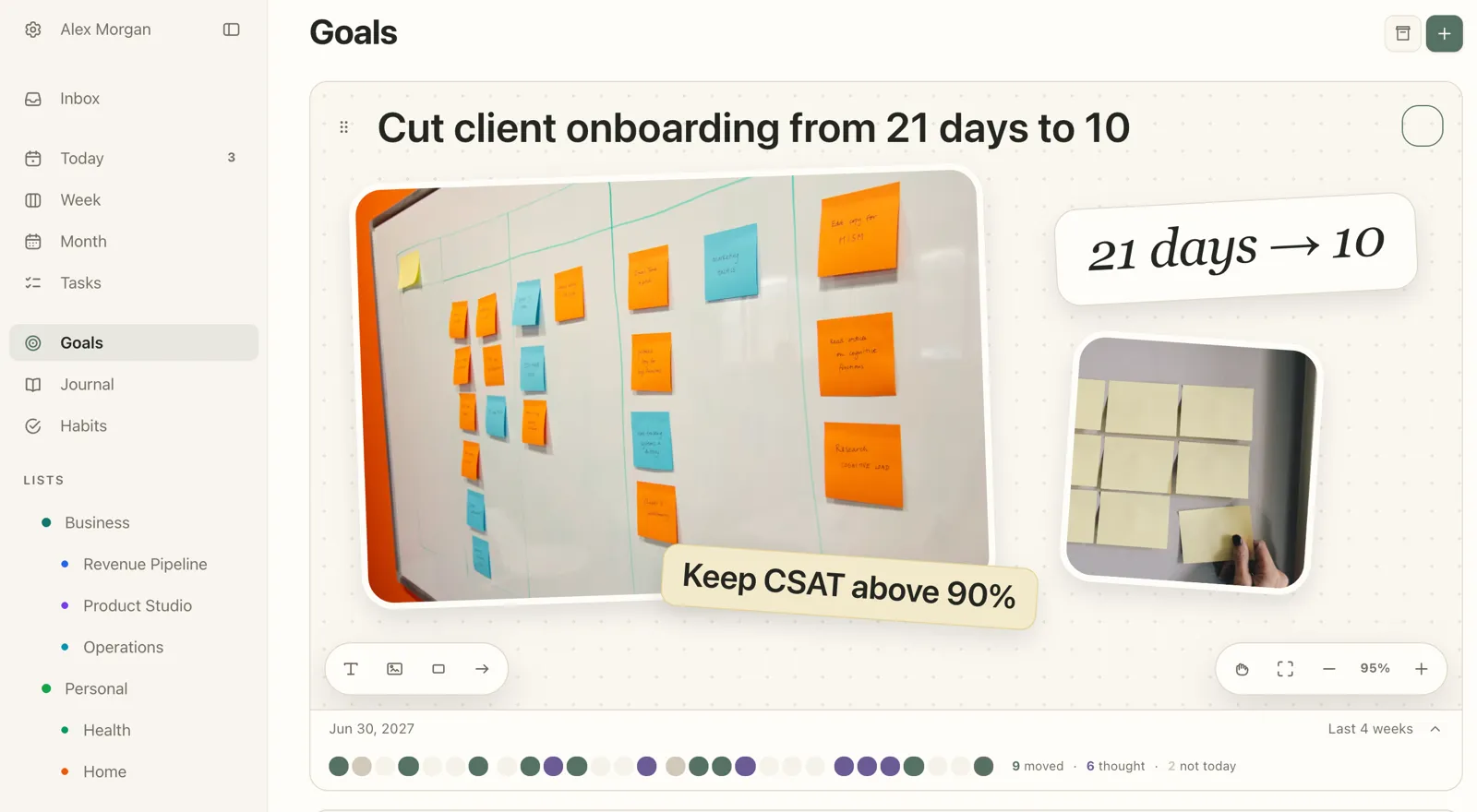
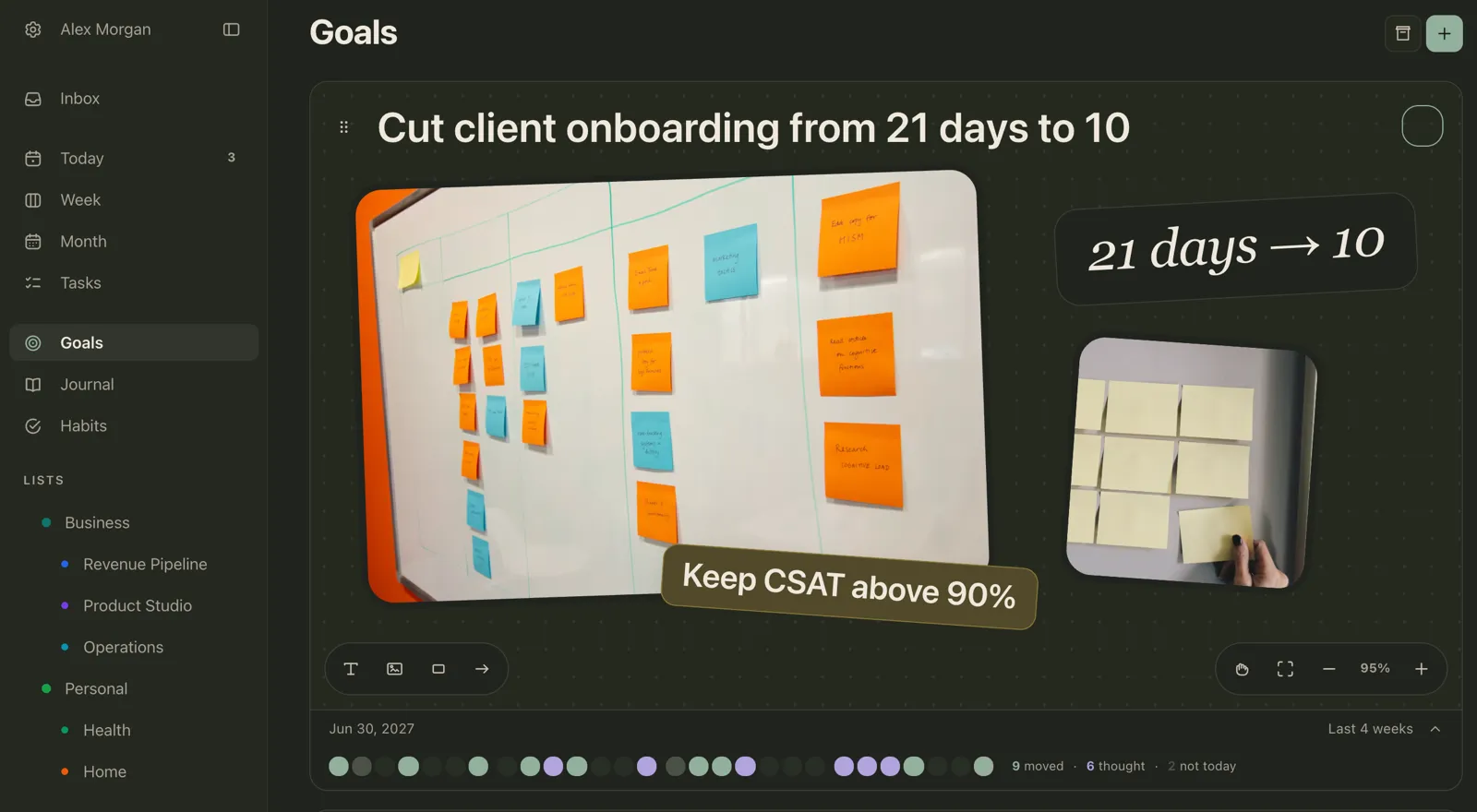
Tasks and habits link to a goal, so this week’s step shows up on Today with the goal’s name under it. In the evening, Log the day has a card for each goal, and a tap records whether today moved it: Moved, Thought or Not today. The line you write there is your wins log, kept without a separate document. Every few weeks, the answers under each board show which goals moved and which only got thought about.
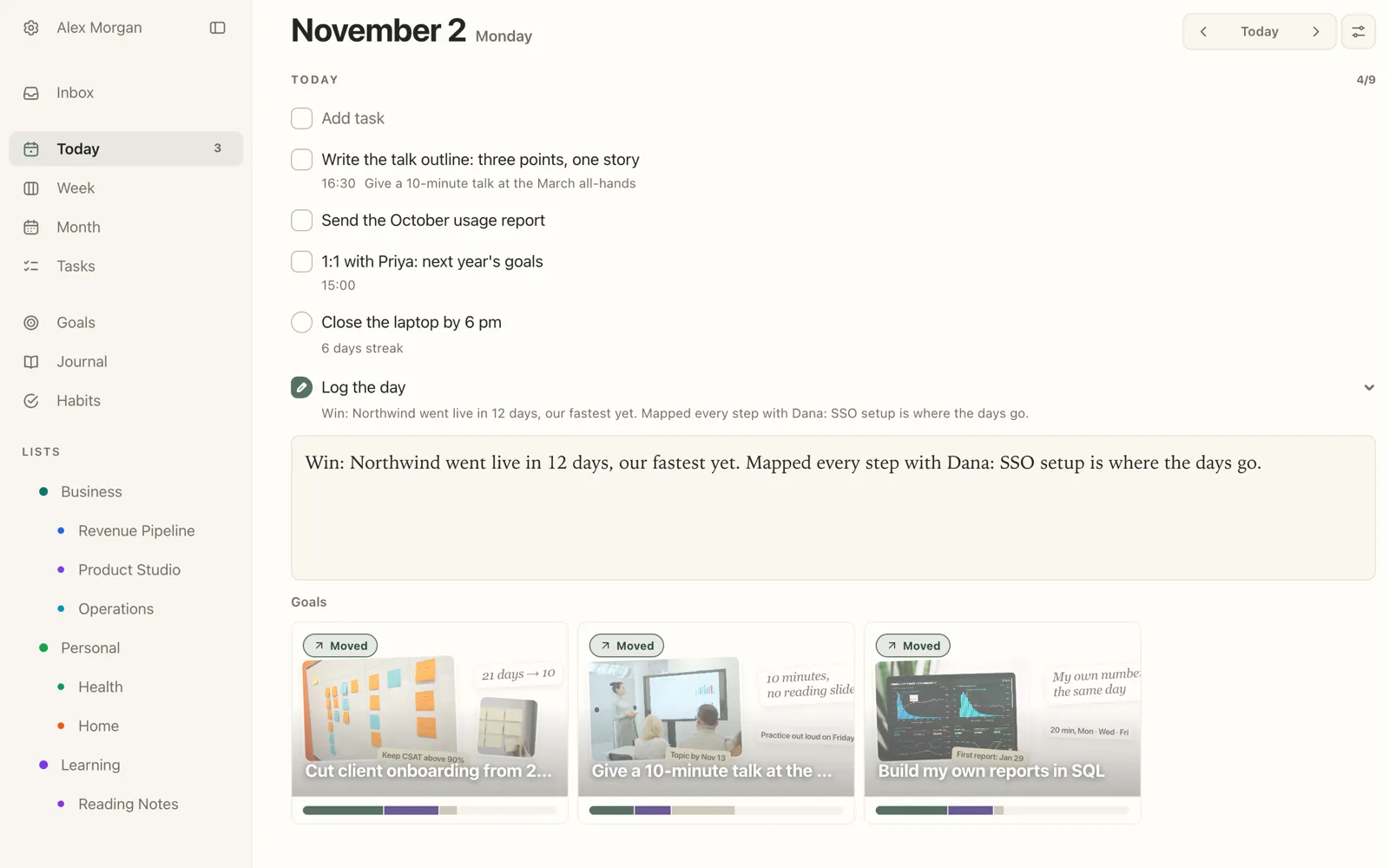
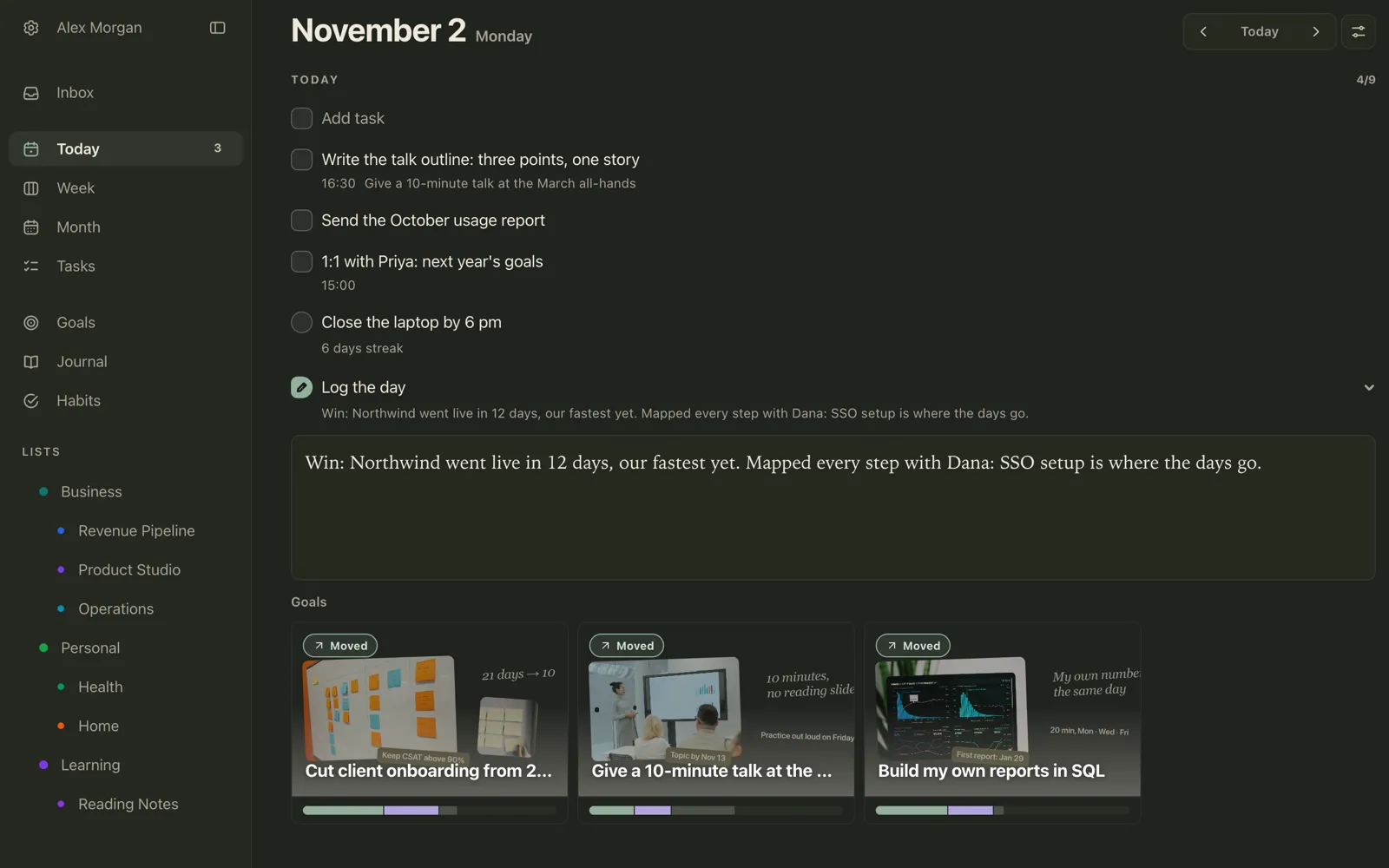
More in the help centre: goal boards, linking tasks and habits to goals, the evening check-in and reading a goal’s progress.
FAQ
What are some examples of work goals?
Cut your average reply time to customer emails from two days to one by March 31. Give a 10-minute talk at a team meeting by June. Automate one manual report every quarter. Earn the certification your role values most by October. Take all your vacation days this year. Each names a result and a date you could show at a review.
What are good work goals for a performance review?
Two or three goals that matter to your team, each with a number or a clear finish, a date and evidence you can show: a report, a count, a finished project. Add one development goal for a skill you want to grow. Agree on them with your manager at the start of the period, not the end.
What are professional development goals?
Goals for growing your skills and your career rather than this year’s output: learning a tool, earning a certification, presenting for the first time, taking on a new kind of work. Write them like any other goal, with proof and a date, and say where you’ll use the skill at work.
How many work goals should I have?
Three is plenty for most people: two performance goals and one development goal. More than five and none of them gets a weekly step, so they turn into a list you read once at the review.
What’s the difference between performance goals and development goals?
Performance goals are about results in your current job, such as speed, quality, sales or a shipped project. Development goals are about you: skills, certifications and experience that make you better at the job or ready for the next one.
How do I write a SMART work goal?
SMART comes from a 1981 article by George Doran: specific, measurable, assignable, realistic and time-related. In practice it means one sentence: “By [date], I will [result], measured by [evidence].” Add “without [guardrail]” so a number doesn’t push out what isn’t measured, and make it a learning goal if you don’t yet know how to get the result.
What should I write if I didn’t meet a work goal?
State the goal and the result plainly, say what got in the way and what you learned, and give a next step with a date. If priorities changed during the year and your manager agreed, say so. An honest missed goal reads better than a vague met one.
Is there an app for tracking work goals?
Yes. Plannedo is a planner for iPhone, Mac and the web that keeps goals, tasks, habits and a journal in one place. Each goal gets a board, linked tasks show up on the day you plan to do them, and an evening check-in records which goals moved. Its free plan includes one goal with a full board and unlimited tasks.
Studies mentioned
- Amabile, T. M., & Kramer, S. J. (2011). The power of small wins. Harvard Business Review, May 2011.
- Buckingham, M., & Goodall, A. (2015). Reinventing performance management. Harvard Business Review, 93(4).
- Doran, G. T. (1981). There’s a S.M.A.R.T. way to write management’s goals and objectives. Management Review, 70(11), 35-36.
- Evans, J. (2019, June 28). Get your work recognized: write a brag document.
- Gallup. Re-engineering performance management.
- Gollwitzer, P. M., & Sheeran, P. (2006). Implementation intentions and goal achievement: A meta-analysis of effects and processes. Advances in Experimental Social Psychology, 38, 69-119.
- Harkin, B., Webb, T. L., Chang, B. P. I., Prestwich, A., Conner, M., Kellar, I., Benn, Y., & Sheeran, P. (2016). Does monitoring goal progress promote goal attainment? A meta-analysis of the experimental evidence. Psychological Bulletin, 142(2), 198-229.
- Harter, J. (2026, October 28). U.S. employee engagement below 30% for first time in 15 years. Gallup.
- Kluger, A. N., & DeNisi, A. (1996). The effects of feedback interventions on performance: A historical review, a meta-analysis, and a preliminary feedback intervention theory. Psychological Bulletin, 119(2), 254-284.
- Latham, G. P., Erez, M., & Locke, E. A. (1988). Resolving scientific disputes by the joint design of crucial experiments by the antagonists: Application to the Erez-Latham dispute regarding participation in goal setting. Journal of Applied Psychology, 73(4), 753-772.
- Locke, E. A., & Latham, G. P. (2002). Building a practically useful theory of goal setting and task motivation: A 35-year odyssey. American Psychologist, 57(9), 705-717.
- Locke, E. A., & Latham, G. P. (2009). Has goal setting gone wild, or have its attackers abandoned good scholarship? Academy of Management Perspectives, 23(1), 17-23.
- Ordóñez, L. D., Schweitzer, M. E., Galinsky, A. D., & Bazerman, M. H. (2009). Goals gone wild: The systematic side effects of overprescribing goal setting. Academy of Management Perspectives, 23(1), 6-16.
- Seijts, G. H., Latham, G. P., Tasa, K., & Latham, B. W. (2004). Goal setting and goal orientation: An integration of two different yet related literatures. Academy of Management Journal, 47(2), 227-239.
- Winters, D., & Latham, G. P. (1996). The effect of learning versus outcome goals on a simple versus a complex task. Group & Organization Management, 21(2), 236-250.
- Wood, R. E., Mento, A. J., & Locke, E. A. (1987). Task complexity as a moderator of goal effects: A meta-analysis. Journal of Applied Psychology, 72(3), 416-425.
Photo credits
The cover photo is by Workperch on Unsplash. Photos on the goal boards are by Paymo, Kelly Sikkema, Vitaly Gariev and Luke Chesser on Unsplash.