Journal Prompts: 150 Questions and How to Answer Them
150 journal prompts for beginners, self-discovery, anxiety, gratitude and goals, how to answer a prompt so the entry helps, and a free 30-day printable.

Journal prompts are questions that give a journal entry somewhere to start. Below are 150 of them, grouped by what you want from the entry: an easy start, a better sense of who you are, a calmer head, a clearer goal. Whichever you pick, answer it in four parts: what happened, how it felt, what you make of it, and one next step.
Most prompt lists stop at the questions. The research on journaling says the way you answer matters just as much, so we start there: five rules from the studies, then the prompts, a 30-day plan you can print, and how we keep a prompt journal in Plannedo.
What are journal prompts?
A journal prompt is a question, or the start of a sentence, that you answer in writing. It fixes the blank page: instead of “what should I write about?” you answer “what drained my energy today?”, which is much easier. A good prompt is specific, about you, and can’t be answered with yes or no.
You don’t work through a list in order. Read a few, pick the one that pulls at you, and answer that. If none does, the first prompt for beginners below works on any day.
How to answer a journal prompt
1. Write what happened and how it felt
Journaling research started with a small study. In 1986 James Pennebaker and Sandra Beall asked 46 students to write for 15 minutes on four evenings in a row about a traumatic or upsetting experience. Some wrote only the facts, some only their feelings, and some both. Over the next six months, visits to the student health center went up in the other groups but stayed flat for the students who wrote both. The groups were small and the result only borderline, but later reviews backed the idea up. A 1998 meta-analysis of 13 studies in healthy people found a medium-sized benefit from writing about emotional experiences, and a 2006 review of 146 studies found a smaller but real one.
The facts make the entry concrete; the feeling is what makes it more than a log. Name it, even if it’s small or mixed.
2. Then try to make sense of it
Feelings on their own can go in circles. In a 2002 study, 122 students kept a journal for a month about something stressful. Those who wrote about their thoughts as well as their emotions, trying to understand what had happened, became more aware of the good that had come out of it. Those who wrote only about their emotions reported more severe illness symptoms during that month.
So after the feeling, ask: why does this matter to me? What does it show? What would I do differently?
3. If it hurts, write to yourself as “you”
Making sense of a painful memory can also backfire. Psychologists Ethan Kross and Ozlem Ayduk call it the self-reflection paradox: you try to understand, and end up ruminating. In their review, what helps is distance: looking at the scene as an observer would, a fly on the wall, instead of replaying it through your own eyes. In later experiments from Kross’s lab, people who talked to themselves with “you” or their own name instead of “I” before a stressful task felt less distressed and handled the task better.
On the page, that means switching pronouns for a paragraph: “Why did that email sting you so much?” It feels odd for about a minute.
4. Dig into bad days, savor good ones
In three studies, Sonja Lyubomirsky and her colleagues found the two kinds of memory work differently. Writing about your worst experiences did people more good than only thinking them over. With happy memories, the cost came from picking them apart: people who wrote about their happiest day and analyzed why it went so well did worse on several measures than people who simply replayed it.
So use the writing to work through the hard days. For a good one, describe the moment in detail and leave the “why” alone.
5. End with one next step
This one is ours, not a study’s. An entry that ends with something to do (“fifteen free minutes after every call”) turns a reflection into a change. Keep it small enough for this week, and put it where you’ll see it tomorrow, on a list or in your planner.
How long, and when to stop
Ten to fifteen minutes is plenty. Most writing studies used 15 to 20 minutes for three or four sessions, and the 2006 review found sessions of at least 15 minutes worked better than shorter ones. Writing alone in private worked better than writing with other people around, so keep it for yourself: spelling doesn’t count, and nobody else reads it.
A painful topic can leave you feeling worse for a while. A review for psychiatrists by Karen Baikie and Kay Wilhelm calls a short-term rise in distress the usual first effect of this kind of writing, and finds no sign that it does lasting harm. Their advice: stop whenever you want, keep it to about 20 minutes, and treat writing as a help alongside treatment, not instead of it.
Which prompts for what
| You want | Start with | Why |
|---|---|---|
| To start the habit | Prompts for beginners, short prompts | Easy questions about today keep the first weeks going |
| To know yourself better | Self-discovery | Patterns show up across entries, not in one |
| To work through something | Self-reflection, then write as “you” | Feelings plus meaning, from a little distance |
| To feel calmer | Anxiety and stress, evening prompts | A worry with a next step is easier to put down |
| To feel better about your life | Gratitude | Once a week was enough in a 10-week study |
| To decide what’s next | Goals and the future | Writing about your best possible self raised well-being |
| To close the week | Weekly prompts | Ten minutes of looking back before you plan |
Journal prompts for beginners
Concrete questions about today. They work on the first day and on the hundredth.
- What happened today that I want to remember?
- What’s on my mind right now?
- What went better than I expected this week?
- What’s something I’m looking forward to this month?
- What did I spend most of my time on today? Is that what I wanted?
- What’s one thing I learned recently?
- Where am I right now? Describe it to someone who can’t see it.
- What drained my energy today, and what gave some back?
- What would I like more of next week?
- Who did I talk to today, and what stayed with me?
Short journal prompts
For two minutes on a busy day. Sixty more one-liners are in One Line a Day Journal.
- Today in three words.
- The moment I’d replay.
- Something I noticed for the first time.
- Today I’m proud that I…
- What I’d tell this morning’s me.
- The thing I keep putting off, in one sentence.
- How my body feels right now.
- One thing I’d do again tomorrow.
- One thing I’d skip.
- Tomorrow I want to…
Morning journal prompts
Daily journal prompts to set up the day, five minutes with the first coffee.
- What would make today a good day?
- What’s the one thing that matters most today?
- What am I worried about, and which part of it is in my control?
- How did I sleep, and how do I feel?
- What am I looking forward to today?
- Who could I make the day a little easier for?
- What will I say no to today?
- If today goes sideways, what’s my plan B?
- What do I want to notice today?
- What did yesterday teach me that I can use today?
Evening journal prompts
To close the day. If your head is full at bedtime, start with a brain dump and answer one of these after.
- What actually got done today, planned or not?
- What was the best moment of the day?
- What took more energy than it should have?
- What did I do today that future me will thank me for?
- What’s still on my mind? Write it down and leave it here.
- When did I feel most like myself today?
- What would I do differently if I had today again?
- What am I grateful for tonight, specifically?
- What did I learn about someone today?
- What’s the first thing tomorrow?
The first one is the ta-da list: a list of what got done, which almost always turns out longer than the day felt.
Journal prompts for self-discovery
Questions to get to know yourself. The answers matter less than the patterns across a few weeks of them.
- When do I lose track of time?
- What do people come to me for?
- What did I love doing at ten years old? Do I still do any of it?
- What do I pretend not to care about?
- Which compliment stayed with me, and why that one?
- What do I believe now that I didn’t five years ago?
- What would I do with a free Saturday and no plans?
- What kind of tired do I feel most often: bored, busy or sad?
- What am I avoiding, and what would happen if I stopped?
- Which three words would my closest friend use for me? Do I agree?
- What makes me angry, and what do I value that it threatens?
- What did I want to be when I grew up, and what part of that still pulls at me?
- Which of my habits would I keep if no one ever saw them?
- Where do I feel most at home?
- What am I good at that I never count?
Self-reflection journal prompts for personal growth
For working something through: facts and feelings first, then what you make of it. If one of these stings, answer it as “you”.
- What’s a mistake I made recently, and what would I do differently?
- Where am I playing it safe?
- What did I say yes to that I wish I’d declined?
- What feedback did I brush off lately? Was some of it right?
- What did I handle better this year than I would have a year ago?
- What story do I tell about myself that may no longer be true?
- Which habit is quietly costing me the most?
- What am I learning right now, and how do I know?
- When did I last change my mind about something important?
- What do I keep starting and not finishing? What usually stops me?
- Who do I admire, and what exactly do they do that I don’t?
- What would I try if I weren’t afraid of looking silly?
- What boundary do I need, and with whom?
- What does a good week look like for me now?
- What’s one thing I can stop doing?
Gratitude journal prompts
In a 10-week study, Robert Emmons and Michael McCullough had students list up to five things they were grateful for, once a week. Compared with students who listed hassles or neutral events, they rated their lives as a whole higher, felt more optimistic about the coming week and reported fewer physical symptoms. Once a week was enough. Be specific: “Ana took the invoices off my plate” beats “my colleagues”.
- Who made this week easier, and did they know it?
- What do I use every day that I’d miss if it were gone?
- A small moment from today I’d like to keep.
- What’s a problem I no longer have?
- What did my body let me do today?
- Who haven’t I thanked yet, and what would I say?
- What’s going right that I’ve stopped noticing?
- Which place am I glad exists?
- What did I get to learn this month?
- What hard thing turned out to be good for me?
Journal prompts for anxiety and stress
Journal prompts for mental health don’t replace care, but writing does help a little. A 2022 review of 20 randomized trials found that journaling lowered scores on mental health symptom scales by about 5 percentage points more than control conditions did, a small to moderate benefit, with results that varied a lot between studies. If worry fills most days or keeps getting worse, talk to a doctor or a therapist.
- What exactly am I worried about? Write it as one plain sentence.
- What’s the worst that could realistically happen, and how would I cope?
- Which part of this is in my control, and which isn’t?
- What’s one small step I could take about it tomorrow?
- What would I tell a friend who had this worry?
- When did I feel like this before, and what helped then?
- What evidence do I have for this worry, and against it?
- Where in my body do I feel this right now?
- What can wait until tomorrow? Write it down so it can.
- What went okay today, despite everything?
Self-love journal prompts
Self-compassion is mostly talking to yourself the way you’d talk to a friend. These prompts practice that.
- What would I say to a friend who had my day?
- What did I do well this week that nobody saw?
- What does my body do for me that I take for granted?
- Which of my flaws am I slowly making peace with?
- When did I last rest without earning it first?
- What do I like about the way I treat people?
- What would I tell myself a year ago?
- What need do I usually ignore?
- What am I being too hard on myself about right now?
- What does taking care of myself look like on a busy day?
Journal prompts for goals and the future
The first prompt here is the classic “best possible self” exercise. In Laura King’s 2001 study, people wrote about their best possible future self for 20 minutes on four days in a row; it was less upsetting than writing about a trauma, and three weeks later they reported higher well-being. For turning an answer into a plan, see How to Set Goals.
- A year from now, things went well. What does a normal Tuesday look like?
- What do I want to be true by the end of this year?
- Which goal do I keep talking about but never start?
- What’s one goal I should drop?
- What would I attempt if I knew it would take five years?
- What did I do this week that moved something I care about?
- What usually gets in the way, and what will I do when it shows up?
- Whose life looks like the one I want, and what do they do every day?
- What does “enough” look like for me?
- What do I want to have learned by this time next year?
Relationship journal prompts
About the people in your life: partners, friends, family.
- Who do I want to see more of, and what’s stopping me?
- What’s a conversation I’ve been avoiding?
- Who knows me best, and what do they understand that others don’t?
- When did I last feel truly listened to?
- What do I bring to my friendships, and what do I take?
- Which relationship asks too much of me right now?
- Who did I lose touch with that I miss?
- How do I show care, and how do I like to receive it?
- What did a recent argument teach me about what I need?
- Who could I reach out to this week?
Journal prompts about work
For the part of life that takes most of the week.
- What part of my work would I do for free?
- What did I do this week that I’m proud of at work?
- Which task do I dread, and why exactly?
- Which skill would change my work most if I got better at it?
- Where will I be in five years if nothing changes?
- What does a good workday look like, hour by hour?
- Who at work do I learn from?
- If I could change one thing about my job, what would it be?
- When do I do my best thinking?
- What would I want people to say about working with me?
Fun journal prompts for adults
Not every entry has to mean something.
- Describe your perfect lazy Sunday, in detail.
- If you had to teach a class on anything, what would it be?
- Which fictional place would you live in for a year?
- Plan a dinner for five guests, living or not.
- What’s a small opinion you’ll defend forever?
- Write a review of your week, star rating included.
- What would your ten-year-old self think of your life now?
- The best thing you ever ate, and where.
- You get $1,000 that has to go on fun this month. What do you do?
- Write about a smell that takes you back.
Weekly journal prompts
For the end of the week, ten minutes before you plan the next one. The full routine is in the Weekly Review Template.
- What were the three best moments of this week?
- What got done, and what moved something that matters?
- What drained me this week, and can I change it?
- What did I learn about myself this week?
- Who did I connect with, and who did I miss?
- What will I carry into next week, and what will I leave behind?
- What’s the one thing that would make next week good?
- How did I take care of my body?
- What surprised me?
- If this week were a chapter, what would its title be?
A 30-day journal prompt plan
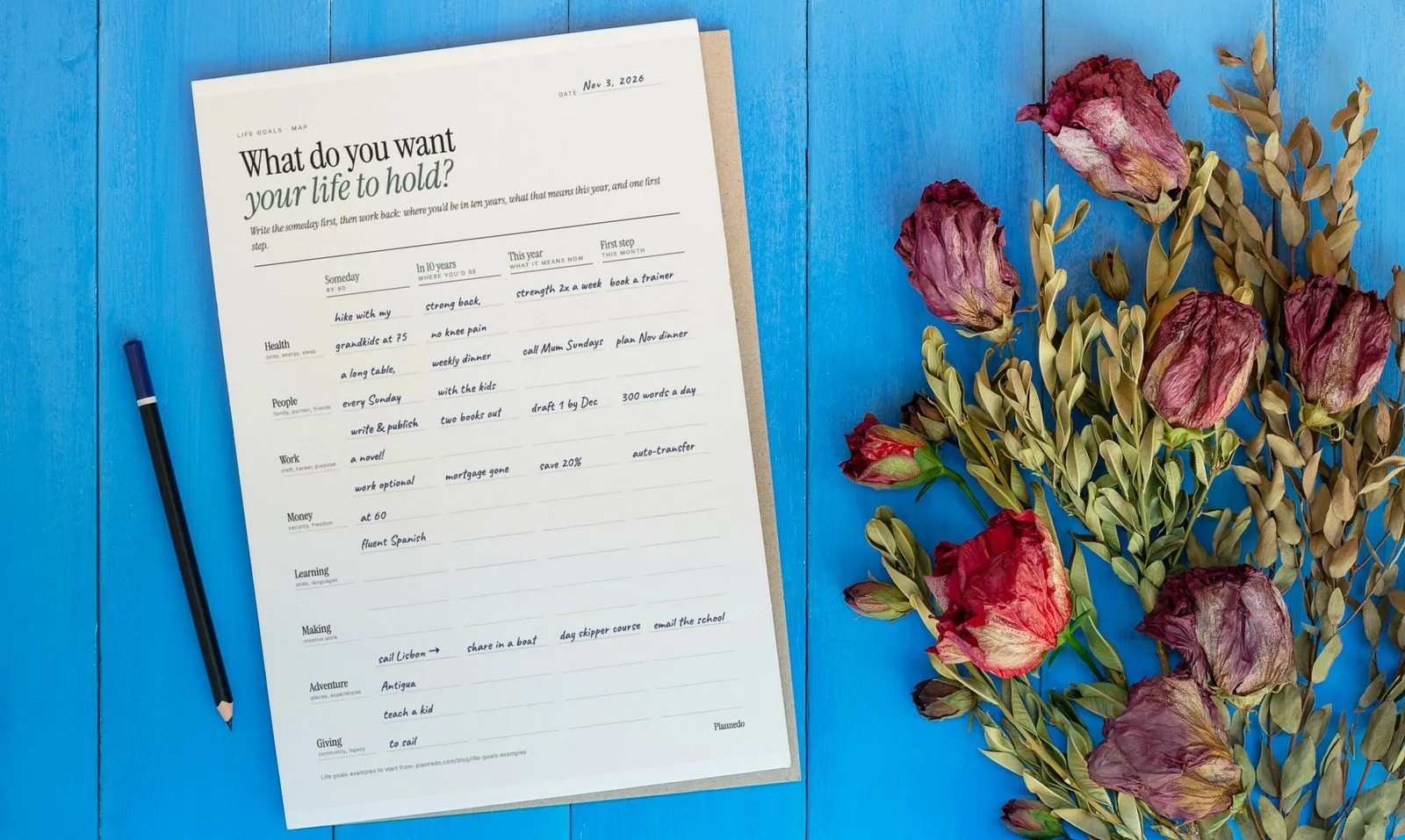
The printable at the top is a month of these prompts in an order that builds. The first week is easy questions about the day, the second is about you, the third about growth and people, the fourth about the future. Every seventh day looks back at the week, and day 30 asks you to read the month back and notice what surprised you. Tick the ring when a prompt is answered; if you skip a day, come back to it or don’t.
The back of the sheet is a page for one entry, set out in the four parts from above: what happened, how it felt, what you make of it, and one next step. Print as many as you need, or fill the PDF in on a tablet.
Journal prompts in Plannedo
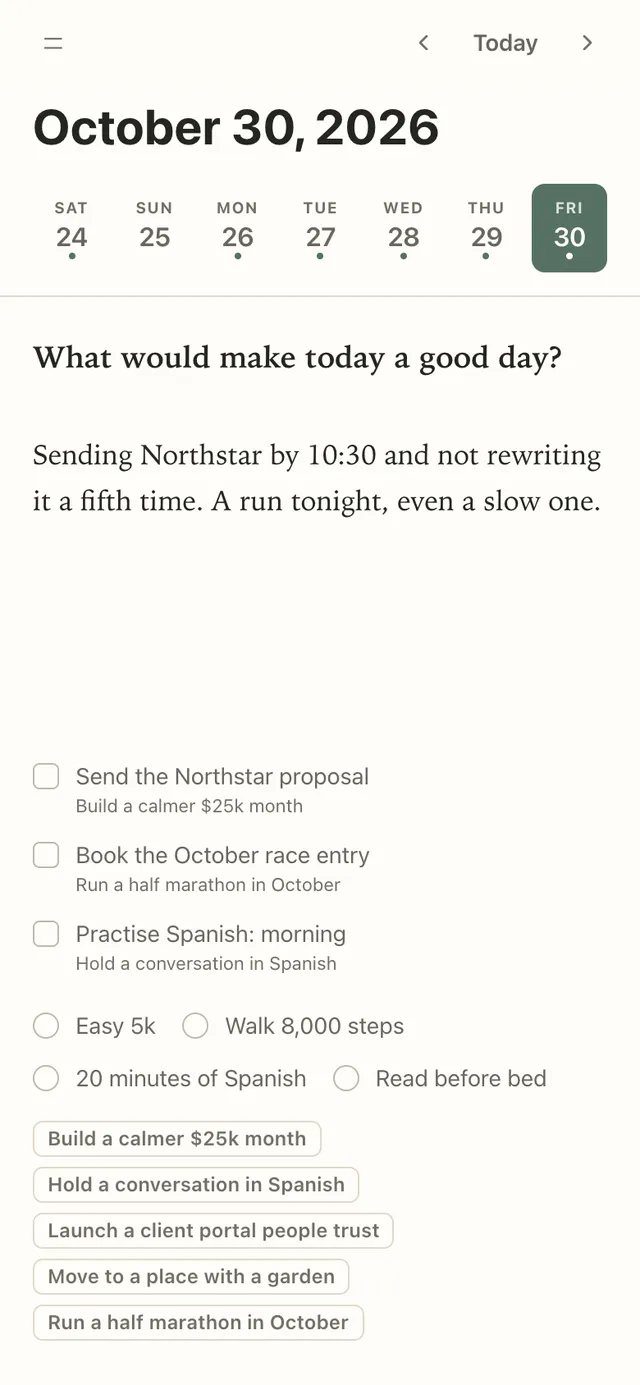
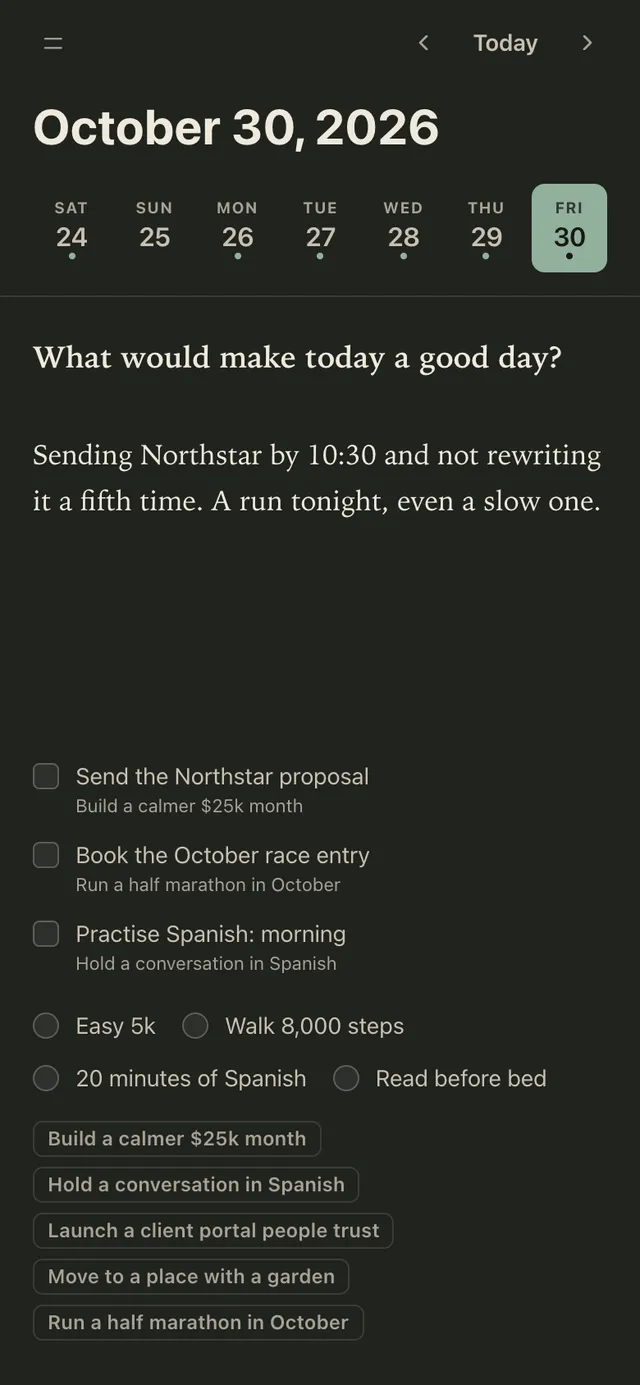
I build Plannedo, a daily planner with a journal. It isn’t a prompt app: there’s no library of prompts and no prompt of the day. An empty entry on the Journal page offers three questions of its own: What did you do today? What worked? What should be repeated?
For the prompts above, I paste the question as the first line, select it and tap H to make it the entry’s heading, then write under it. The entry saves itself as you type. Under it, the page shows what the day held: its tasks, habits and goals. A year later that’s the useful part: the entry says how it felt, and the tasks say what you were actually doing.
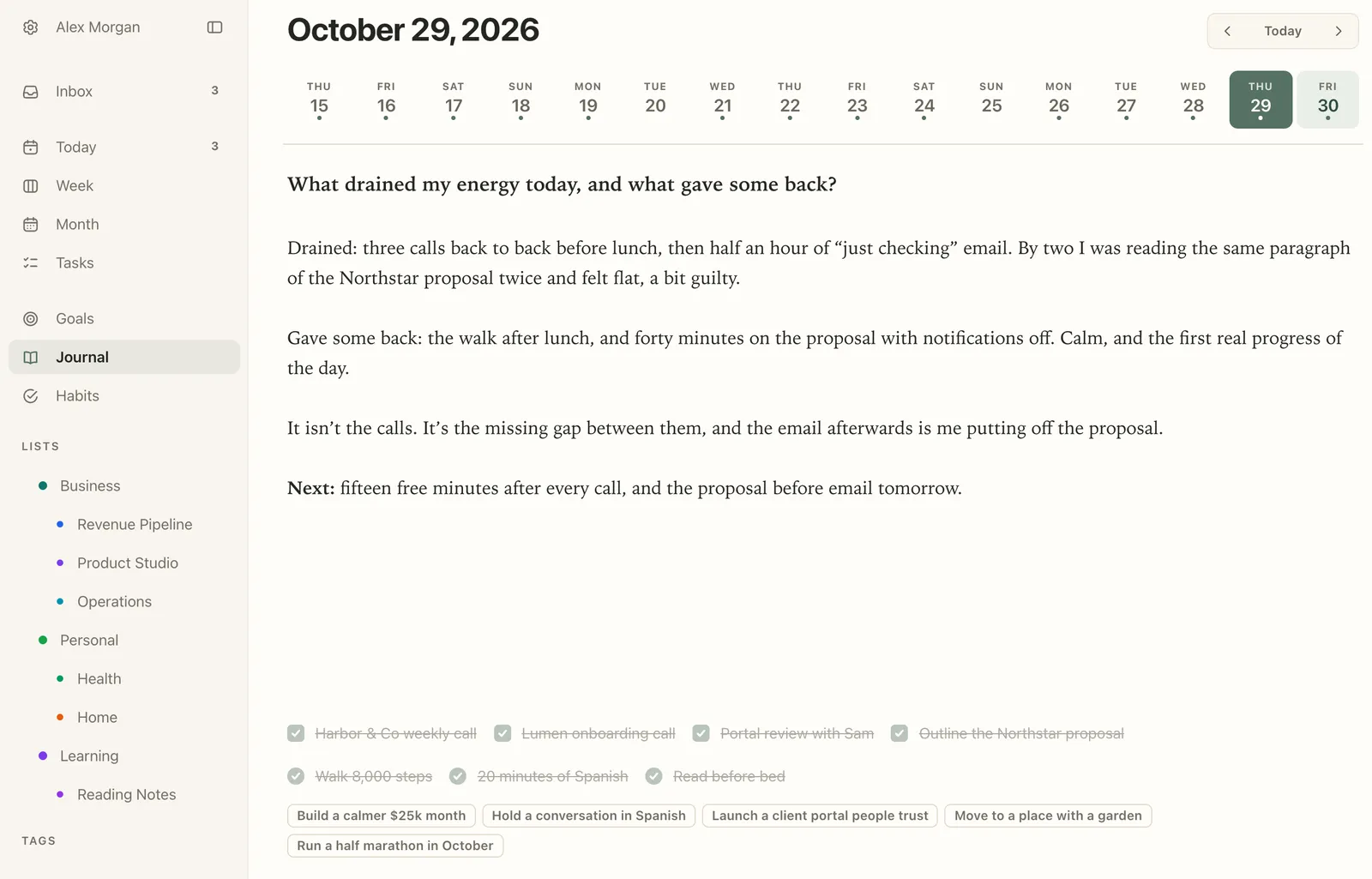
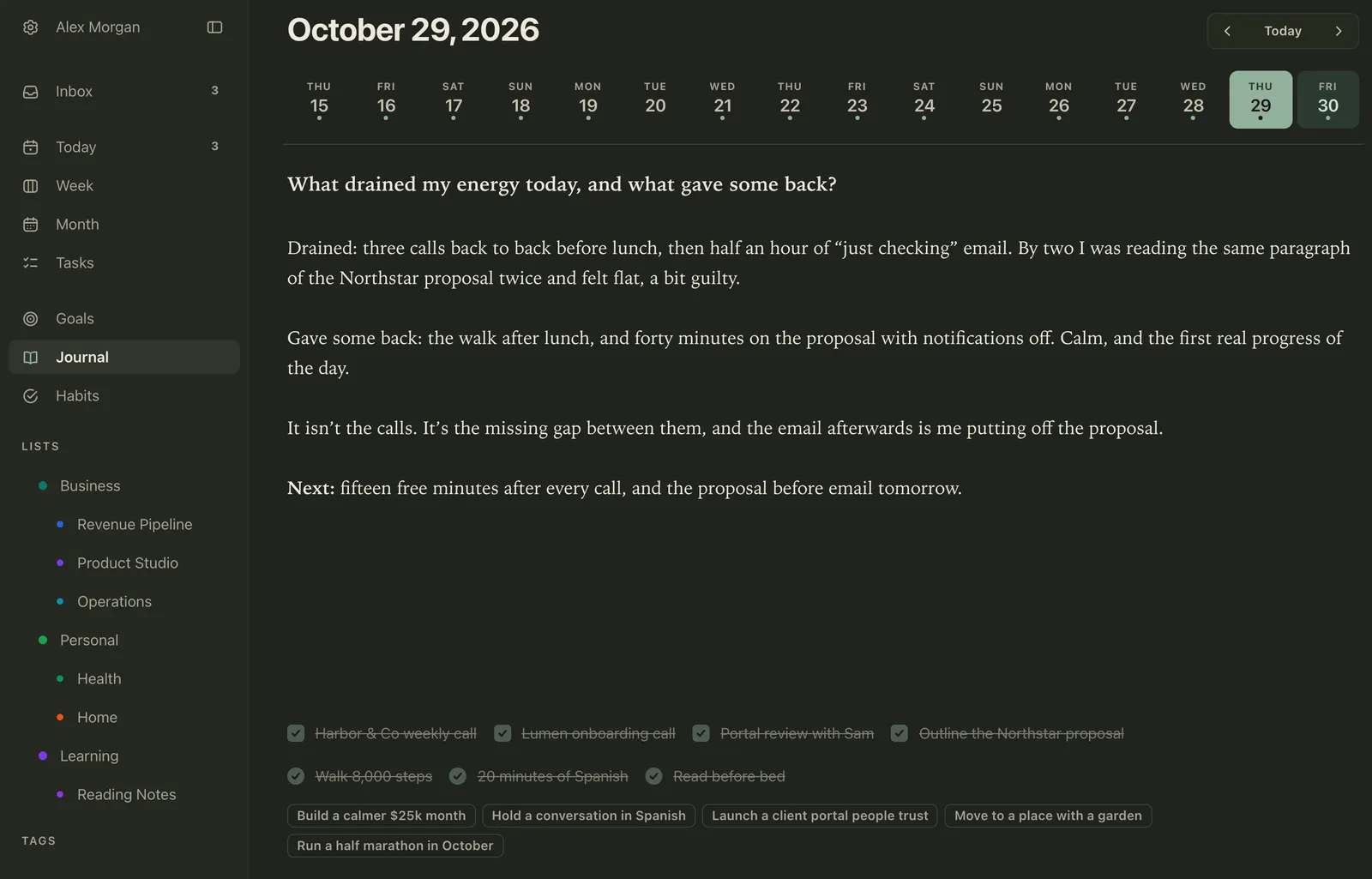
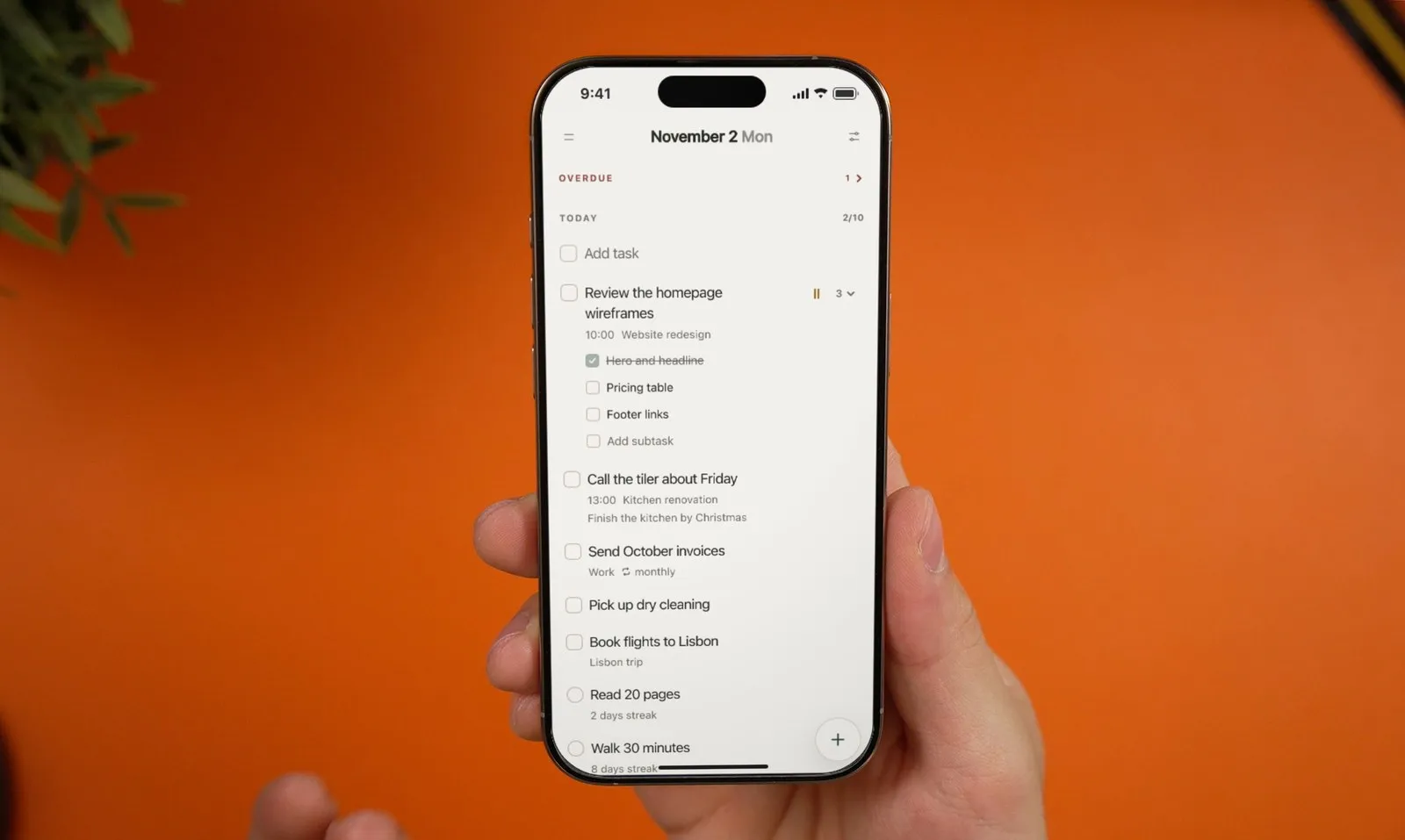
On the phone, a short morning prompt takes a minute. In the evening, Log the day on Today has room for a few lines, next to a tap per goal for whether today moved it. Add the next step from an entry as a task for tomorrow, and it’s waiting on Today in the morning.
Details are in the help centre under The journal and Evening check-in.
FAQ
What are good journal prompts for beginners?
Concrete questions about today: “What happened today that I want to remember?”, “What’s on my mind right now?” or “What drained my energy today, and what gave some back?” They’re easy to answer, so they keep the first weeks going. Write for ten minutes, or two on a busy day.
How do you answer a journal prompt?
In four parts: what happened, briefly; how it felt; what you make of it, meaning why it matters or what it shows; and one small next step. Studies on writing found that combining facts with feelings, and feelings with an attempt to understand them, helps more than any one of those alone.
How long should a journal entry be?
Ten to fifteen minutes of writing is plenty, which is usually half a page to a page. Most studies on expressive writing used 15 to 20 minute sessions, and a 2006 review found sessions of at least 15 minutes worked better than shorter ones. On busy days, a few lines still count.
How often should you use journal prompts?
As often as you’ll keep it up. Daily works if you attach it to a fixed moment, like the first coffee or after brushing your teeth. Fewer can be enough: in a 10-week gratitude study, writing once a week made a measurable difference.
Should I journal in the morning or at night?
Both work for different jobs. Morning prompts set up the day (“What would make today a good day?”), evening prompts close it (“What actually got done today?”). Pick the moment you already have every day, so the habit has something to hang on.
Can journaling help with anxiety?
It can help a little, but it isn’t a treatment. A 2022 review of 20 randomized trials found journaling lowered scores on mental health symptom scales by about 5 percentage points more than control conditions, with big differences between studies. If anxiety fills most days or keeps getting worse, talk to a doctor or a therapist.
What if a prompt brings up something painful?
Feeling worse for a while is a common first effect of writing about something hard, and it doesn’t appear to do lasting harm. Stop whenever you want, keep it to about 20 minutes, and try writing to yourself as “you” for a paragraph. If it stays heavy, talk to someone you trust or a professional.
Is there a free journal prompts printable?
Yes. The printable in this post has thirty days of prompts on the front, with a weekly look back, and a page for one entry on the back. It comes in US Letter and A4, and the PDF is fillable, so you can type into it on an iPad or a computer instead of printing.
Studies mentioned
- Pennebaker, J. W., & Beall, S. K. (1986). Confronting a traumatic event: Toward an understanding of inhibition and disease. Journal of Abnormal Psychology, 95(3), 274-281.
- Smyth, J. M. (1998). Written emotional expression: Effect sizes, outcome types, and moderating variables. Journal of Consulting and Clinical Psychology, 66(1), 174-184.
- Frattaroli, J. (2006). Experimental disclosure and its moderators: A meta-analysis. Psychological Bulletin, 132(6), 823-865.
- Ullrich, P. M., & Lutgendorf, S. K. (2002). Journaling about stressful events: Effects of cognitive processing and emotional expression. Annals of Behavioral Medicine, 24(3), 244-250.
- Kross, E., & Ayduk, O. (2011). Making meaning out of negative experiences by self-distancing. Current Directions in Psychological Science, 20(3), 187-191.
- Kross, E., Bruehlman-Senecal, E., Park, J., Burson, A., Dougherty, A., Shablack, H., Bremner, R., Moser, J., & Ayduk, O. (2014). Self-talk as a regulatory mechanism: How you do it matters. Journal of Personality and Social Psychology, 106(2), 304-324.
- Lyubomirsky, S., Sousa, L., & Dickerhoof, R. (2006). The costs and benefits of writing, talking, and thinking about life’s triumphs and defeats. Journal of Personality and Social Psychology, 90(4), 692-708.
- Emmons, R. A., & McCullough, M. E. (2003). Counting blessings versus burdens: An experimental investigation of gratitude and subjective well-being in daily life. Journal of Personality and Social Psychology, 84(2), 377-389.
- King, L. A. (2001). The health benefits of writing about life goals. Personality and Social Psychology Bulletin, 27(7), 798-807.
- Sohal, M., Singh, P., Dhillon, B. S., & Gill, H. S. (2022). Efficacy of journaling in the management of mental illness: A systematic review and meta-analysis. Family Medicine and Community Health, 10(1), e001154.
- Baikie, K. A., & Wilhelm, K. (2005). Emotional and physical health benefits of expressive writing. Advances in Psychiatric Treatment, 11(5), 338-346.
Photo credits
The cover photo is by Thought Catalog on Unsplash.